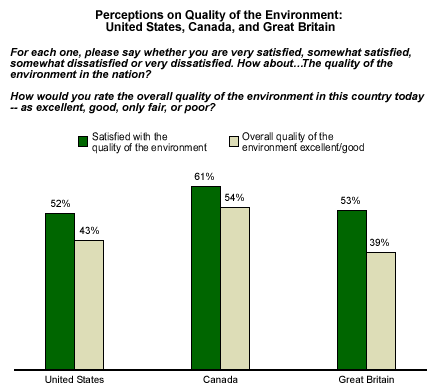
Recent Gallup surveys conducted in the United States, Canada, and Great Britain* suggest that Canadians are more likely to have a positive view of the quality of the environment in their country than are their British and American "cousins." However, a majority of the citizens in each of these countries are satisfied with the quality of their respective nation's environment.
Quality of the Environment
More Canadians rate the quality of their environment as "excellent" or "good" (54%) than either Americans (43%) or Britons (39%). Although Americans and Britons who classify their country's environment as excellent or good are in the minority, majorities of those in each country say they are satisfied with the quality of the environment. Fifty-two percent of Americans are satisfied with the quality of the environment, as are 53% of Britons and 61% of Canadians.
Majorities of Americans, Britons, and Canadians also feel, however, that the quality of the environment as a whole is getting worse in their countries. Nearly 6 in 10 Americans (58%) and Canadians (59%) think the quality of the environment is getting worse in their countries; 52% of Britons see the environment headed in the same direction. With majorities in each country expresssing a gloomy forecast for future conditions, it will be interesting to see whether satisfaction levels change over the next few decades.
Environmental Involvement
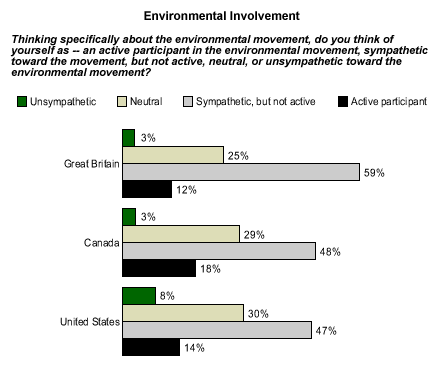
So if majorities in each country think the environment is getting worse, are they doing anything about it? Canadians are slightly more likely than Americans and Britons to view themselves as "active participants" in the environmental movement; 18% of Canadians describe themselves as such, compared with 12% of Britons and 14% of Americans. Britons, however, are most likely to define themselves as "sympathetic, but not active" in the environmental movement (59% of Britons, compared with 48% of Canadians and 47% of Americans). Eight percent of Americans, consider themselves "unsympathetic" to the environmental movement, compared with 3% of Canadians and Britons. Many residents of all three countries think the quality of the environment is headed downhill, but far fewer find it important enough to do something about.
Which Priority: The Environment or Economic Growth?
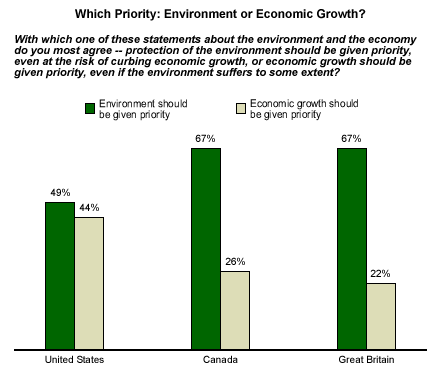
When asked to make a choice between protecting the environment at the risk of curbing economic growth, or giving economic growth priority even if the environment suffers, Canadians and Britons overwhelmingly choose the environment. About two-thirds (67%) of both British and Canadian respondents say the environment should be given priority, while 22% and 26%, respectively, say the economy should be given priority. While Americans also tend to favor the environment in this conflict, they are more divided; 49% say the environment should be given priority, while 44% say economic growth should be given priority.
These findings probably reflect the public's perceptions of the economy in each country. Only 45% of Americans are "very" or "somewhat" satisfied with their country's economy, as opposed to 61% of Canadians and 60% of Britons. By comparison, in April 2000, when the U.S. economy was thriving, 67% of Americans said the environment should be given priority and only 28% said economic growth should be given priority.
*Results in the United States are based on telephone interviews with 1,000 national adults, aged 18 and older, conducted May 2-4, 2004. For results based on the total sample of national adults, one can say with 95% confidence that the maximum margin of sampling error is ±3 percentage points. The survey was conducted by Gallup USA.
Results in Canada are based on telephone interviews with 1,003 national adults, aged 18 and older, conducted April 29-May 12, 2004. For results based on the total sample of national adults, one can say with 95% confidence that the maximum margin of sampling error is ±3 percentage points. The survey was conducted by Gallup Canada.
Results in Great Britain are based on telephone interviews with 1,018 national adults, aged 18 and older, conducted April 25-May 5, 2004. For results based on the total sample of national adults, one can say with 95% confidence that the maximum margin of sampling error is ±3 percentage points. The survey was conducted by Gallup UK.
In addition to sampling error, question wording and practical difficulties in conducting surveys can introduce error or bias into the findings of public opinion polls.
