In his 2003 book, Who Controls Teachers' Work?, University of Pennsylvania professor Richard Ingersoll describes two common and competing views of today's schools and the roles that teachers play in them. The first perspective compares schools to factories in which decisions about strategy and protocol are centralized, with teachers relatively constrained by those decisions. The second perspective regards teachers more as professionals, experts who require a large degree of autonomy in order to do their jobs well.
Teens' responses to a recent Gallup Youth Survey* provide support for the second view. Their comments about which teachers they respond best to suggest that keeping a group of kids engaged in learning requires having plenty of latitude to be highly creative, to build strong relationships, and to tailor the learning process to the needs of each individual student.
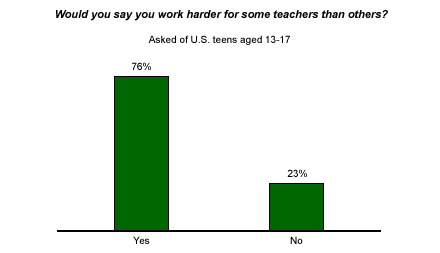
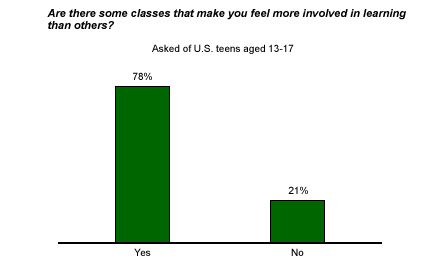
The survey first asked the nationwide panel of 13- to 17-year-olds whether they thought they worked harder for some teachers than others; about three in four said yes. A related question -- whether some classes make them feel more involved in learning than others do -- produced similar results.
Teachers
Those teens who agreed that they work harder for some teachers than others were then asked why they thought that was. The most common response was simply that they like some teachers better than others. But other teens were more specific: About one in eight said they work to the level of the teacher's expectation. And another 12% simply said they work harder for teachers who care. Here's a sampling of the comments:
- "Because some teachers expect more of you and believe in you,
and you don't want to let them down so you try harder for them.
Especially if you like that teacher and that class. If a teacher is
mean, then a lot of times you don't want to make them happy by
doing what they ask -- you want to just do enough to get by." --
16-year-old girl
- "[I] want to make different teachers happy. Some care more
about me than others and I want to make them proud." -- 15-year-old
boy
- "Some teachers motivate certain students more than others.
Sometimes you can sense teachers that are there just to gain enough
experience to move to a higher-paying school system. Different
teachers bring out different patterns in me." -- 14-year-old
girl
- "When teachers want to teach, I want to learn. When they don't
want to be there, they give off a bad vibe that I will not respond
to in a positive way." -- 17-year-old girl
- "Teachers that actually put their soul into what they are doing are going to get a better response out of students. The teachers who just assign worksheets and slap a grade on them are getting what they are asking for -- uncaring attitudes and disobedience." -- 16-year-old girl
Classes
Responses to the question asking why some classes make teens feel more involved than others do tended to be similar to those above -- which underscores the idea that effective schooling relies almost entirely on creative and passionate teachers.
- "[Those classes] make you excited about learning. Like in
language arts class we just did a debate on evolution vs.
creationism, and my teacher made us get on teams and research it
and argue for and against it and it really made me and my friends
think about it and talk about it even when we weren't in class." --
13-year-old boy
- "What makes those classes different is that the teachers
involve the students more in the lesson. I have some teachers that
are so caught up in learning that they leave no room for the
students' involvement, which, in my opinion, hampers the students'
understanding of the lesson." -- 15-year-old girl
- "In these classes I learn how things work and why things happened and they depend less on just learning facts that have very little use. I also find that in these classes the textbook is rarely used. These classes are much more common among those in which the teacher is not teaching to the statewide tests." -- 16-year-old boy
Bottom Line
Students rely on stimulating instructors to engage them in the learning process, so it's only natural that they express frustration with teachers who are not fully engaged. The point is perhaps best summed up in the simple response given by one 17-year-old boy when asked why he works harder for some teachers than others: "Because some teachers work harder for me."
*The Gallup Youth Survey is conducted via an Internet methodology provided by Knowledge Networks, using an online research panel that is designed to be representative of the entire U.S. population. The current questionnaire was completed by 785 respondents, aged 13 to 17, between Jan. 22 and March 9, 2004. For results based on the total sample, one can say with 95% confidence that the maximum margin of sampling error is ±4 percentage points.