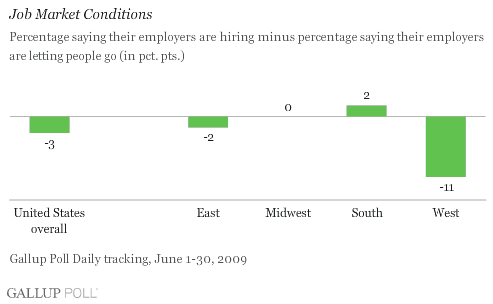
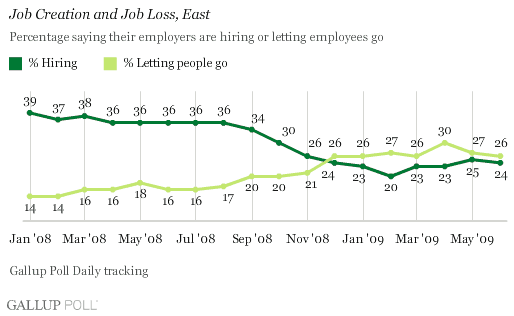
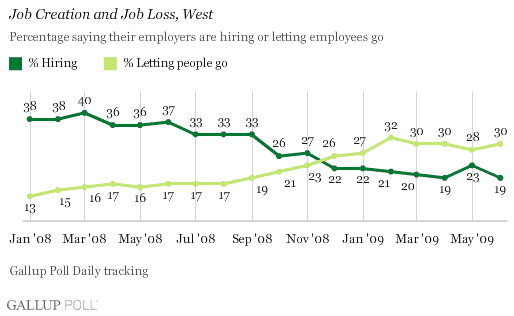
PRINCETON, NJ -- Gallup Poll Daily tracking for June finds job creation exceeding job loss by two percentage points in the South. Job creation is equal to job loss in the Midwest, but trails job loss in the East (-2) and the West (-11).
Nationwide
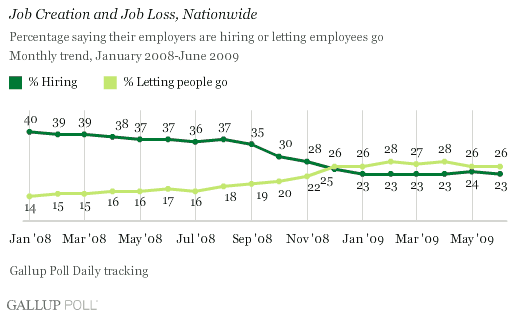
Every day, Gallup asks employed Americans whether their employers are hiring people and expanding the size of their workforces, not changing the size of their workforces, or letting people go and reducing the number of people they employ. Aggregated results for June find job creation nationwide continuing to trail job loss, 23% to 26%, a difference of -3 percentage points. This is on par with May (-2) but is a sharp deterioration from last June, when job creation (37%) exceeded job loss (17%) by 20 points. Job creation exceeded job loss for the first 11 months of 2008, but the reverse has been the case since last December.
South
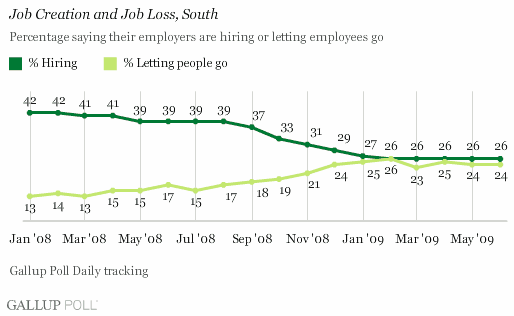
The job situation in the South has been slightly positive and essentially stable during the first half of 2009. Job creation has been at 26% or 27% in this region, while job loss has ranged between 23% and 26%. Still, this represents a substantial worsening of the job situation compared to the 39% job creation and 17% job loss of a year ago. The South continues to benefit from the large presence of the energy industry, although another plunge in oil prices after their surge earlier this year could lead to a further deterioration in an already weak job situation.
Midwest
The Midwest has the next-best job situation, with job creation (24%) equal to job loss (24%). Job creation has improved from March's 20% while job loss has eased from 29%. Given the recent improvement, it appears that by March, the job situation in this region had already deteriorated to the point that it reflected the toll on jobs resulting from the automaker bankruptcies before they unfolded. Further, the Midwest may already be benefiting from inventory rebuilding as companies attempt to rebalance after the sharp reductions of late 2008 and early 2009.
East
Job creation (24%) continues to trail job loss (26%) in the East -- not much different than the situation in May, but far weaker than the job creation (36%) and job loss (16%) situation of a year ago. The stock market surge and the increased stabilization of the banking industry may be helping the job market in the East, although this situation could be threatened by another plunge in the equities markets.
West
The job situation is worst by far in the West. Job creation is at an anemic 19% there -- the lowest rate for any region and matching its previous low in April. At the same time, job loss is at 30% -- two points below its previous high of 32% in February. The housing debacle apparently continues to depress this region more than any other. In addition, the slowdown in international trade may be having a disproportionately large impact on the West. And California's budget crisis may not be helping.
Commentary
Job creation and job loss are ongoing dynamics in the U.S. economy. In order for the economy to grow, job creation must outpace job loss. A year ago, even though the nation was already experiencing the current recession, job creation was at 37% while job loss was 17%. The current situation, in which job creation actually trails job loss, reflects the continuing deterioration in the job market nationwide.
Even more disturbing than the continued overall decline, however, is the job situation in the West, with the rate of job loss exceeding that of job creation by 11 percentage points. This suggests that job-market conditions there are still deteriorating at a rapid pace -- one that continues to far exceed that of the other regions of the nation.
While there has been a lot of talk about job creation during the first half of 2009, Gallup's job- creation measure shows virtually no change between January and June. And although the rate of job loss was slightly higher in February, March, and April, for the past two months it has returned to its January level.
Job creation is essential to getting consumers to increase their spending -- at least, to whatever the "new normal" spending levels will be. At this point, Gallup's daily monitoring of both job creation and consumer spending confirms that neither has improved over the first half of 2009. Unless conditions improve in the job market, current spending levels could be the "new normal" for some time to come.
Survey Methods
Gallup's job market measures are based on aggregated interviews with a nationally representative random sample of approximately 250 adults aged 18 or older each day. For monthly results based on samples of approximately 7,500, the maximum margin of sampling error is ±2 percentage points.
Interviews are conducted with respondents on land-line telephones (for respondents with a land-line telephone) and cellular phones (for respondents who are cell-phone only).
In addition to sampling error, question wording and practical difficulties in conducting surveys can introduce error or bias into the findings of public opinion polls.