Community studies show that the source of information consumers use most frequently to find out about hospitals is word-of-mouth communication from friends and family. Thus, hospital staff members represent a valuable resource with regard to disseminating information about the hospitals that employ them. But is it possible that employees' willingness to recommend their hospitals to others affects the loyalty of patients already using the hospitals?
To answer this question, Gallup examined both employee survey results and patient loyalty survey results for approximately 200 hospitals across the country. Results from one employee question -- "Would you recommend your facility to family and friends if they needed medical care?" -- were tested for relationships to three patient loyalty measures.
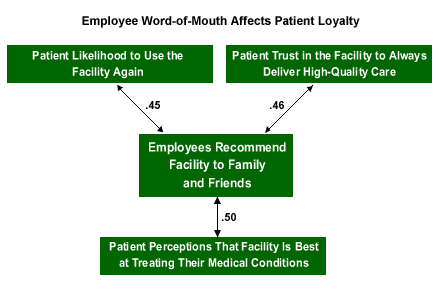
Correlations between staff likelihood to recommend and each of the patient loyalty outcome measures are .45 or higher. While the correlation analyses don't imply causality, they do indicate that there are strong relationships between employees' likelihood to recommend a facility and each of the three loyalty outcomes: patients' likelihood to use the facility again, patients' trust that the facility always delivers high-quality care, and patients' perceptions that the facility is the best at treating their medical conditions.
Word-of-Mouth and Perceived Quality
Employees' likelihood to recommend a hospital does appear to affect patients' likelihood to return to that hospital, as well as patients' perceptions of quality. The explanation for this relationship is simple -- if an employee is not willing to speak highly of his or her hospital to friends and family, he or she will probably not speak highly of the hospital to the patients, either.
How can a hospital generate positive word-of-mouth from its staff members? Or more generally, how can a hospital make its staff members feel positively about the hospital, so they will naturally want to recommend it? The answer: Employees must feel engaged with -- that is, emotionally committed to -- their jobs and the hospital in general.
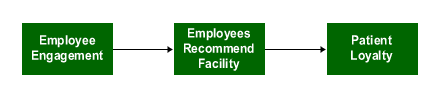
Gallup research has shown that only 24% of healthcare employees are engaged in their jobs, so it's clear there is ample room for improvement in this area. With so many disengaged employees, many hospitals are missing out on a valuable opportunity to generate positive communication about their facilities.
Hospitals must also look carefully at their scores for specific aspects of employee engagement, such as whether their employees feel that their coworkers are dedicated to quality. Employees who are otherwise highly engaged will not want to recommend their facility to others if they don't believe that their coworkers are strongly committed to delivering quality care.
Hospital processes must be geared to allowing employees to deliver that quality care to their patients. Employees must be in roles that fit their talents, they must know what is expected of them at work, and they must have the correct materials and equipment to do their jobs.
Bottom Line
Hospitals spend millions on advertising and public relations in an effort to improve their images in the community and build patient loyalty. But if their employees are disengaged and speaking negatively about the hospital to others, this public relations expenditure is probably being undermined.