WASHINGTON, D.C. -- If all the adults worldwide who Gallup surveys show would like to migrate actually picked up and moved where they wanted, Gallup's Potential Net Migration Index (PNMI) suggests many developed countries could be overwhelmed and many developing countries could sit relatively empty.
The Potential Net Migration Index is the estimated number of adults who would like to move permanently out of a country subtracted from the estimated number who would like to move into it, as a proportion of the total adult population. The results are based on nationally representative surveys of more than 260,000 adults worldwide. The higher the resulting positive PNMI value, the larger the potential net adult population gain. In Turkey, for example, subtracting the estimated 7 million adults who would like to move abroad from the 2 million adults who would like to move to Turkey and dividing that number by the total adult population (52 million) results in a PNMI value of -10%.
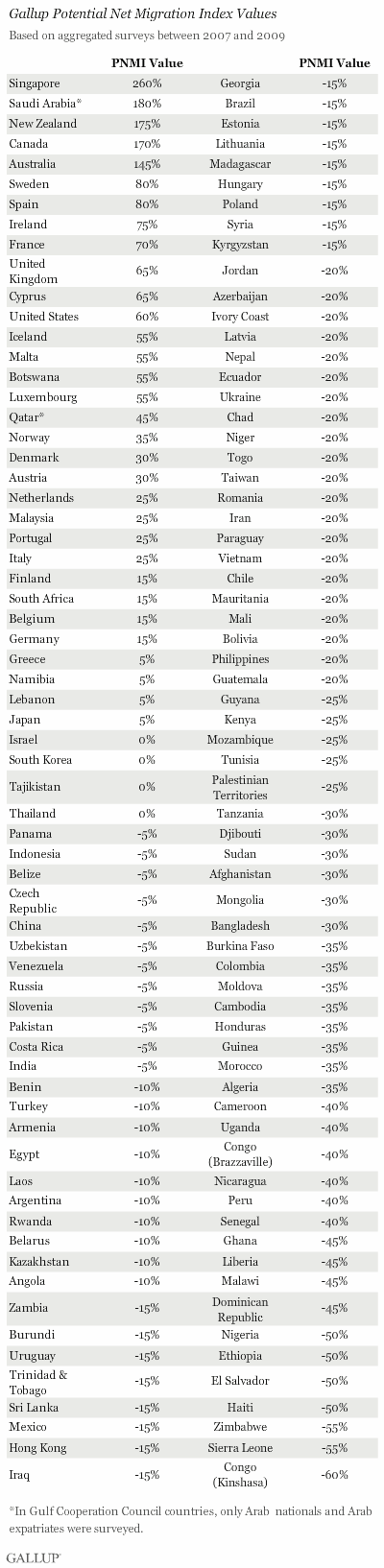
Across the 135 countries surveyed between 2007 and 2009, Singapore posts the highest Potential Net Migration Index of all countries and areas, with a net migration index value of +260%. Saudi Arabia (+180%), New Zealand (+175%), Canada (+170%), and Australia (+145%) round out the top five.
Interestingly, the United States, which is the top desired destination among all potential migrants, does not make the top five in terms of potential net population growth. The United States' net migration value of +60% places it farther down the list, after Canada and several other developed nations that dominate the top of the list. One important caveat to consider, however, is that the population size of a destination country is related to its ranking.
Developing countries, in contrast, dominate the bottom of the list. The countries with the highest negative Potential Net Migration Index values are the Democratic Republic of the Congo (Kinshasa) (-60%), Sierra Leone (-55%), and Zimbabwe (-55%), Haiti (-50%), and El Salvador (-50%).
While Gallup's findings reflect people's aspirations rather than their intentions, the implications of what could happen if hypothetical desires became reality are serious considerations for leaders to think about as they plan development and migration strategies now and in the future. Gallup will continue to monitor trends in desired migration, and will publish an updated index that includes more countries in early 2010.
For complete data sets or custom research from the more than 150 countries Gallup continually surveys, please contact us.
Survey Methods
Results are based on aggregated telephone and face-to-face interviews with 259,542 adults, aged 15 and older, in 135 countries from 2007 to 2009. The 135 countries surveyed represent 93% of the world's adult population. In Gulf Cooperation Council countries, only Arab nationals and Arab expatriates were surveyed. Index values have been rounded to the nearest integer value ending in a 0 or 5.
For most countries, aggregated sample sizes (across three years of surveys) range between 1,000 and 3,000 interviews. One can say with 95% confidence that the country-level margin of sampling error, accounting for weighting and sample design, ranges from ±3 percentage points to ±6 percentage points. Results are projected to the total population of each country aged 15 and older, using 2008 World Bank population estimates.