U.S. Health and Human Services Secretary Tommy G. Thompson recently announced that the Medicare program would strip language from its policies that did not characterize obesity as a disease, thus removing many treatment and coverage barriers for many seniors and disabled Americans who have illnesses that stem from being dangerously overweight. "Obesity is a critical public health problem in our country that causes millions of Americans to suffer unnecessary health problems and to die prematurely," Thompson said in recent testimony before a Senate subcommittee.
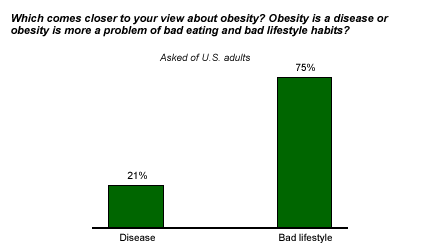
The change puts the government's characterization of obesity at odds with the perceptions of most Americans. Gallup's 2004 Consumption Habits poll* indicates that three-fourths of Americans (75%) view obesity as a problem resulting from bad eating and lifestyle habits, while only 21% view it as a disease.
Linda Degatano, a 40-year-old mother and teacher from Pennsylvania, doesn't see obesity as a disease. "I think that dieting is hard work," she says. "I am upset that people will turn to medical intervention with the new Medicare designation when it is a lifestyle issue." While this new Medicare designation may not change how people feel about obesity, it is likely to make it easier for those with serious weight issues to be covered for weight-loss assistance.
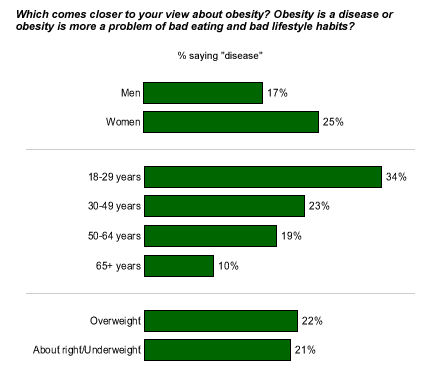
Older Americans, who will be the most direct beneficiaries of the Medicare changes because Medicare provides health coverage for the elderly, are actually less likely than younger Americans to see obesity as a disease. Ten percent of Americans aged 65 and older see obesity as a disease, compared with 34% of 18- to 29-year-olds. Men are slightly less likely than women to believe that obesity is a disease, 17% of men view it this way, while 25% of women do. And perhaps most surprisingly, Americans who see themselves as overweight are no more likely than Americans who see themselves as "about right" or underweight to define obesity as a disease.
Six in 10 American adults were classified as overweight or obese in 1999, and 300,000 U.S. deaths each year in the United States are associated with obesity, according to the U.S. Office of the Surgeon General. Forty-four percent of Americans currently describe their weight situations as overweight (well below the figure cited by the surgeon general's office, which is based on body mass calculations) and a bare majority of Americans see themselves as about right.
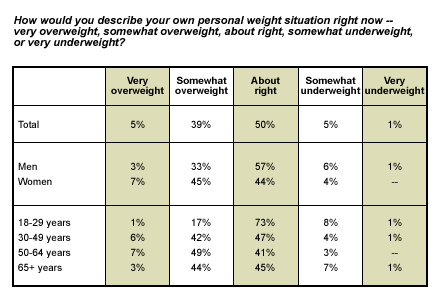
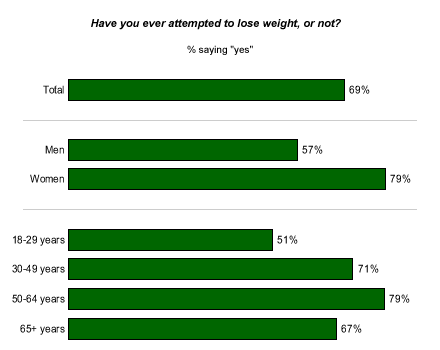
Given the variety of diet programs unendingly marketed to Americans -- including Atkins, South Beach, and Weight Watchers -- it is not surprising that nearly 7 in 10 Americans say they have tried to lose weight at some point in their lives. Women are far more likely than men both to consider themselves overweight and to have attempted to lose weight.
Bottom Line
The U.S. Surgeon General reports that the numbers of overweight and obese Americans are increasing -- a phenomenon that cuts across gender, age, race, and ethnicity. The recent decision to consider obesity a disease for Medicare recipients opens the doors for, but does not guarantee, coverage for therapies such as stomach surgery, diet programs, and behavioral and psychological counseling.
And though Americans are more likely to consider obesity a lifestyle issue rather than a disease, they appear to be in perfect agreement with the spirit of the surgeon general's most basic recommendation on curing what has been called an obesity epidemic: "The Nation must take action to assist Americans in balancing healthful eating with regular physical activity."
*These results are based on telephone interviews with a randomly selected national sample of 1,005 adults, aged 18 and older, conducted July 8-11, 2004. For results based on this sample, one can say with 95% confidence that the maximum error attributable to sampling and other random effects is ±3 percentage points. In addition to sampling error, question wording and practical difficulties in conducting surveys can introduce error or bias into the findings of public opinion polls.