Bovine spongiform encephalopathy (BSE), better known as mad cow disease, appeared in the United States for the first time last December when a cow in Washington was diagnosed with the disease. The story was big news nationwide, as eating meat from BSE-infected cattle is believed to cause variant Creutzfeldt-Jakob disease, a fatal brain disorder in humans.
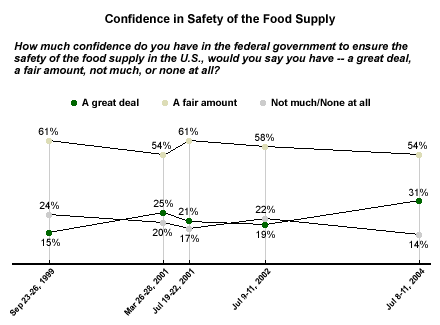
Despite the relatively recent mad cow scare, Gallup's July 2004 Consumption Habits poll* shows that Americans are much more confident in the federal government's ability to protect the nation's food supply now than they were a few years ago. Nearly a third (31%) of Americans have "a great deal" of confidence in the federal government "to ensure the safety of the food supply in the U.S.," up from 21% in July 2001 and 19% in July 2002. This percentage has more than doubled since 1999, when just 15% of Americans had a great deal of confidence in the government's ability to keep the food supply safe. The September 1999 survey was conducted just weeks after two record E. coli outbreaks in New York and Illinois.
Despite the doubling in the percentage of Americans with a great deal of confidence in the government to protect the food supply, the fact remains that roughly 7 in 10 Americans express at best just "a fair amount" of confidence that the government can ensure the safety of the food supply. Fourteen percent of Americans have little or no confidence in the government in this regard.
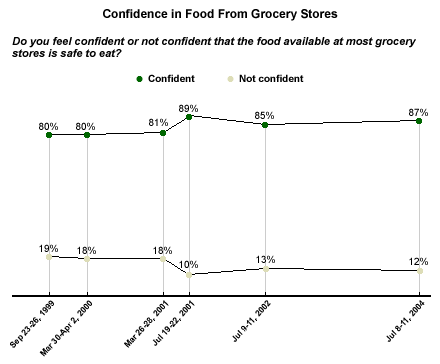
Americans are also confident that "the food available at most grocery stores is safe to eat." Eighty-seven percent of U.S. adults feel confident in grocery store food, while just 12% are not confident. Confidence has increased since 1999, even though most Americans were also confident back then.
Why this increased level of confidence? "People feel the food supply is safe because it is safe," says Matthew Baun, spokesperson for the U.S. Department of Agriculture (USDA) Food Safety and Inspection Service (FSIS). "[USDA] has undertaken unprecedented steps in the past few years to implement science-based policies that combat illness-causing pathogens on raw meat and poultry products."
In Fulfilling the Vision: Initiatives in Protecting Public Health, a report published on July 14, FSIS cites "a dramatic decline" in the number of meat and poultry product recalls, "a trend of reduction in pathogens found in meat and poultry regulatory samples," and significant declines over the past seven years in illnesses caused by E. coli, salmonella, and other food-borne bacteria.
American confidence in the government to protect the nation's food supply "is not warranted given recent government warnings and food recalls," says Craig Culp, spokesperson for the Center for Food Safety, a non-profit organization that lobbies for tougher food safety regulations. Despite the apparent increase in confidence over the past two years, Culp contends that "the numbers would be far lower if Americans were asked about their confidence in the government to protect them against specific threats, such as mad cow disease, E. coli, and mercury in fish."
When asked whether he feels that food is safer now than two years ago, Culp responds, "I think the mad cow incident is clear evidence that nation's food supply is actually less safe." He cites diminished government funding for monitoring the food industry as much of the problem.
Republicans More Confident in Food Safety
As with just about every issue relating to the government these days, there is a political divide in opinion on the government's ability to keep the food supply safe. More than 4 in 10 Republicans (42%) have a great deal of confidence in the federal government to ensure a safe food supply, as do only 27% of Democrats and 23% of independents. Just 5% of Republicans are not confident, compared with 17% of Democrats and 23% of independents. Republicans are also slightly more likely than Democrats to be confident that food from grocery stores is safe to eat -- 93% compared with 82%.
Bottom Line
The Gallup Poll data indicate that the mad cow scare in December 2003 has not negatively affected Americans' perceptions about the safety of the U.S. food supply in general. In fact, Baun believes that "the prompt and thorough response to the country's first case of mad cow disease" gave Americans more reason to be confident in the food they eat.
*Results are based on telephone interviews with 1,005 national adults, aged 18 and older, conducted July 8-11, 2004. For results based on the total sample of national adults, one can say with 95% confidence that the margin of sampling error is ±3 percentage points.