Dr. Kimberly Harms, a practicing dentist and adviser to the American Dental Association (ADA), says that tooth decay is the single most common chronic childhood disease, affecting more than 50% of youths aged 5 to 17. The ADA guidelines for a healthy smile include brushing teeth at least twice a day, flossing daily, and focusing on a healthy diet, with an emphasis on limiting sugary foods.
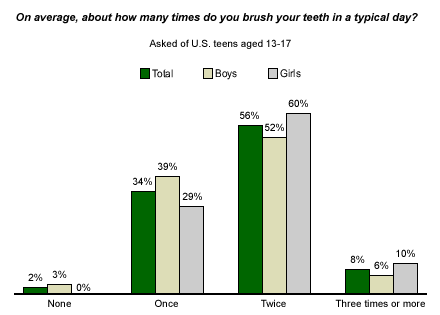
Yet many teenagers are not taking all these steps. According to the most recent Gallup Youth Survey*, while the majority of teens (64%) say they brush their teeth twice a day or more, a third (34%) report brushing their teeth only once a day and 2% say that they don't even brush their teeth daily.
Girls are somewhat more likely than boys to brush twice a day or more (70% vs. 58%). That doesn't surprise Harms. "Girls simply spend more time on grooming than do boys. However, as boys begin to focus on their appearance, this gap does narrow."
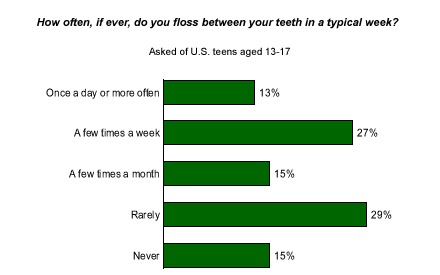
Flossing daily is necessary for maintaining healthy teeth and gums and preventing future gum problems such as gingivitis, a serious bacterial infection that can lead to bone and tooth loss. However, few teenagers floss as often as they should. The survey finds that only 13% of teenagers floss their teeth daily and 44% say they rarely or never floss.
Harms says that flossing is a difficult habit for kids to form. While she acknowledges that gingivitis does not usually present itself until adulthood, it is crucial that kids establish good habits at an early age to prevent future infection. "Children and teenagers need to learn not only how often to brush and floss, but the correct technique for brushing and flossing," she says. "Children with braces are at an even greater risk for infection due to the increased difficulty of cleaning between teeth."
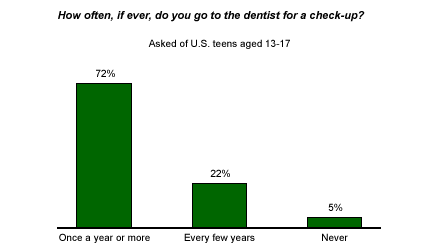
According the U.S. Centers for Disease Control and Prevention (CDC), Americans made about 500 million visits to dentists in 2003. The Gallup Youth Survey shows that most teens do see a dentist regularly. However, while nearly three-quarters of teenagers see a dentist at least once a year, slightly more than a quarter do not. Harms notes that the ADA is very concerned that a large segment of children go to bed with untreated dental decay. And, while she indicates that socio-economic factors may be the main reason for not visiting the dentist, she believes that busy lives are also a factor.
Bottom Line
While the fluoride that is added to much of the nation's water supply has helped to reduce the risk of tooth decay in recent years, the CDC estimates that 100 million Americans still do not have a water supply with enough fluoride to protect teeth. The increase in consumption of junk foods and beverages also continues to be a serious threat to dental health, particularly if many children haven't developed adequate dental hygiene habits.
Harms makes a final point in that regard, noting that children who eat a healthy breakfast are less likely to have tooth decay than children who don't. While there is no single clear-cut reason for this relationship, she believes that children who eat a healthy breakfast are less likely to consume snack foods, sodas, and juices that can coat their teeth with sugar.
*The Gallup Youth Survey is conducted via an Internet methodology provided by Knowledge Networks, using an online research panel that is designed to be representative of the entire U.S. population. The current questionnaire was completed by 439 respondents, aged 13 to 17, Aug. 8-19, 2004. For results based on the total sample, one can say with 95% confidence that the maximum margin of sampling error is ±5 percentage points.