GALLUP NEWS SERVICE
PRINCETON, NJ -- On Monday afternoon, a jury recommended death by lethal injection for Scott Peterson for murdering his wife, Laci, and their unborn child. This comes at the same time that a new study released by the Death Penalty Information Center reports a sharp decrease in the number of death sentences imposed and executions carried out over the past five years. Both the highly visible Peterson sentencing and the reduction in executions in this country draw attention again to American public opinion on this controversial issue.
A review of Gallup polling finds that about two in three Americans say they are in favor of the death penalty for convicted murderers. But support is considerably lower when Americans are asked to choose between the death penalty and life imprisonment. Death penalty supporters cite justice and fairness as the main reasons for their support, while those opposing the death sentence say it is wrong to take a life. A majority of Americans also say the death penalty is applied fairly in this country, and nearly half say it is not imposed often enough. Support for the death penalty is higher among men than among women, higher among Republicans than among Democrats, and higher among whites than among blacks.
Support for the Death Penalty
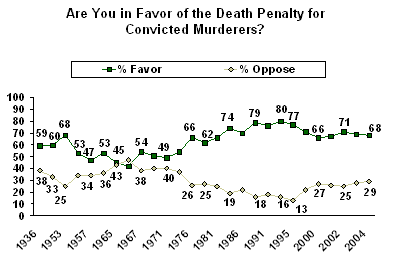
Gallup began asking Americans if they are "in favor of the death penalty for a person convicted of murder" in the 1930s, and has updated this measure on a regular basis in the decades since.
The results from two polls conducted this year show that, on average, 68% of Americans say they support the death penalty. The percentage of Americans in favor of the death penalty has fluctuated significantly over the years, ranging from a low of 42% in 1966, during a revival of the anti-death penalty movement, to an all-time high of 80% in 1994. Over the past several years, public opinion on the death penalty has been more stable, with upward of two in three Americans supporting it.
Which groups of Americans are most likely to support the death penalty? In order to answer this question, Gallup recently combined the results of the nine surveys that asked the basic death penalty question from 2001 through 2004 (see "Who Supports the Death Penalty?" in Related Items). The overall results show some interesting differences:
- Eighty percent of Republicans support the death penalty, compared with 65% of independents and 58% of Democrats.
- Nearly three in four conservatives (74%) support capital punishment, compared with 68% of moderates and 54% of liberals.
- More than 7 in 10 men (74%) support the death penalty, compared with 62% of women.
- There are substantial differences between whites and blacks in their support for capital punishment, with 71% of whites supporting the death penalty and only 44% of blacks supporting it.
- There are only slight variations by age, with roughly two in three Americans in every age group supporting capital punishment.
- The data show that 65% of those who attend church services weekly or nearly weekly favor capital punishment, compared with 69% of those who attend services monthly and 71% of those who seldom or never attend.
Death Penalty vs. Life Imprisonment
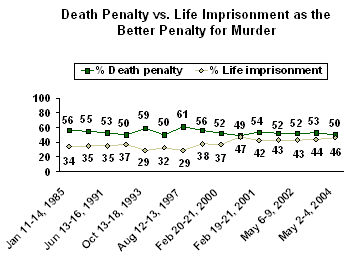
Support for the death penalty is considerably lower when respondents are asked to choose between the death penalty and "life imprisonment, with absolutely no possibility of parole" as the better punishment for murder. Americans were essentially divided on this measure this past May, with 50% choosing the death penalty and 46% choosing life imprisonment.
There has been a good deal of fluctuation on this specific measure in recent years. The highest level of support for the death penalty in response to this question came in August 1997, when 61% chose the death penalty and just 29% life imprisonment. On the other hand, just a few years later, in late August/early September 2000, the two alternatives were virtually tied, with 49% support for the death penalty and 47% for life imprisonment. Between 50% (the current percentage) and 54% have supported the death penalty in response to this question in the years since 2000, while support for life imprisonment has varied between 42% and 46% (the current percentage).
Variations of Death Penalty Support
In the last few years, Gallup has found support for the death penalty ranging from 13% to 81% when Americans are asked about its use in specific cases or for specific groups of people.
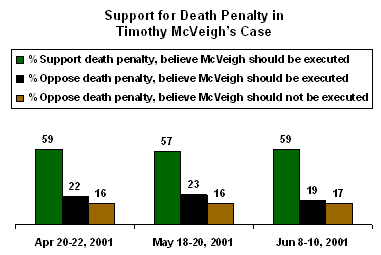
Timothy McVeigh, the man convicted of murder in the Oklahoma City bombing case, was put to death by lethal injection on June 11, 2001. In the months prior to his death, roughly 8 in 10 Americans supported the death penalty in his case, including about one in five adults nationwide who said they generally opposed the death penalty but supported it in the McVeigh case. (The Oklahoma City case involved the deaths of 168 people, including 19 children.)
In May 2002, Gallup asked Americans if they supported the death penalty for different groups of people. Roughly two in three Americans (68%) said they supported the death sentence for women. However, support was substantially lower for juveniles (26%), the mentally ill (19%), and the mentally retarded (13%).
|
Support for the Death Penalty |
||
| May 6-9, 2002 |
Favor |
Oppose |
|
% |
% |
|
|
Women |
68 |
29 |
|
Juveniles |
26 |
69 |
|
The mentally ill |
19 |
75 |
|
The mentally retarded |
13 |
82 |
Why Do People Support or Oppose the Death Penalty?
Gallup periodically asks Americans to explain, in their own words, why they support or oppose the death penalty for convicted murderers. After the Peterson sentence was handed down on Monday, Ron Grantski, longtime companion of Laci Peterson's mother, was quoted as saying that Scott Peterson "got what he deserved." This is a sentiment shared by a majority of people who support the death penalty. A May 2003 poll shows that 57% of respondents mentioned something about the punishment fitting the crime, fairness, or justice.
Eleven percent mentioned the costs associated with housing prisoners and saving taxpayers money. Another 11% said the death penalty is a deterrent to crime, while 7% said it is a way to make sure the criminals do not repeat their crimes.
Why do you favor the death penalty for persons convicted of murder? [Open-ended]
[BASED ON 715 WHO FAVOR THE DEATH PENALTY FOR PERSONS CONVICTED OF MURDER]
|
May |
Feb |
Feb |
Jun |
|
|
% |
% |
% |
% |
|
|
An eye for an eye/ |
37 |
48 |
40 |
40 |
|
They deserve it |
13 |
6 |
5 |
5 |
|
Save taxpayers money/ |
11 |
20 |
12 |
12 |
|
Deterrent for potential crimes/ |
11 |
10 |
8 |
8 |
|
They will repeat crime/ |
7 |
6 |
4 |
4 |
|
Biblical reasons |
5 |
3 |
3 |
3 |
|
Depends on the type of |
4 |
6 |
6 |
6 |
|
Serve justice |
4 |
1 |
3 |
2 |
|
Fair punishment |
3 |
1 |
6 |
6 |
|
If there's no doubt the person |
3 |
2 |
-- |
-- |
|
Would help/benefit |
2 |
1 |
-- |
-- |
|
Support/Believe in |
2 |
6 |
-- |
-- |
|
Don't believe they |
2 |
2 |
1 |
1 |
|
Life sentences don't always |
1 |
2 |
-- |
-- |
|
Relieves prison overcrowding |
1 |
2 |
-- |
-- |
|
Other |
4 |
3 |
10 |
10 |
|
No opinion |
2 |
1 |
3 |
3 |
The most common reason people cite in their opposition to the death penalty is the belief that it is wrong to take a life, mentioned by 46% of respondents in May 2003. Another commonly mentioned reason is that some people are wrongly convicted (25%). Other reasons include some type of religious justification, including the principle that punishment should be left to God (13%).
Why do you oppose the death penalty for persons convicted of murder? [Open-ended]
[BASED ON 277 WHO OPPOSE THE DEATH PENALTY FOR PERSONS CONVICTED OF MURDER]
|
May |
Jun |
|
|
% |
% |
|
|
Wrong to take a life |
46 |
41 |
|
Persons may be wrongly convicted |
25 |
11 |
|
Punishment should be left to God/ |
13 |
17 |
|
Need to pay/suffer longer/ |
5 |
-- |
|
Possibility of rehabilitation |
5 |
6 |
|
Depends on the circumstances |
4 |
-- |
|
Unfair application of death penalty |
4 |
6 |
|
Does not deter people |
4 |
7 |
|
Other |
3 |
16 |
|
No opinion |
4 |
6 |
Applied Fairly?
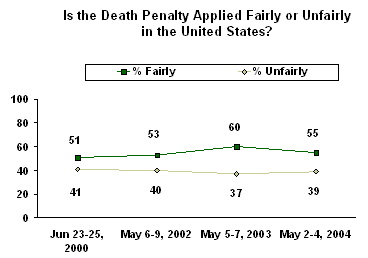
A majority of Americans, 55%, say they believe the death penalty is applied fairly in this country. Thirty-nine percent say it is not. Gallup has consistently found majority support on this measure since it was first asked in 2000.
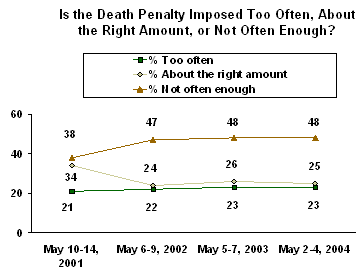
Nearly half of all Americans, 48%, say the death penalty is not imposed often enough. Twenty-three percent say it is imposed too often, and 25% say it is imposed just about the right amount. This question has shown little change over the past three times it has been asked, but the percentage saying in May 2001 that it is not imposed often enough was slightly lower than average, probably because of media focus on the McVeigh case.
Survey Methods
These results are based on telephone interviews with randomly selected national samples of at least 1,000 adults, aged 18 and older, conducted across various polls in 2001 through 2004. For results based on these samples, one can say with 95% confidence that the maximum error attributable to sampling and other random effects is ±3 percentage points. In addition to sampling error, question wording and practical difficulties in conducting surveys can introduce error or bias into the findings of public opinion polls.
