Gallup recently completed our fourth comprehensive nationwide survey of the People's Republic of China -- nearly 3,600 hour-long, in-person, in-home interviews conducted across both urban and rural areas of the country. Findings from the latest survey will be presented in coming weeks exclusively to Gallup Poll On Demand subscribers.
This ambitious project dates back to 1994, when Gallup conducted the first-ever nationwide survey of China's citizens using strict, probability-based sampling procedures. Similarly exhaustive hour-long surveys were conducted in 1997 and 1999.
Gallup has now interviewed more than 15,000 Chinese adults across every province and autonomous administrative unit in the country -- from rural areas of inner Mongolia to urban Guangzhou; from Heilongjiang on the border with Russian Siberia to tropical Hainan Island in the Gulf of Tonkin; in Tibet (Xizang) and in predominantly Muslim Xinjiang on the border with Afghanistan.
A Decade of Rapidly Rising Living Standards, Particularly in Urban Areas
As the current survey's findings document, the change in the living standards of China's people over the last decade is nothing short of astonishing -- surely the most dramatic transformation ever witnessed by more than a fifth of mankind over such a brief period.
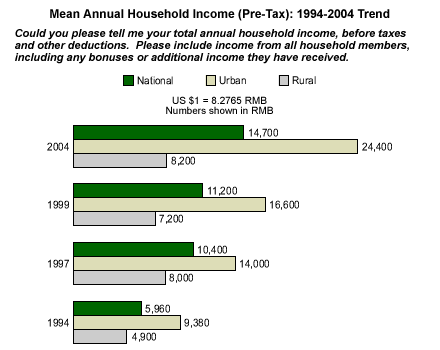
Nationwide, average reported household incomes are now nearly 2 1/2 times what respondents reported in 1994. The bulk of this dramatic income growth occurred among China's urban residents, who are now, on average, three times as affluent as their rural counterparts. But even rural incomes -- which have stagnated in recent years -- are nearly double what they were a little over a decade ago.
This dramatic rise in affluence has been accompanied by a remarkable degree of change in the everyday lives of China's 1.3 billion people. In Gallup's initial 1994 nationwide survey, only a minority (40%) of Chinese households had a color television set, just one in four owned a refrigerator, 1 in 10 had a landline telephone, and only 3% owned a mobile phone. Video compact disc players? They had only recently been invented.
Our latest survey indicates that color televisions and landline phones have become the norm rather than the exception in Chinese homes -- 82% of households have the former, 63% the latter. Nearly half (48%) of China's roughly 400 million households now own at least one mobile phone. Even more remarkable is that at least half (52%) of all Chinese households now own a VCD player -- double the percentage that owned a refrigerator in 1994.
Satisfaction
If China's people are far more affluent, are they also more satisfied with the quality of their lives? On this point, the data are far more ambiguous.
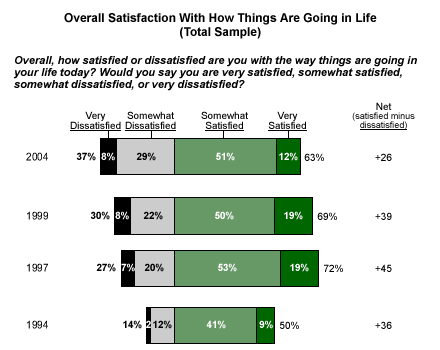
Gallup asked respondents, "Overall, how satisfied or dissatisfied are you with the way things are going in your life today -- very satisfied, somewhat satisfied, somewhat dissatisfied, or very dissatisfied?" As in earlier surveys, Chinese are significantly more likely to express satisfaction (63%) than dissatisfaction (37%) with their current quality of life, with the largest percentage expressing moderate, rather than strong, satisfaction (51% say "somewhat satisfied" and 12% say "very satisfied")*. Only a tiny minority of Chinese -- never more than 8% in any of our four surveys -- describe themselves as "very dissatisfied."
However, despite impressive growth in average household income, the ratio of Chinese expressing satisfaction to those expressing dissatisfaction has actually eroded somewhat over time**.
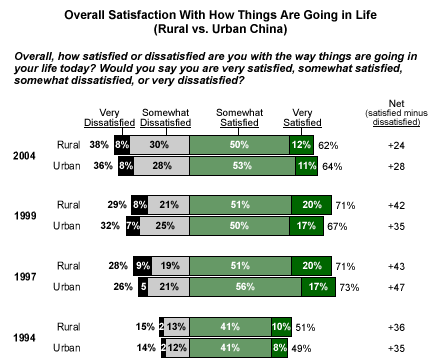
It is interesting to note that there is no significant difference between the self-reported satisfaction of China's urban and rural residents, notwithstanding the enormous (and growing) gap in affluence between China's cities and its countryside. The proportion of rural residents describing themselves as "satisfied" is statistically equal to the percentage among their city-dwelling counterparts -- a pattern that has persisted across all four waves of Gallup's survey.
So is it true that greater affluence does not translate into greater happiness?
Well, not entirely. The data also show that, regardless of where they live, China's wealthiest residents are indeed happier than the country's poorest residents. Among the one in eight households fortunate enough to have total annual incomes of 30,000 RMB ($3,620 U.S.) or more, 80% describe themselves as either very (16%) or somewhat (64%) satisfied with the way things are going in their lives. In contrast, among those with total annual household incomes below 3,000 RMB ($362 U.S.), only about half (49%) say they are either very (11%) or somewhat (38%) satisfied. About 1 in 10 Chinese households fall into this very low income category.
All That Glitters Is Not Gold?
How can it be that China's city dwellers -- so much better off financially than their rural counterparts -- appear to be no more satisfied with their lives? Is this simply a matter of higher expectations, or might there be other factors at work?
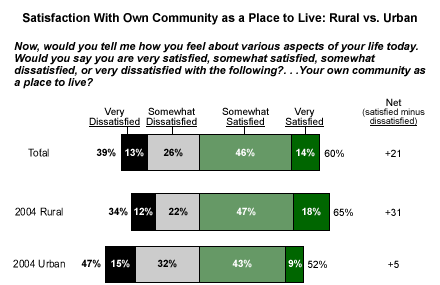
One explanation for this apparent paradox may lie in the responses to a follow-up question in which respondents were asked to rate their level of satisfaction with their own community "as a place to live."
While China's cities continue to grow rapidly because of massive internal migration, those Chinese who have remained in the countryside are now dramatically more likely than their urban counterparts to say they are satisfied with their own communities "as a place to live." Furthermore, although this pattern existed to a modest degree in responses to our 1994 survey, it has become more pronounced in each subsequent wave.
Why might this be? Despite the far greater economic opportunities they provide, China's cities certainly are not immune to many of the ills that have plagued rapidly expanding urban sectors worldwide -- such as a shortage of available and affordable housing, pollution, and even rising crime rates. Even so, tens of millions of Chinese continue to "vote with their feet" each year, leaving the agricultural hinterlands in search of a brighter future elsewhere.
Next week: Specific areas of satisfaction, and degree of optimism toward the future
*By way of comparison, when a similar question was asked in late 2004 in the United States, 84% of Americans described themselves as satisfied with how things are going in their lives (58% very satisfied, 26% somewhat satisfied), while just 14% said they were dissatisfied (5% very dissatisfied, 9% somewhat dissatisfied).
**When Gallup first asked this question in China in 1994, the following five-response-choice scale was used: "very satisfied, somewhat satisfied, neither satisfied nor dissatisfied, somewhat dissatisfied, or very dissatisfied?" However, because such a high proportion (38%) of the 1994 respondents opted for the 'soft option' mid-point ("neither satisfied nor dissatisfied"), in each subsequent wave of this survey we have substituted the following four-choice scale: "very satisfied, somewhat satisfied, somewhat dissatisfied, or very dissatisfied?"
