A third of the world's smokers live in China, according to World Health Organization (WHO) figures. One million Chinese die each year from tobacco-related illnesses, and unless smoking patterns change, WHO expects 3 million to die each year by the year 2050.
About one in four Chinese (26%) say they smoke regularly, and an additional 11% say they smoke occasionally, according to the 2004 Gallup Poll of China. The public health consequences of this controllable health behavior are tremendous; the problem is poised to dangerously stress the resources of the already overtaxed Chinese health system.
Who Is Smoking in China?
Smoking in China is overwhelmingly a male habit. At least two-thirds of all Chinese men (68%) smoke at least occasionally, and roughly half (49%) are regular smokers. In contrast, only 6% of women smoke regularly (3%) or occasionally (3%).
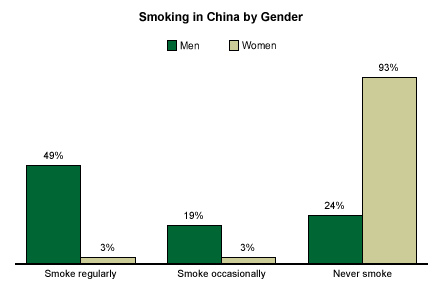
Richard Burkholder, Gallup director of international polling, notes that smoking is far less socially acceptable among Chinese women than among Chinese men. "Many Chinese women place a heavy emphasis on stylishness, extending to fashion, cosmetics and hairstyles," Burkholder says. "To many Chinese, the sight of a woman smoking a cigarette tends to conflict with their sense of style and appropriateness -- a reaction similar to that which a pipe-smoking woman might encounter in the U.S."
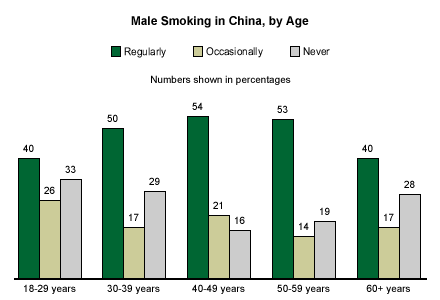
Among Chinese men, smoking behavior varies by age. Men between the ages of 40 and 49 are the heaviest smokers -- 75% of this group smokes either regularly (54%) or occasionally (21%). Men between the ages of 18 and 39 are more likely to have never smoked than are men aged 40 to 59. This offers a glimmer of hope for curbing the prevalence of smoking in China.
Reducing Smoking in China
Thus far, efforts to reduce smoking in China have had limited impact. Only 4% of all Chinese and 8% of Chinese men volunteered in the survey that they used to smoke but quit. How can smoking be discouraged among Chinese men?
In the United States, effective strategies have included limiting the promotion of tobacco products and restricting locations where people can smoke in public. Only a few cities in China have banned smoking in public places, and such laws are spottily enforced.
Public attitudes must also be changed. Chinese women smoke less, in part because it is socially unacceptable. There are no such taboos for men. Cigarettes are cheap and smoking is allowed in most locations. In its absence of social mores that discourage smoking, easy access to cheap cigarettes combined with a lack of restrictions will help maintain its pervasiveness.
Bottom Line
In the United States:
- The risk of dying from lung cancer is 22 times higher among male smokers than nonsmokers.
- Smokers are two to four times more likely than nonsmokers to develop heart disease.
- The risk of stroke approximately doubles among smokers.
- Smokers are 10 times more likely than nonsmokers to develop vascular disease.