Americans' ratings of Congress have dropped an average of eight percentage points in the past two months and are lower now than at any other point since spring 2000. Congressional ratings have declined among almost every demographic subgroup, with the most notable changes occurring among lower-income Americans and highly educated people. These changes come at a time when Congress has been busy debating Social Security reform, finalizing next year's budget, and passing controversial legislation regarding the Terri Schiavo case.
At the beginning of 2005, congressional approval ratings were in the low- to mid-40% range. Ratings have declined in the past two months, and now fewer than 4 in 10 Americans (38%) say they approve of Congress.
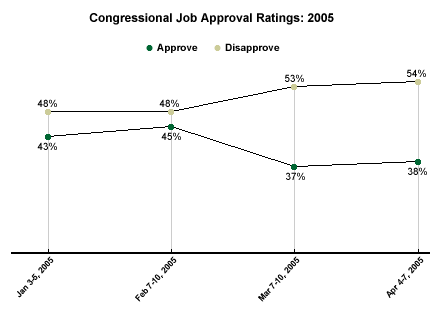
Aggregated Gallup Poll data* collected over these past four months allow for an analysis of where the drop from January-February to March-April has occurred. The analysis shows that the decline in support is rather general, as most demographic subgroups tend to show a drop and these are all about the same magnitude. However, departures from this general pattern are evident in household income and education groups.
Household Income
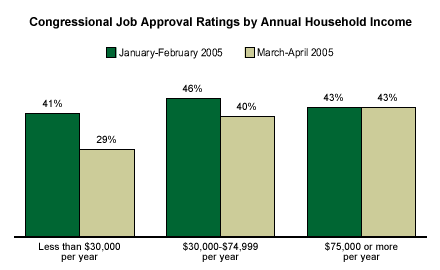
Congressional approval ratings declined most dramatically among Americans living in lower-income households. Congressional ratings among Americans with household incomes of less than $30,000 a year dropped 12 percentage points between the first two months of the year and the subsequent two months. Meanwhile, ratings decreased only six points among Americans in households with incomes between $30,000 to $74,999, and showed no change at all among those living in households with total earnings of $75,000 or more.
Early in the year, ratings of Congress were similar among people at all income levels; now they are much lower among those in households earning less than $30,000 per year.
Education
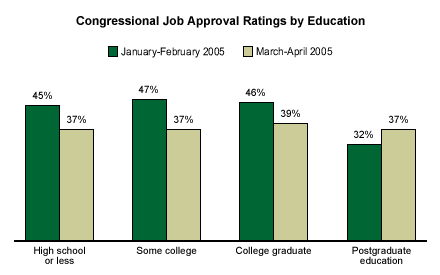
Congressional approval ratings actually improved in recent months among Americans with postgraduate educations, while ratings fell by roughly equal proportions among college graduates, those with some college education, and those with a high school education or less. Earlier in the year, postgraduates rated Congress much more negatively than people with lower levels of education; now, approval ratings of Congress are roughly the same among respondents of all educational backgrounds.
Political Viewpoints
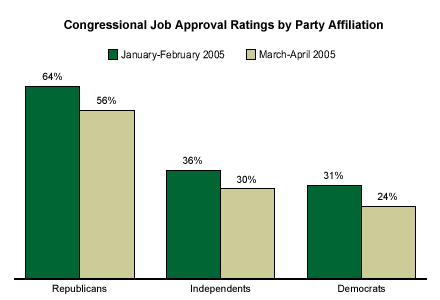
Approval of Congress declined about equally among Republicans (eight points) and Democrats (seven points), while independents showed essentially no change. Republicans continue to rate the GOP-controlled Congress much more positively than Democrats do.
Likewise, self-described ideological conservatives continue to view Congress more positively than moderates or liberals do. Approval of Congress among moderates has dropped eight points, from 41% to 33%, in the past few months. Ratings fell by slightly smaller amounts among conservatives (from 56% to 52%) and liberals (from 28% to 22%).
Gender, Age, and Race
Ratings of Congress have dropped more or less uniformly among gender, age, and racial groups.
Bottom Line
Congress definitely took a public relations hit with its unpopular action in the Schiavo case -- more than 7 in 10 Americans said they disapproved of its involvement. Negative economic perceptions, as currently exist, also tend to take a toll on Americans' evaluations of the national legislature. Congress' ratings in recent years have broken some uncharted positive territory, but in recent years, and recent months, the arrow is pointing downward.
*Results are based on telephone interviews with 2,013 national adults, aged 18 and older, conducted Jan. 3-5, 2005, and Feb. 7-10, 2005. For results based on this sample, one can say with 95% confidence that the margin of sampling error is ±2 percentage points.
Results are based on telephone interviews with 2,014 national adults, aged 18 and older, conducted March 7-10, 2005 and April 4-7, 2005. For results based on this sample, one can say with 95% confidence that the margin of sampling error is ±2 percentage points.
Margins of sampling error for subgroups will be higher than those for the entire samples.
