When it comes to getting along with their friends, most teens appear to play well with others.
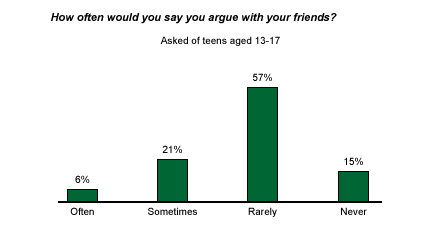
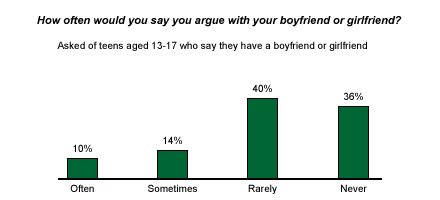
In a recent Gallup Youth Survey*, teens were asked how often they argue with their friends, and, if they had boyfriends or girlfriends, how often they argued with them. In both cases, majorities of teens describe harmonious relationships. Fifty-seven percent of teens say they rarely argue, and 15% say they never argue, with their friends. Among teens with boyfriends or girlfriends, 40% say they rarely argue with their significant others and 36% say they never argue. Roughly a quarter in each situation say they argue often or sometimes.
The percentage of teens who say they rarely or never argue with their friends surprises Andrea Brandt, a licensed psychotherapist who specializes in anger management and relationship issues. "But a lot of teens come from homes where they were 'taught' to suppress their feelings; where parents never gave them the tools necessary to learn to express their anger," Brandt says. "They need to learn that anger is normal, and if they are given the tools early, kids would be much more proficient at dealing with anger when they grow up."
David, a 17-year-old Youth Survey respondent, says he argues with his friends probably once every two weeks. "In our group [of friends], I guess people get into little fights, like two people will be arguing about stuff and it becomes the whole group's problem." A situation like that came up two weekends ago, he says. "A couple of our friends were fighting, so we had everybody sit down in one room and just kind of talk about what was bothering them. And by having everybody sit down and say what they were mad about, what got their feelings hurt, we kind of got everything out in the open and everybody felt better."
Boyfriends and Girlfriends
Teens generally don't argue often with their friends, but teens with significant others are more likely to say they never argue with their boyfriends or girlfriends. Equal percentages of boys and girls who have significant others say they never argue.
Brandt says that child-parent relationships always inform early relationships with the opposite sex -- which can be one reason teens avoid conflict with boyfriends or girlfriends. "If a girl, for instance, always wanted to please her father, earliest relationships with boys will most likely carry the same demeanor."
Nyssa, a 15-year-old Youth Survey respondent, says she and her boyfriend hardly ever argue over serious things. "It's little things like 'you don't have to go do this if you don't want to' -- that sort of thing," she says. "They're not really arguments, he's just letting me know that I'm free to make my own decisions." When a subject does come up, she says, one of them cracks a joke about it and they move on.
The Anger Quotient
A majority of teens say they get angry at least sometimes (see "U.S. Teens Walk Away From Anger" in Related Items) -- but only 11% say they get angry often. However, these teens are more likely to say they argue with their friends. A majority of teens who report being angry often also say they argue often (18%) or sometimes (34%) with their friends. It makes sense to Brandt. "It must just be their normal demeanor," she says. "Some parents address everything from a rough, loud place and kids grow up thinking that's normal."
*These results are based on telephone interviews with a randomly selected national sample of 1,028 teenagers in the Gallup Poll Panel of households, aged 13 to 17, conducted Jan. 17 to Feb. 6, 2005. For results based on this sample, one can say with 95% confidence that the maximum error attributable to sampling and other random effects is ±3 percentage points. In addition to sampling error, question wording and practical difficulties in conducting surveys can introduce error or bias into the findings of public opinion polls.