The most recent data from Gallup's annual congregational engagement survey reveal that in a typical American congregation, about a third (32%) of the members are "engaged" with the congregation, 52% are "not engaged," and 16% are "actively disengaged."
Engagement is the result of several measurable factors, most of which -- understanding the expectations of membership, feeling cared about, and being provided with personal development opportunities, for example -- rely to some extent on the congregation's leadership. Given the importance of his or her role, does the length of tenure of the congregation's leader -- the pastor, priest, rabbi, or other spiritual leader -- make a difference? Recent Gallup data* suggest that, with the exception of years 5 through 10, it doesn't have much effect.
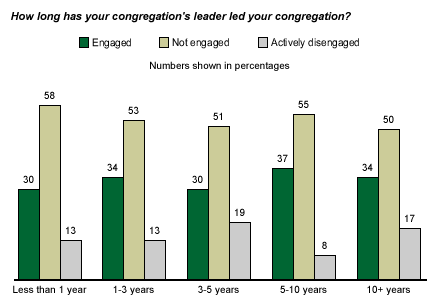
Years 5 Through 10: Optimum Leadership?
The average engagement levels of the congregation members we studied are pretty even across most categories of the leader's tenure. The exception appears to be in years 5 through 10, when the percentage who are actively disengaged drops to single digits (8%), and the engaged percentage reaches 37%. This suggests that by this time, the congregation and the leader have gotten to know each other's strengths and weaknesses, and members have decided for the most part to "get on board" with the leader's vision -- or at least try not to hinder it.
However, after a leader has been in his or her congregation for more than 10 years, members' likelihood to be engaged falls back and active disengagement rises. So after a certain point, the leader's length of tenure alone fails to encourage engagement among congregants.
The Leadership Factors of Engagement
So what leadership factors are directly related to engagement? Our data indicate that responses to these four questions are strongly related to members' engagement levels -- namely those members who "strongly agree" with each of these statements are more likely to be engaged and less likely to be actively disengaged than the average member.
- The leadership of my congregation always treats me with respect.
- The leadership of my congregation makes me enthusiastic about the future.
- I trust the ethics and integrity of my congregation's leaders.
- I am confident in my congregation's financial future.
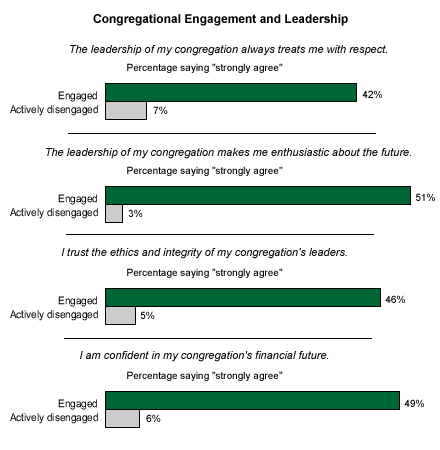
As I've discussed in relation to turnout at religious services (see "Leader Quality -- not Tenure -- Linked to Worship Turnout" in Related Items), we once again see that it's the quality of leadership that drives positive outcomes rather than the length of time that leadership has been in place. Leaders who provide their members with a compelling vision of the future of their faith community and who treat members with respect, are enthusiastic about the future, have high ethical standards, and instill confidence about the congregation's financial well-being are most likely going to grow an engaged congregation -- regardless of how long they've served.
*Results are based on telephone interviews with 1,000 adult members of a church, synagogue, or other religious faith community, aged 18 and older, and 500 nonmembers, conducted in October 2004. For results based on this sample, one can say with 95% confidence that the margin of sampling error is ±2.6 percentage points.
