Politics is not the only force that divides the country -- a recent Gallup survey* revealed that Americans also split nearly equally between spenders and savers. Half of Americans say they are the type of person who more enjoys saving money, while 46% more enjoy spending it.
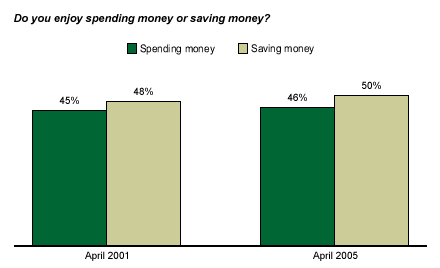
Americans are often berated for not saving enough, but consumer spending is so important to the nation's economic well-being that one has to wonder which team -- the spenders or the savers -- President George W. Bush and his economic advisers are rooting for. Democratic Americans may be doing more than their share to keep recession at bay. The majority of Democrats, compared with just 39% of Republicans, say they more enjoy spending money.
|
Republican |
Independent |
Democrat |
|
|
|
|
|
|
|
Enjoy spending |
39 |
46 |
54 |
|
Enjoy saving |
58 |
49 |
43 |
|
No opinion |
3 |
5 |
3 |
|
100% |
100% |
100% |
Women are often typecast as "shopaholics," but men appear to be no different in their orientation toward money. Men and women are virtually identical in their answers to this question: 46% of both groups say they more enjoy spending money, while 51% of men and 48% of women say they prefer saving it.
Greater differences in attitudes about money are observed by age, with the penchant for spending highest among younger Americans. A slim majority of those aged 18 to 29 and 30 to 49 say they more enjoy spending money. Those aged 50 and older prefer saving it.
|
18-29 |
30-49 |
50-64 |
65+ |
|
|
|
|
|
|
|
|
Enjoy spending |
51 |
51 |
45 |
34 |
|
Enjoy saving |
48 |
46 |
50 |
59 |
|
No opinion |
1 |
3 |
5 |
7 |
|
100% |
100% |
100% |
100% |
Putting gender and age together, we see that younger women are the most likely to get a thrill from shopping, while older women are the least likely. In fact, the 13-point gap in the percentage of older versus younger women who enjoy spending is one of the largest demographic distinctions seen in this data (second only to the 15-point difference between Republicans and Democrats).
|
Men 18-49 |
Men 50+ |
Women 18-49 |
Women 50+ |
|
|
|
|
|
|
|
|
Enjoy spending |
48 |
44 |
54 |
38 |
|
Enjoy saving |
51 |
52 |
42 |
55 |
|
No opinion |
1 |
4 |
4 |
7 |
|
100% |
100% |
100% |
100% |
Only slight differences are seen according to household earnings, with those living in higher-income households slightly more likely to say they enjoy spending money than those in lower-income households.
What Does It Mean?
While interesting, one's orientation toward money appears to bear little relation to one's financial well-being. Those who describe their personal financial situation as "excellent" or "good" are essentially no more likely to enjoy saving money than those whose situation is "only fair" or "poor."
Most Americans claim to be living within their means: 85% of savers and 76% of spenders attest to this in the recent survey. The percentage admitting they are living beyond their means is only marginally higher among spenders than savers: 24% vs. 14%.
Perhaps most relevant for the economy, savers are no more likely than spenders to project an increase in their level of spending in the near future. Just 24% of spenders and 25% of savers say that their spending level is likely to increase over the next six months.
Bottom Line
People may have feelings about spending money -- whether they like it or don't. The data suggest that spenders may be slightly worse off financially than savers, but for the most part, one's self-identification as a spender or saver doesn't appear to be a major indicator of financial well-being.
*Results are based on telephone interviews with 1,003 national adults, aged 18 and older, conducted April 18-21, 2005. For results based on the total sample of national adults, one can say with 95% confidence that the margin of sampling error is ±3 percentage points.