American consumers have been on a buying spree for some time now. The low-interest-rate environment has perpetuated a home-buying frenzy that has reached bubble proportions. Economists worry about "global imbalances" and say our low national savings rate is partially to blame for the United States' current account deficit. But is the American consumer showing any sign of cutting back now that the low-interest-rate party might be coming to an end? The most recent Experian/Gallup Personal Credit survey* indicates that while about half of U.S. consumers expect their debt levels to drop over the next six months, relatively few Americans are reducing their debt burdens.
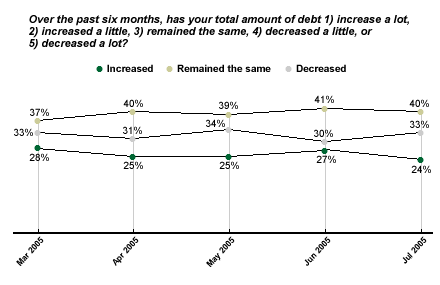
The July 2005 survey asked consumers whether their debt has increased, decreased, or stayed the same over the last six months. A plurality of respondents -- 40% -- say their total amount of debt has remained the same and another 33% say their total debt has decreased. Twenty-four percent of Americans have increased their debt burdens over the same period. So although a third of Americans claim to have lowered their personal debt, the reality is that two-thirds of Americans are maintaining or increasing their total debt exposure. This percentage has remained relatively steady since we began asking this question monthly in February.
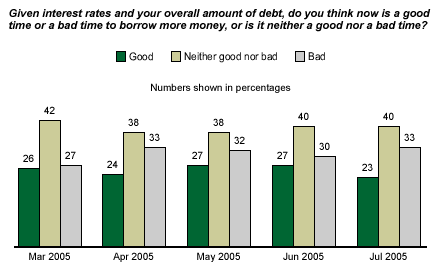
Consumer perceptions of whether now is a good time to be borrowing money line up quite well with consumer borrowing behavior. A plurality (40%) maintain that now is neither a good time nor a bad time to borrow, a third say now is a bad time to be taking on more debt, and about one in every four consumers (23%) say borrowing conditions remain favorable.
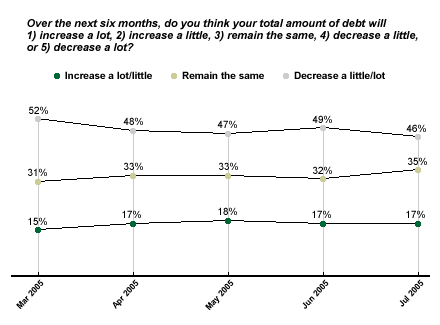
In each survey administered so far this year, about half of consumers have said they expect their total personal debt levels to decrease over the next six months. (According to the most recent survey, for example, 46% of consumers predict their debt will go down in the next six months.) But as of mid-June, only a third of consumers say their debt levels have actually decreased in the last six months. So, these data taken together suggest that while many consumers intend to reduce their debt in the near future, a significant proportion have not done so.
Bottom Line
The Experian/Gallup survey reveals that while there is substantial pent-up pressure to lower debt levels, that pressure has not translated into action for many people. As the Fed nurses interest rates back to more realistic levels, the majority of consumers are resigned to the idea that they must reduce personal debt levels. But when -- or if -- that will actually happen remains to be seen.
*Results for the survey are based on telephone interviews with 1,000 U.S. adults, aged 18 and older, conducted June 13-19, 2005. For results based on this sample of adults, one can say with 95% confidence that the maximum margin of sampling error is ±3 percentage points.