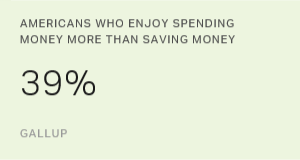
American consumers have been the heroes of the recent economic recovery, refusing to cut personal spending even as the business cycle took some dark turns. Gallup data show consumer spending intentions have not wavered in the aftermath of the 2001 recession -- since then, at least 7 in 10 Americans have consistently said they plan to maintain or increase their level of spending in the near future.
But with a 0% personal savings rate and rising household debt levels, analysts are still asking when the seemingly indefatigable consumer will run out of steam. A late July CNN/USA Today/Gallup poll* gauged American consumers' sense of vulnerability in regard to their personal finances.
Energy, Healthcare Costs Seen as a Threat
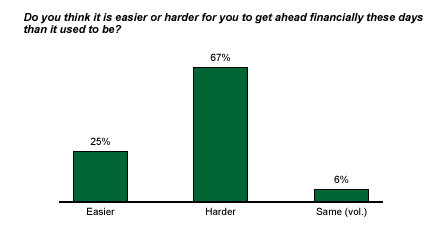
When Gallup asks Americans for an assessment of their personal finances, they generally describe them in positive terms. Even so, the July 22-24 poll finds 67% of Americans reported it is harder to "get ahead financially than it used to be," while just 25% said it is easier.
High energy prices are one of the main obstacles to getting ahead financially. Pundits keep reminding us that the U.S. economy is much less energy-intensive today than it was in the 1970s, but the reality is that American consumers are feeling the heat. Even before average national gas prices surpassed inflation-adjusted highs after Hurricane Katrina, 61% of Americans reported that they consider energy prices a "very serious" threat to their current standard of living. At that time, an equal percentage said healthcare costs were a very serious threat. It is unclear what the effect of the recent higher gas prices would be on the relative ranking of these two items today.
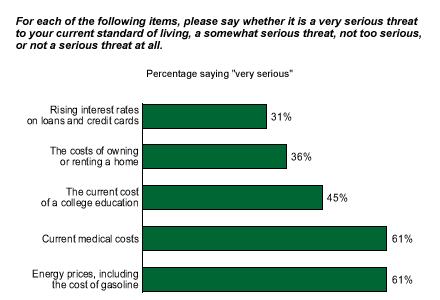
Americans were much less likely to consider the costs of a college education, home rental or ownership expenses, or rising interest rates on loans and credit cards as serious threats to their standards of living.
Pay Raises Aren't Cutting It
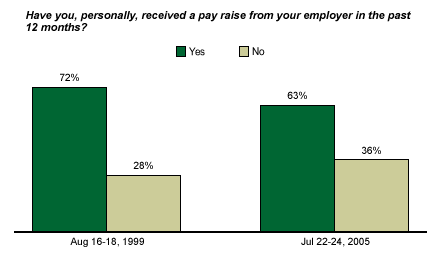
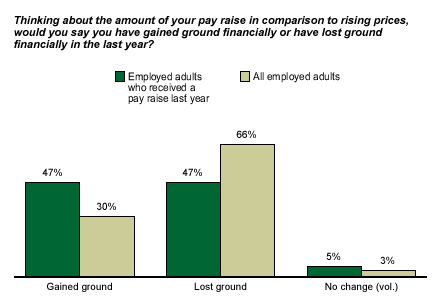
If consumers' buoyant intentions are puzzling to some in the face of minimal savings and increasing debt burdens, they are even more so in light of the fact that personal incomes have eroded. Department of Labor statistics show that in 8 of the last 12 months, inflation has outpaced increases to American workers' average weekly earnings. In keeping with these numbers, 47% of those who received a recent pay increase (63% of employed Americans surveyed said they received a raise in the past 12 months) said they lost ground financially, the same percentage who said they gained ground relative to rising prices following the pay increase.
Bottom Line
The prevailing low-interest-rate environment and the ensuing mortgage-refinancing spree have allowed U.S. consumers to keep spending at unsustainably high levels. Consumers might continue to declare their intentions to keep spending, but those numbers may increasingly indicate wishful thinking. By their own admission, they're worried about the toll that high energy prices, increasing healthcare costs, and eroding wages are taking on their personal finances.
*Results are based on telephone interviews with 1,006 national adults, aged 18 and older, conducted July 22-24, 2005. For results based on the total sample of national adults, one can say with 95% confidence that the margin of sampling error is ±3 percentage points.
For results based on the sample of 598 adults employed full or part time, the maximum margin of sampling error is ±4 percentage points.
For results based on the sample of 370 workers who received a pay raise in the last 12 months, the maximum margin of sampling error is ±6 percentage points.