Ensuring America's schools maintain high standards through testing and accountability has been a key focus of education reform over the last 20 years. But fundamentally, the success or failure of education hinges on what goes on behind each classroom door -- the complex interplay of subject matter, student mindset, and teacher performance that generates learning and development.
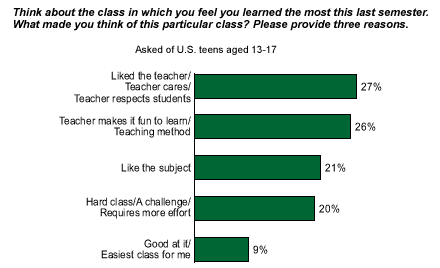
One way to get behind those classroom doors is to ask students themselves which classes teach them the most and why. In the latest Gallup Youth Survey*, students aged 13 to 17 were asked to think of the one class in which they feel they learned the most during the last semester. When asked to explain their choices in an open-ended format, slightly more than half of teens -- 53% -- give credit to the teacher. Teacher-related responses fall about evenly into two general categories: 1) the teacher cares about and respects students; or 2) the teacher makes it fun to learn or students like their teaching method.
One in five students (21%) named the class because of its subject matter. About the same percentage (20%) say they learned the most in this class because it was the most challenging. And 9% say they learned the most from the class they were best at or the one that was easiest.
A few verbatim responses from the survey illustrate the emphasis students place on the teacher:
- "My teacher understood the way that I learned and worked. I was never criticized for my ideas or feelings, but I was met with questions and ideas that could change the way I looked at something." -- 17-year-old girl
- "I learned to appreciate poetry (when the teacher is passionate about it, I learned to be passionate about it). I love to write, and this is the only class in which writing assignments can be creative without the teacher docking points for 'flowery wording.' History meets creativity." -- 17-year-old girl
- "The teacher was AMAZING. Not only was he extremely well informed, he'd been teaching in the subject for so long he knew what was effective and what wasn't. It's great when the teacher is so good that even in a subject I wouldn't ordinarily enjoy, it was fun to learn in the class." -- 17-year-old boy
- "My teacher always pushed us to our limits; I have never been pushed so hard in my life to achieve. She was very fun and really took time to know each one of us. She was there after school to help when we needed it." -- 16-year-old girl
What Is It About the Teacher?
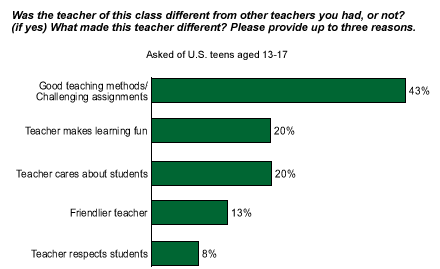
Gallup also asked students specifically whether the teacher in the class they learned the most from was different from the other teachers they had. Seventy percent said yes. When asked what set that teacher apart, 63% of those who say their teacher was different gave a response related to the teacher's classroom methods (good teaching methods/challenging assignments/teacher makes learning fun), while 41% offered one of a variety of responses regarding the teacher's relationships with students.
Verbatim responses to this question illustrate how the best teachers engaged their students and elevated their sense of their own potential:
- "Although my outlook on most things was vastly different, we still connected because she was real. She's easy-going and open-minded. She is into pop culture and is probably the smartest person I know. I've had this teacher for multiple classes, and I've grown to love her. She was never afraid to do things her way and was not afraid of her flaws. She was stubborn, funny, and genuine." -- 16-year-old girl
- "Because he taught us a new way to write and think. It wasn't the basic writing technique -- he got you to open up your mind and believe in yourself." -- 17-year-old girl
- "He wasn't bland or monotone like most of my teachers, but he was full of life and made learning fun." -- 15-year-old boy
Bottom Line
Ask students what makes the biggest difference in their own learning and they're most likely to say the teacher. That may seem obvious, but consider the nature of these responses. It's not teachers' grasp of their subject matter that students are most likely to describe, but rather the teachers' capacity for infusing energy and creativity into their methods, and for building caring, respectful relationships with students.
No Child Left Behind calls for a highly qualified teacher in every classroom, but the real key is to figure out what "highly qualified" means. Subject matter knowledge is a must, but from the students' perspective, creativity and relationship-building are just as important to helping them learn.
*These results are based on Web surveys with a randomly selected national sample of 600 teenagers in the Gallup Poll Panel of households, aged 13 to 17, conducted July 6 to Sept. 4, 2005. For results based on this sample, one can say with 95% confidence that the maximum error attributable to sampling and other random effects is ±4 percentage points. In addition to sampling error, question wording and practical difficulties in conducting surveys can introduce error or bias into the findings of public opinion polls.