GALLUP NEWS SERVICE
PRINCETON, NJ -- Asked to name the most urgent health problem facing the United States, Americans are most likely to list cost and access to healthcare rather than a specific disease or medical syndrome. This continues the basic pattern of recent years, but marks a decided change from the period of time between 1987 and 1999, when AIDS was consistently named as the most urgent health problem facing the nation.
Gallup has asked Americans about the most urgent health problem each November during the past six years as part of the Gallup Poll Social Series update on health, and periodically between 1987 and 2000. The question is an open-ended query, allowing respondents to answer in their own words.
This year's results are as follows (full results and trends are displayed at the end of this article):
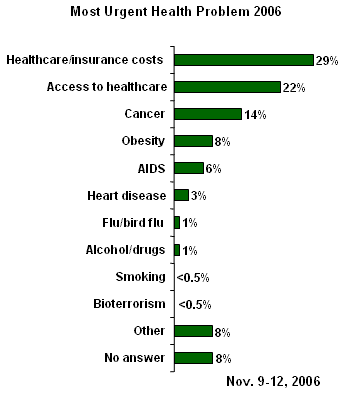
Slightly more than half of Americans spontaneously mention the cost of healthcare or access to healthcare as the most urgent health problem currently facing the country. Following well behind in terms of percentage mentions are cancer, obesity, AIDS, and heart disease. A number of other health problems are mentioned by 1% of the population or less.
This emphasis on Americans' ability to receive affordable access to healthcare as the most urgent health problem, rather than a specific disease or condition, has an interesting history. In the early 1990s, the percentage of Americans mentioning cost of healthcare as the most urgent problem zoomed up to as high as 30% in 1993. This was in the midst of the Clinton administration's push on new healthcare legislation. By Gallup's 1997 and 1999 surveys, however, this top-of-mind concern about cost and access had somewhat abated. In 2000, the percentage of Americans mentioning cost and access began to climb again, reaching as high as 58% two years ago before receding to the current 51%.
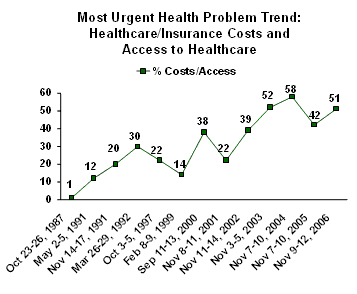
In the surveys conducted prior to 2002, the public's top response to this urgent health problem question was some sort of disease; in most instances AIDS.
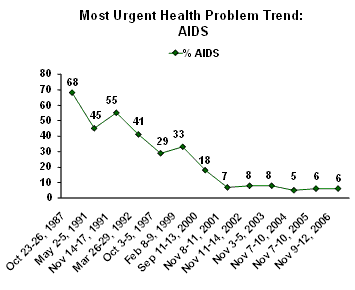
In fact, when Gallup first asked this most urgent health question in 1987, an overwhelming 68% of Americans said that AIDS was the nation's top health problem. This top-of-mind salience of AIDS as the most urgent health problem facing the nation has declined during the years since, to the point where just 6% of Americans mention AIDS in this year's poll.
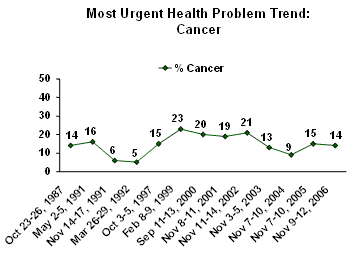
The percentage of Americans mentioning cancer as the top problem has fluctuated over the last two decades. It has never been the problem most likely to be mentioned, but in 1999, 2000, and 2002, 20% or more of Americans mentioned cancer as the country's most urgent health problem.
From time to time, other health issues have cropped up in the public's consciousness as measured by this question:
- In November 2001, as the nation focused on the seemingly random appearances of anthrax powder in various letters and post offices (and just two months after the Sept. 11 terrorist attacks), 22% of Americans said that bioterrorism was the most urgent health problem facing the nation. By the following year, however, bioterrorism dropped to just 1% of all mentions. This year, less than 1% of Americans mention bioterrorism.
- Last year, 10% of Americans mentioned the flu as the nation's top health problem, which corresponded with the news of a possible avian or bird flu pandemic. This year, only 1% of Americans mention flu as the country's most urgent health problem.
- Few Americans mentioned obesity as the country's most urgent health problem in Gallup surveys until recent years. By 2002, 7% of Americans named obesity as the most urgent problem, and 8% mention it this year.
- Heart disease is often named as the nation's leading cause of death, but only 3% of Americans say that it is the most urgent health problem facing the nation today. No more than 7% have mentioned heart disease during Gallup's history of asking this question.
Survey Methods
Results are based on telephone interviews with 1,004 national adults, aged 18 and older, conducted Nov. 9-12, 2006. For results based on the total sample of national adults, one can say with 95% confidence that the maximum margin of sampling error is ±3 percentage points. In addition to sampling error, question wording and practical difficulties in conducting surveys can introduce error or bias into the findings of public opinion polls.
What would you say is the most urgent health problem facing this country at the present time? [Open-ended]
|
(Cost) |
(Acc) |
(CA) |
(OB) |
(AI) |
(HD) |
(Flu) |
(A/D) |
(SM) |
(BIO) |
OTH |
DK |
|
|
% |
% |
% |
% |
% |
% |
% |
% |
% |
% |
% |
% |
|
|
2006 Nov 9-12 |
29 |
22 |
14 |
8 |
6 |
3 |
1 |
1 |
* |
* |
8 |
8 |
|
|
|
|
|
|
|
|
|
|
|
|
|
|
|
2005 Nov 7-10 |
25 |
17 |
15 |
9 |
6 |
4 |
10 |
1 |
1 |
* |
5 |
7 |
|
2004 Nov 7-10 |
29 |
29 |
9 |
7 |
5 |
2 |
2 |
* |
* |
* |
9 |
8 |
|
2003 Nov 3-5 |
27 |
25 |
13 |
7 |
8 |
3 |
* |
1 |
1 |
1 |
8 |
6 |
|
2002 Nov 11-14 |
25 |
14 |
21 |
7 |
8 |
5 |
1 |
* |
2 |
1 |
7 |
9 |
|
2001 Nov 8-11 |
14 |
8 |
19 |
4 |
7 |
6 |
1 |
1 |
1 |
22 |
9 |
8 |
|
2000 Sep 11-13 |
25 |
13 |
20 |
3 |
18 |
3 |
-- |
2 |
1 |
-- |
8 |
7 |
|
1999 Feb 8-9 |
13 |
1 |
23 |
1 |
33 |
5 |
-- |
2 |
3 |
-- |
13 |
6 |
|
1997 Oct 3-5 |
9 |
13 |
15 |
* |
29 |
3 |
-- |
6 |
2 |
-- |
18 |
5 |
|
1992 Mar 26-29 |
30 |
-- |
5 |
-- |
41 |
2 |
-- |
-- |
-- |
-- |
18 |
4 |
|
1991 Nov 14-17 |
20 |
-- |
6 |
-- |
55 |
2 |
-- |
-- |
-- |
-- |
14 |
3 |
|
1991 May 2-5 |
10 |
2 |
16 |
1 |
45 |
2 |
-- |
5 |
* |
-- |
15 |
4 |
|
1987 Oct 23-26 ^ |
1 |
-- |
14 |
3 |
68 |
7 |
-- |
4 |
1 |
-- |
8 |
3 |
|
^ Total adds to more than 100% due to multiple responses. |
||||||||||||
|
* Less than 0.5% |
||||||||||||
|
KEY: (Acc) Access to health care; (AI) AIDS; (BIO) Bioterrorism/Anthrax/Smallpox; (CA) Cancer; (Cost) Health care/insurance costs; (HD) Heart disease; (Flu) Flu; (SM) Smoking; (OB) Obesity; (A/D) Alcohol/Drug abuse; (OTH) Other; (DK) No opinion |
||||||||||||