GALLUP NEWS SERVICE
Princeton, NJ -- Those arguing for free-market approaches to poverty in Central America can be heartened by Gallup World Poll data indicating nearly half of residents in five of the region's countries have considered starting a business. At least 40% of the populations in Costa Rica, El Salvador, Guatemala, Honduras, and Nicaragua say they have at some point considered starting a business of their own.
However, the percentages who say they've considered starting a business that is formally registered according to the law in each country are all between 13% and 24%. The difference implies that about half of the prospective entrepreneurs in these countries are "lost" to the informal economy. Reliable estimates of informal-sector activity are rare, but a 2003 United Nations report put it at about 56% of total employment in Central America at the end of the 1990s.
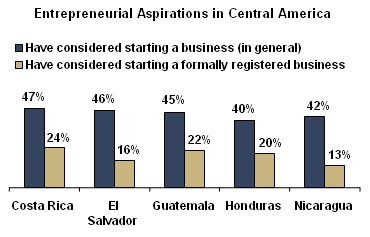
Why don't more of those who plan to start businesses consider formalizing the venture legally? For many Central Americans, the desire to start a business is driven by necessity -- i.e., by their lack of access to quality, well-paid jobs. Such entrepreneurial behavior tends to be different from that driven by a sense of opportunity, which is more likely to spring from a long-term plan that includes making the business a legal entity.
Barriers to Going Legit
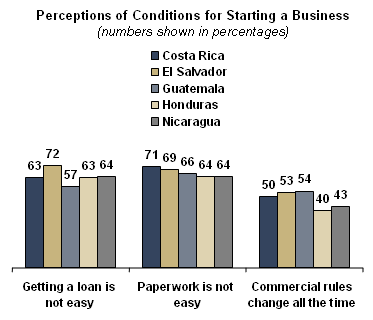
Regardless of their initial incentives, Central Americans are looking to free-market forces to take control of their economic destinies. In doing so, they perceive barriers -- including lack of access to capital and cumbersome paperwork -- that prevent them from becoming true business owners and creating long-term wealth.
Majorities in the total populations of each country say it is not easy for anyone who wants to start a business there to get a loan, presumably restricting many prospective entrepreneurs to small-scale operations consisting of themselves and their family members. Similarly, majorities across the board say the government in their country does not make access to the permits and completion of the necessary paperwork easy enough for those wishing to start formal businesses. Sizeable proportions in each country -- at least half in three of the five surveyed -- also say business owners there cannot feel confident that commercial rules and laws will not change at any given time.
Survey Methods
Results are based on face-to-face interviews conducted in 2006 with randomly selected national samples of approximately 1,000 adults, aged 15 and older who live permanently in the five Central American countries polled. For results based on these samples, one can say with 95% confidence that the maximum error attributable to sampling and other random effects is ±3 percentage points. In addition to sampling error, question wording and practical difficulties in conducting surveys can introduce error or bias into the findings of public opinion polls.