GALLUP NEWS SERVICE
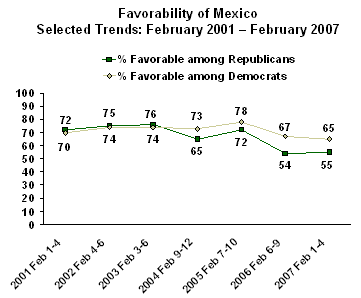
PRINCETON, NJ -- Gallup's Feb. 1-4 World Affairs poll finds Republicans and Democrats differ in their overall views of many nations around the world. Republicans are much more likely than Democrats to favorably rate Israel, Afghanistan, and Iraq, while Democrats are much more positive about France, Venezuela, and Mexico. Republicans' ratings of Iraq and Afghanistan have declined over the past year, and their ratings of Mexico have been lower over the past two years than at any other point since 2001. Ratings of France among Democrats are at their highest point since the Iraq war began, but are lower and have been relatively steady among Republicans in recent years. Republicans and Democrats show only modest variation in their views of North Korea and Iran.
Partisan Views of Nations
Republicans (including independents who lean toward the Republican Party) are much more likely than Democrats (including Democratic-leaning independents) to say they have a favorable opinion of Israel (73% vs. 58%), Afghanistan (30% vs. 19%), and Iraq (21% vs. 11%).
Democrats are more positive than Republicans in their views of France (69% vs. 40%), Venezuela (47% vs. 33%), and Mexico (65% vs. 55%). Democrats are slightly more likely than Republicans to rate Russia, Jordan, Syria, and Cuba favorably.
Even though the two party groups differ in their views of several countries around the world, Republicans and Democrats generally tend to agree in their overall rankings of countries. Additionally, the vast majority of Republicans and Democrats have favorable opinions of Australia, Canada, and Britain, and most have negative views toward Iran and North Korea.
|
Partisan Ratings of Countries
|
|||
|
|
|
Gap (Republicans minus Democrats) |
|
|
% |
% |
|
|
|
Israel |
73 |
58 |
+15 |
|
Afghanistan |
30 |
19 |
+11 |
|
Iraq |
21 |
11 |
+10 |
|
Pakistan |
30 |
26 |
+4 |
|
Turkey |
56 |
53 |
+3 |
|
Great Britain |
91 |
88 |
+3 |
|
Australia |
92 |
89 |
+3 |
|
Saudi Arabia |
37 |
36 |
+1 |
|
Japan |
85 |
84 |
+1 |
|
North Korea |
12 |
13 |
-1 |
|
India |
70 |
71 |
-1 |
|
Egypt |
60 |
62 |
-2 |
|
Germany |
83 |
85 |
-2 |
|
Brazil |
70 |
74 |
-4 |
|
Iran |
6 |
12 |
-6 |
|
The Palestinian Authority |
12 |
18 |
-6 |
|
China |
46 |
52 |
-6 |
|
Canada |
89 |
95 |
-6 |
|
Syria |
17 |
24 |
-7 |
|
Cuba |
21 |
28 |
-7 |
|
Jordan |
47 |
55 |
-8 |
|
Russia |
49 |
57 |
-8 |
|
Mexico |
55 |
65 |
-10 |
|
Venezuela |
33 |
47 |
-14 |
|
France |
40 |
69 |
-29 |
There has been much controversy about the threats North Korea and Iran pose to the United States in regard to the development of nuclear weapons in these countries. Given the seriousness of the potential threat these countries pose, it is not surprising that Republicans' and Democrats' ratings of these two countries are fairly similar. Majorities in both partisan groups view North Korea and Iran unfavorably.
Republican Favorites
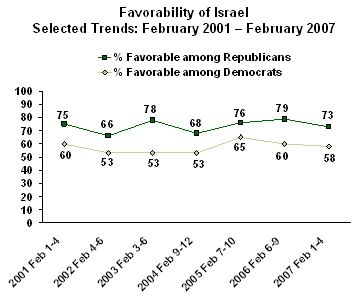
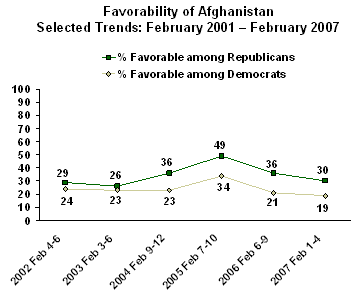
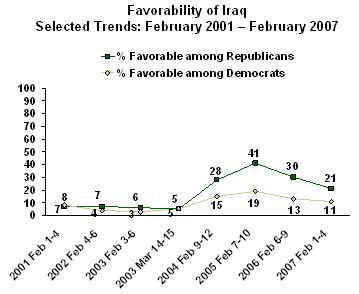
The latest poll finds Republicans rating Israel, Afghanistan, and Iraq more positively than do Democrats. But, has this always been the case? Here is a detailed look at the trends in favorability of these countries since 2001.
- Israel . Republicans have consistently been more positive than Democrats in their overall opinion of Israel since 2001. The largest partisan difference over this period occurred in 2003, about a month prior to the start of the Iraq war. At that time, 78% of Republicans and 53% of Democrats rated Israel favorably. The latest poll finds only a 15-point partisan gap, with ratings among Republicans at 73% and among Democrats at 58%.
- Afghanistan . Gallup found only slight variations in ratings of Afghanistan in 2002 and 2003 among Republicans and Democrats. Favorable ratings of the country increased among Republicans in 2004, but did not change among Democrats. In 2005, both Republicans' and Democrats' views of Afghanistan reached their highest point, at 49% and 34% respectively, but since then, views of the country have deteriorated among both groups.
- Iraq . Few Americans, less than 10%, rated Iraq favorably prior to the start of the war in Iraq in 2003. Then, after the war started, the percentage viewing Iraq favorably increased among both party groups, but much more so among Republicans. Views of Iraq reached their highest point in 2005, with 41% of Republicans and 19% of Democrats holding favorable opinions of the country. Republicans' and Democrats' ratings of Iraq have since declined.
Democratic Favorites
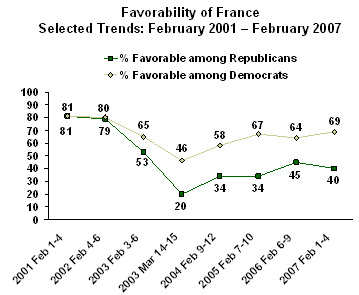
Democrats are much more positive than Republicans in their views of France, Venezuela, and Mexico. Partisan ratings of France and Mexico show some changes in recent years that are worth noting.
- France . Republicans' and Democrats' views of France were essentially no different in 2001 and 2002. However, favorable views of France dropped substantially among both groups in early 2003, but much more so among Republicans than Democrats. Among Democrats, France's favorable ratings reached a low of 46% in mid-March 2003, while ratings dropped all the way to 20% among Republicans. Since then, ratings of France have improved among both groups, but Democrats still rate the country more favorably than do Republicans. The latest 69% favorable rating among Democrats is the highest Gallup has measured since the Iraq war started, though this is not a statistically significant increase from ratings in recent years.
- Mexico . Gallup found essentially no difference between Republicans and Democrats in their ratings of Mexico from 2001 through 2003, and only modest variations in 2004 and 2005. Over the past two years, though, Republicans have become less likely to rate Mexico favorably. From 2001 through 2004, Republicans ratings of Mexico averaged 72%, and over the past two years, this average has only been 55%. Democrats' views of Mexico have been much more consistent over this period. Republicans' favorable views may have dropped because of their position on the immigration issue in recent years.
Gallup has only asked Americans to rate Venezuela once, that being in this latest poll. The partisan gap in opinions (33% of Republicans vs. 47% of Democrats) may be related to Venezuelan President Hugo Chavez's strong vocal opposition to President George W. Bush and his policies.
Survey Methods
Results are based on telephone interviews with 1,007 national adults, aged 18 and older, conducted Feb. 1-4, 2007. For results based on the total sample of national adults, one can say with 95% confidence that the maximum margin of sampling error is ±3 percentage points.
For results based on the sample of 410 Republicans or Republican leaners, the maximum margin of sampling error is ±5 percentage points.
For results based on the sample of 507 Democrats or Democratic leaners, the maximum margin of sampling error is ±5 percentage points.
In addition to sampling error, question wording and practical difficulties in conducting surveys can introduce error or bias into the findings of public opinion polls.