GALLUP NEWS SERVICE
PRINCETON, NJ -- On Saturday, President George W. Bush will hold his first meeting with Russian President Vladimir Putin in the small country of Slovenia, formerly part of Yugoslavia. The talks are expected to focus on Bush's stated intentions of building a missile defense system in the United States, in direct violation of the 1972 Anti-Ballistic Missile Treaty between the Soviet Union and the United States. Recent Gallup polls suggest that the general public holds a more favorable view of Russia than it did two years ago, during the fighting in Kosovo, when Russia's President Boris Yeltsin was one of the United States' severest critics. Polls also show that while Americans seem predisposed to support the concept of a missile defense system, their support wanes considerably when they hear arguments suggesting the system has not worked successfully.
According to a CNN/USA Today/Gallup poll, conducted June 8-10, Americans are more likely to consider Putin friendly than unfriendly to the United States, by 43% to 14%, while another 43% have no opinion. The friendly group includes 7% who say Putin is an ally, and another 36% who say he is a friend, but not an ally. The unfriendly group includes 5% who think Putin is an enemy, with the other 9% saying just unfriendly.
In Gallup's annual Foreign Relations Poll conducted in February of this year, just over half of Americans -- 52% -- said they had a favorable opinion of Russia, with 42% saying an unfavorable opinion. This represented a considerable improvement over the favorability ratings given Russia in 1999 and 2000, when Russia opposed U.S. and NATO troops fighting in Kosovo.
The chart below shows that since the end of the Cold War, ratings of Russia have been mostly a net positive, with the only net negative ratings occurring during the period when the United States led a NATO-backed force in Kosovo, in opposition to the Belgrade government. At the time, Yeltsin argued forcefully against the use of NATO forces in Kosovo and tended to support the Yugoslavian government under Slobodan Milosevic. After Putin succeeded Yeltsin in March, 2000, the Russian government was widely criticized for its continued fighting in Chechnya -- a Russian province that wants its independence. With both the war in Chechnya and the fighting in Kosovo no longer prominent in the news, Americans' favorability ratings of Russia have rebounded.
| American Public's Rating of Russia* 1989-2001 |
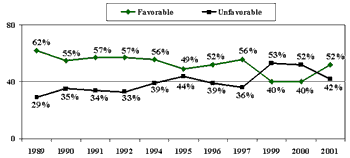 |
| * Average rating for each year |
Americans Wary of Missile Defense System
While Bush is presenting his arguments for a missile defense system to Putin and other European leaders, Americans appear uncertain about deploying such a system. A Gallup poll in February found that the public strongly favors the concept of a missile defense system, but when presented with information about the workability of the system, support falls off dramatically.
A CBS News/New York Times poll conducted in mid-May, 2000, asked respondents whether they would "favor or oppose the United States continuing to try to build this missile defense system against nuclear attack." By a margin of 58% to 28%, Americans supported the missile defense system. But then the CBS/NYT poll presented some negative information about the missile defense system to the supporters, and asked them if in light of these facts, they would still support the shield. The poll also presented opponents with an argument in favor of the missile shield to see if that would change their minds.
Once the supporters were told that the system had already cost $60 billion, about one in nine no longer expressed support, mostly indicating opposition. A recalculation of attitudes based on that one factor shows that after people are told the system costs $60 billion, there is still net support -- 47% to 35%.
After people are told, however, that many scientists say the system is unlikely to work, Americans oppose the system by more than a two-to-one margin -- 56% to 25%. Similarly, when told that building the system means the United States would have to break the arms control treaty it now has with Russia, 52% oppose the system and only 28% support it. Finally, if respondents believed the system had a good chance of working successfully, they would support it by an overwhelming margin of 71% to 12%.
In general, the public has not been paying a great deal of attention to this issue, and a CBS poll conducted this March showed that only about three in ten Americans were even aware that the United States does not currently have a defense against incoming ballistic missiles.
SurveyMethods
The most recent results reported here are based on telephone interviews with a randomly selected national sample of 1,011 adults, 18 years and older, conducted June 8-10, 2001. For results based on this sample, one can say with 95 percent confidence that the maximum error attributable to sampling and other random effects is plus or minus 3 percentage points. In addition to sampling error, question wording and practical difficulties in conducting surveys can introduce error or bias into the findings of public opinion polls.
Do you consider Russian president Vladimir Putin [Vlad-UH-meer POO-tin] to be -- an ally of the United States, friendly, but not an ally, unfriendly, an enemy of the United States, or don't you know enough to say?
|
|
|
|
|
Don't know enough |
|
|
|
2001 Jun 8-10 |
7 |
36 |
9 |
5 |
43 |
* |
