GALLUP NEWS SERVICE
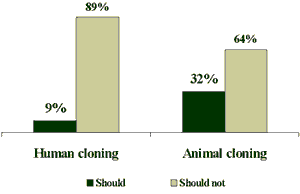
PRINCETON, NJ – Last week, the Bush administration announced its support for a new federal law that would make human cloning a federal crime. A recent Gallup poll shows that roughly nine in 10 Americans (89%) say that the cloning of humans -- if it becomes possible -- should not be allowed. While polling about human cloning shows widespread public opposition, Americans seem somewhat less opposed to the cloning of animals. A May 2001 Gallup poll shows that nearly two-thirds of Americans (64%) say the cloning of animals should not be allowed.
| Should Cloning Be Allowed? |
 |
Since Dolly the sheep was cloned in 1997, Americans have consistently denounced the notion of cloning as immoral. A February 1997 CNN/USA Today/Gallup poll found that 87% of Americans said if humans could ever be cloned, it would be a bad thing for humanity, and 88% said that human cloning would be morally wrong.
Although Americans appear to be very wary of human cloning, and at this point don't want it, a review of recent research on the topic suggests that Americans are not willing to overwhelmingly say that it should be banned forever, or that all research on it should be shut down.
- An NBC/Wall Street Journal poll in June 1999 asked the public if they favor or oppose an outright ban on the cloning of human beings and found that substantially fewer Americans (58%) support an outright ban than generally feel cloning should be outlawed.
- Another NBC/Wall Street Journal poll in mid-1999 asked about banning "medical research" on human cloning and found that 47% favored such a ban, but that 48% opposed it.
- A Penn, Shoen, and Berland Associates poll in the summer of 1998 asked Americans about the government's role in cloning and found that only a slight majority felt the government should ban human cloning forever, but one in four Americans (27%) felt the government should take a wait-and-see attitude on the issue, and 16% said the government should allow research on human cloning to continue.
Majority of Higher-Educated and Higher-Income Americans
Support Animal Cloning
The vast majority of Americans across several demographic subgroups oppose human cloning. However, Americans with the highest levels of education and income give majority support for the cloning of animals. Fifty-six percent of Americans with postgraduate education say that cloning of animals should be allowed, and a slight majority (52%) of Americans earning $75,000 and over support animal cloning. Support declines substantially among people of lower incomes and lower education levels, with only 19% of people with a high school diploma or less and 14% of people earning under $20,000 showing support for animal cloning.
While a majority of both men and women say they are opposed to animal cloning, men are much less likely to be opposed (53%) than are women (74%). Americans 65 and older are more likely than any other age group to oppose animal cloning -- 78% oppose it, while about six in 10 Americans below the age of 65 oppose it.
There is also a religious dimension to patterns of support for cloning, with non-religious Americans being far more supportive of animal cloning than are those who are more religious. In fact, a majority of Americans who say religion is "not very important" in their lives say that cloning of animals should be allowed. This drops to 40% among those who say religion is "fairly" important in their lives, and drops to only 22% among those who say religion is "very" important in their lives. By contrast, there are only minor differences among these groups with respect to support for human cloning, with more than 80% of the religious as well as the non-religious opposed to it.
Survey Methods
These results are based on telephone interviews with a randomly selected national sample of 1,012 adults, 18 years and older, conducted May 10-14, 2001. For results based on this sample, one can say with 95 percent confidence that the maximum error attributable to sampling and other random effects is plus or minus 3 percentage points. In addition to sampling error, question wording and practical difficulties in conducting surveys can introduce error or bias into the findings of public opinion polls.
Do you think the cloning of animals should or should not be
allowed?
|
Should |
Should not |
No opinion |
|
|
|
|||
|
2001 May 10-14 |
32% |
64 |
4 |
If it becomes possible, do you think the cloning of humans
should or should not be allowed?
|
Should |
Should not |
No opinion |
|
|
|
|||
|
2001 May 10-14 |
9% |
89 |
2 |
