GALLUP NEWS SERVICE
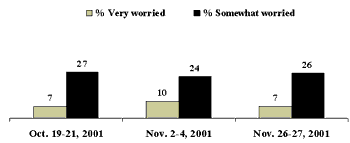
PRINCETON, NJ -- In recent days, news coverage of anthrax has resurfaced following the death of a Connecticut woman from inhalation anthrax and reports about a letter mailed to Senator Patrick Leahy that contained the bacteria. However, the public's concern about being exposed to anthrax has shown little change in recent weeks. The latest CNN/USA Today/Gallup poll, conducted Nov. 26-27, shows just 7% of Americans are "very worried" and 26% are "somewhat worried" that they will be exposed to anthrax. The level of concern is unchanged from polls conducted in October and early November, when 34% of Americans said they were worried about being exposed to anthrax.
| How worried are you that you or someone in your family will be exposed to anthrax -- very worried, somewhat worried, not too worried, or not worried at all? |
 |
Concern about anthrax exposure is low among all demographic groups, though women are more likely to express worry than are men. Four in 10 women are worried about being exposed, compared to 23% of men. Also, those with less formal education are more likely to be worried about exposure than are those with more education -- 44% of Americans with a high school education or less are worried compared to just 21% of those with a college degree. Even though most of the anthrax incidents have occurred in the Eastern part of the country, there is little difference in the level of concern about anthrax exposure between those residing in the East and those living in other parts of the country.
Public Not Especially Confident in Government's Ability to Protect Public From Anthrax
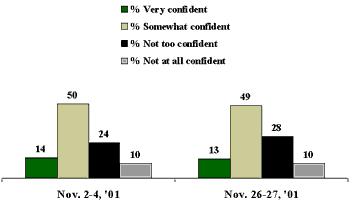
The poll shows that a majority, 62%, of Americans are confident in the government's ability to prevent additional people from being exposed to anthrax, but only 13% say they are "very confident." Thirty-eight percent of Americans say they are "not too" or "not at all confident." Again, these figures are little changed from earlier this month, when 64% were confident, including 14% who were very confident.
| How confident are you in the ability of the United States government to prevent additional people from being exposed to anthrax? Are you -- very confident, somewhat confident, not too confident, or not at all confident? |
 |
The public also expresses qualified confidence in the government's ability to apprehend those who have been involved in spreading the anthrax bacteria in the United States. Two-thirds of Americans say it is likely that the government will be able to identify and punish those responsible for the recent cases involving anthrax, but only 21% say this is "very likely" to happen.
Americans Slightly More Likely to Think Non-U.S. Citizens Responsible for Incidents
So far, legal authorities have not determined who is behind the anthrax cases. Speculation continues as to whether the mailings were part of a foreign-based terrorist plan, or the work of domestic terrorists unconnected with other countries. Americans are divided on the matter, with 40% believing the culprits are U.S. citizens and 48% believing they are not.
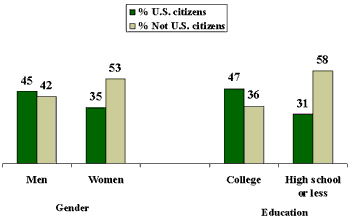
Men are slightly more likely to believe that U.S. citizens (45%) are responsible for the anthrax incidents rather than non-citizens (42%). Women, on the other hand, tend to believe that non-citizens are responsible, by a 53% to 35% margin. Differences also exist by education. A plurality of those with a college degree (47%) believe that U.S. citizens are responsible, while 36% believe non-citizens are. By a nearly two-to-one margin (58% to 31%), those with a high school education or less believe that foreign terrorists are responsible rather than domestic terrorists.
| Who do you think is responsible for most, if not all, of the recent cases involving anthrax -- U.S. citizens, or people who are not U.S. citizens? |
 |
| Nov. 26-27, ‘01 |
Survey Methods
These results are based on telephone interviews with a randomly selected national sample of 1,025 adults, 18 years and older, conducted Nov. 26-27, 2001. For results based on this sample, one can say with 95 percent confidence that the maximum error attributable to sampling and other random effects is plus or minus 3 percentage points. In addition to sampling error, question wording and practical difficulties in conducting surveys can introduce error or bias into the findings of public opinion polls.
Now thinking about another subject,
How worried are you that you or someone in your family will be exposed to anthrax -- very worried, somewhat worried, not too worried, or not worried at all?
|
|
|
|
Not |
ALREADY EXPOSED (vol.) |
|
||
|
% |
% |
% |
% |
% |
% |
||
|
2001 Nov 26-27 |
7 |
26 |
34 |
33 |
* |
* |
|
|
2001 Nov 2-4 ^ |
10 |
24 |
37 |
28 |
0 |
1 |
|
|
2001 Oct 19-21 |
7 |
27 |
35 |
31 |
0 |
* |
|
|
^ |
Based on half sample |
||||||
|
* |
Less than 0.5% |
||||||
|
(vol.) |
Volunteered response |
||||||
How confident are you in the ability of the United States government to prevent additional people from being exposed to anthrax? Are you -- very confident, somewhat confident, not too confident, or not at all confident?
|
Very |
Somewhat |
Not too |
Not at all |
No |
||
|
% |
% |
% |
% |
% |
||
|
2001 Nov 26-27 |
13 |
49 |
28 |
10 |
* |
|
|
2001 Nov 2-4 ^ |
14 |
50 |
24 |
10 |
2 |
|
|
^ |
Based on half sample |
|||||
|
* |
Less than 0.5% |
|||||
Who do you think is responsible for most, if not all, of the recent cases involving anthrax -- U.S. citizens, or people who are not U.S. citizens?
|
|
People who are not |
No |
|
|
2001 Nov 26-27 |
40% |
48 |
12 |
How likely is it that the U.S. government will be able to identify and punish the people responsible for the recent cases involving anthrax and bring them to justice -- very likely, somewhat likely, not too likely, or not at all likely?
|
Very |
Somewhat |
Not too |
Not at all |
No |
|
|
2001 Nov 26-27 |
21% |
45 |
28 |
6 |
* |
|
* Less than 0.5% |
|||||
