Dressing up babies in pink or blue may seem hopelessly outdated to many, but a recent Gallup Youth Survey* indicates that traditional gender roles among young people continue to manifest even in their use of modern technology.
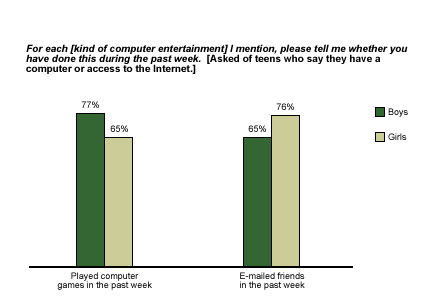
The survey found that 93% of teens said they have the opportunity to use the Internet, while 86% said they have a computer at home. Those figures are similar among teen boys and girls, but differences in how they use computers were detected when they were asked about specific forms of computer entertainment. The telephone poll suggests that boys are more likely to play computer games -- 77% of boys said they had done so in the past week, compared to 65% of girls. Those numbers are reversed when teens were asked about e-mailing friends; 76 % of girls said they had done so in the past week, compared to 65% of boys.
Part of the explanation for the difference may lie with the violent nature of many best-selling computer games. In a qualitative study of middle-school and high school girls conducted in 2000 by the American Association of University Women, several participants criticized the graphic violence in a number of popular games as being much more appealing to boys than to girls.
The idea that girls are less accepting of violence in video games is supported by a 1998 Gallup Youth Survey**, which found consistent differences between boys' and girls' attitudes toward media violence. For example, while less than half of boys surveyed (44%) agreed that "violence on television and in movies sends the wrong message to young people," more than six in 10 girls (62%) agreed with this statement. And while only three in 10 boys (32%) agreed that "there should be greater restrictions" on the number and type of movies and television programs that feature violence, sex, or bad language, more than half of girls (55%) held this view.
While the differences between the ways girls and boys use computers for entertainment aren't huge, they are significant and carry implications for the way software is developed for and marketed to teens. Such findings may also help address the apparent social bias that has many more boys than girls gravitating toward careers in computer technology.
* Results are based on telephone interviews with 454 teens, ages 13-17, conducted June - September 2001. For results based on this sample, one can say with 95% confidence that the margin of sampling error is +/- 5 percentage points.
** Results are based on telephone interviews with 500 teens, ages 13-17, conducted January - March 1998. For results based on this sample, one can say with 95% confidence that the margin of sampling error is +/- 5 percentage points.