GALLUP NEWS SERVICE
PRINCETON, NJ -- This year, scandals have rocked corporate boardrooms, Wall Street, accounting firms, the Catholic Church, and even Major League Baseball. A new CNN/USA Today/Gallup poll examines how much Americans trust people in general, and how much the public trusts those who belong to particular groups in society. Updating a long-term trend question on trust in others, the poll finds that a majority of Americans continue to be skeptical that most people can be trusted. At the same time, the level of trust in people is somewhat higher than it has been in the recent past. The poll also shows a wide variance in the types of people Americans trust, with business leaders and stockbrokers joining car dealers and HMO managers as the least trusted, while teachers are the most trusted. In the wake of the sexual abuse scandal, Catholic priests are much less likely to be trusted than Protestant ministers.
Four in 10 Americans Believe Most People Can Be Trusted
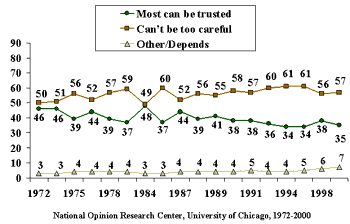
The poll, conducted July 5-8, shows that 41% of Americans say that "most people can be trusted," while 57% say "you can't be too careful in dealing with people." Comparing the current data to the long-standing trend data on this question from the General Social Survey, a regular study conducted by the National Opinion Research Center at the University of Chicago, there is a slight increase in trust from February 2000, at which time 35% said they trusted most people. The current 41% level of trust is high when compared to historical data from the General Social Survey. It has not been at this level since February 1989, and has not consistently been over 40% since before Watergate. However, the level of distrust has been fairly consistent -- around 60% for at least the past decade.
| Generally speaking, would you say that most people can be trusted or that you can't be too careful in dealing with people? |
 |
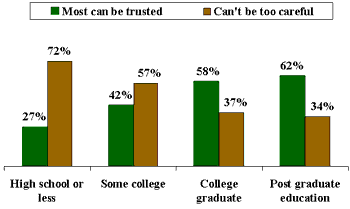
Gallup's data show some interesting demographic differences in trust. Most notably, those with greater levels of education express a much higher level of trust in people than do those with lower levels of education. Roughly six in 10 Americans with a college degree or above believe most people can be trusted, compared with 42% of those with some college education, and just 27% of those with a high school education or less.
| Public Trust: By Education Level |
 |
| July 5-8, 2002 |
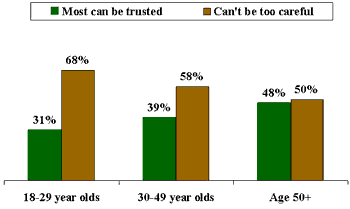
Older Americans tend to place more trust in people as well. Those above the age of 50 are nearly as likely to say that most people can be trusted as to say that you can't be too careful in dealing with people. Among those between the ages of 30-49, just four in 10 say they trust most people, and among those between the ages of 18-29 only three in 10 say this.
| Public Trust: By Age Group |
 |
| July 5-8, 2002 |
Trust in Big Business Relatively Low
The overall level of trust in people hides a great deal of variation in the trust Americans have in specific types of people. The poll asked the public to say whether most members in particular groups can be trusted, or if one can't be too careful in dealing with members of those groups. The results appear below.
SUMMARY TABLE: GROUPS THAT CAN BE TRUSTED
|
2002 Jul 5-8 |
Most can be trusted |
Can't be |
|
% |
% |
|
|
Teachers |
84 |
15 |
|
Middle class people |
75 |
21 |
|
People who run small businesses |
75 |
22 |
|
Military officers |
73 |
24 |
|
Police officers |
71 |
26 |
|
Coaches of youth sports |
68 |
28 |
|
Poor people |
67 |
28 |
|
Protestant ministers |
66 |
26 |
|
Doctors |
66 |
31 |
|
Accountants |
51 |
44 |
|
Professional athletes |
48 |
45 |
|
Catholic priests |
45 |
48 |
|
Rich people |
43 |
51 |
|
Journalists |
38 |
58 |
|
Government officials |
26 |
69 |
|
Lawyers |
25 |
70 |
|
Stockbrokers |
23 |
68 |
|
CEOs of large corporations |
23 |
73 |
|
Managers of HMOs |
20 |
72 |
|
Car dealers |
15 |
81 |
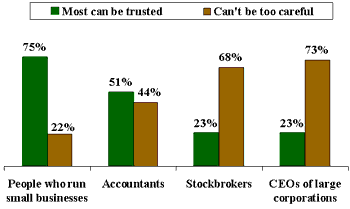
Clearly, the recent wave of corporate scandals has done little to engender faith in the executives of large companies. Only 23% of Americans say that CEOs of large corporations can be trusted, while 73% say you cannot be too careful in dealing with them. Stockbrokers are viewed similarly, with only 23% of the public saying you can trust most of them. Car dealers (at 15%) and managers of HMOs (at 20%) are the only two groups tested that rank lower than CEOs and stockbrokers.
Relatively speaking, accountants perform well. Despite the fact that accounting irregularities are at the heart of some of the recent business scandals, 51% of Americans say most accountants can be trusted. And it is clear the lack of trust in CEOs does not extend to all business managers. Three out of four Americans say that most people who run small businesses can be trusted.
| Public Trust in Business Professions |
 |
| July 5-8, 2002 |
Americans are far less likely to say they trust most "rich people" (43%) than to say they trust "poor people" (67%) or "middle class people" (75%).
Among the groups tested, teachers are the most trusted group -- 84% of Americans say most teachers can be trusted. Military officers (73%), police officers (71%), coaches of youth sports (68%) and doctors (66%) are also accorded high levels of trust by the public. In addition to car dealers and HMO managers, lawyers (25%), government officials (26%), and journalists (38%) rank low on the trust measure. The public is divided as to whether most professional athletes can be trusted, with 48% believing they can and 45% being less trustful. This mixed opinion about professional athletes may reflect recent allegations that many Major League Baseball players use performance-enhancing drugs.
Catholic Priests Not Given a High Level of Trust
The poll shows a gap in the level of trust Americans place in religious clergy. Sixty-six percent of Americans say most Protestant ministers can be trusted, but the level of trust in Catholic priests is just 45%. Forty-eight percent of Americans say that you cannot be too careful in dealing with priests. This is most likely due to the problem of sexual abuse of young people by priests that has plagued the Catholic Church this year.
Survey Methods
These results are based on telephone interviews with a randomly selected national sample of 1,013 adults, 18 years and older, conducted July 5-8, 2002. For results based on this sample, one can say with 95 percent confidence that the maximum error attributable to sampling and other random effects is plus or minus 3 percentage points. In addition to sampling error, question wording and practical difficulties in conducting surveys can introduce error or bias into the findings of public opinion polls.
Generally speaking, would you say that most people can be trusted or that you can't be too careful in dealing with people?
|
|
Most can be trusted |
Can't be |
OTHER/DEPENDS |
No |
|
% |
% |
% |
% |
|
|
2002 Jul 5-8 |
41 |
57 |
1 |
1 |
|
National Opinion Research Center, University of Chicago |
||||
|
2000 Feb |
35 |
57 |
7 |
1 |
|
1998 Feb |
38 |
56 |
6 |
* |
|
1996 Feb |
34 |
61 |
5 |
* |
|
1994 Jan |
34 |
61 |
4 |
* |
|
1993 Feb |
36 |
60 |
4 |
-- |
|
1991 Feb |
38 |
57 |
5 |
-- |
|
1990 Feb |
38 |
58 |
4 |
-- |
|
1989 Feb |
41 |
55 |
4 |
-- |
|
1988 Feb |
39 |
56 |
4 |
1 |
|
1987 Feb |
44 |
52 |
4 |
-- |
|
1986 Feb |
37 |
60 |
3 |
-- |
|
1984 Feb |
48 |
49 |
3 |
-- |
|
1983 Feb |
37 |
59 |
4 |
* |
|
1978 Feb |
39 |
57 |
4 |
-- |
|
1976 Feb |
44 |
52 |
4 |
-- |
|
1975 Feb |
39 |
56 |
4 |
* |
|
1973 Feb |
46 |
51 |
3 |
-- |
|
1972 Feb |
46 |
50 |
3 |
1 |
For each of the following groups, please tell me whether most of the people in them can be trusted or that you can't be too careful in dealing with them? How about -- [RANDOM ORDER]?
ITEMS A-I: BASED ON --509-- NATIONAL ADULTS IN FORM A
ITEMS J-K: BASED ON FULL SAMPLE
ITEMS L-T: BASED ON --504-- NATIONAL ADULTS IN FORM B
A. Accountants
|
|
Most can be trusted |
Can't be |
OTHER/DEPENDS |
No |
|
2002 Jul 5-8 |
51% |
44 |
2 |
3 |
B. CEOs of large corporations
|
|
Most can be trusted |
Can't be |
OTHER/DEPENDS |
No |
|
2002 Jul 5-8 |
23% |
73 |
2 |
2 |
C. Catholic priests
|
|
Most can be trusted |
Can't be |
OTHER/DEPENDS |
No |
|
2002 Jul 5-8 |
45% |
48 |
2 |
5 |
D. Doctors
|
|
Most can be trusted |
Can't be |
OTHER/DEPENDS |
No |
|
2002 Jul 5-8 |
66% |
31 |
2 |
1 |
E. Managers of Health Maintenance Organizations, or HMOs
|
|
Most can be trusted |
Can't be |
OTHER/DEPENDS |
No |
|
2002 Jul 5-8 |
20% |
72 |
3 |
5 |
F. Police officers
|
|
Most can be trusted |
Can't be |
OTHER/DEPENDS |
No |
|
2002 Jul 5-8 |
71% |
26 |
2 |
1 |
-
- Poor People
Most can be trusted
Can't be
too carefulOTHER/DEPENDS
(vol.)No
opinion2002 Jul 5-8
67%
28
3
2
- Rich people
-
Most can be trusted
Can't be
too carefulOTHER/DEPENDS
(vol.)No
opinion2002 Jul 5-8
43%
51
2
4
- Middle class people
|
|
Most can be trusted |
Can't be |
OTHER/DEPENDS |
No |
|
2002 Jul 5-8 |
75% |
21 |
3 |
1 |
J. Car dealers
|
|
Most can be trusted |
Can't be |
OTHER/DEPENDS |
No |
|
2002 Jul 5-8 |
15% |
81 |
2 |
2 |
K. People who run small businesses
|
|
Most can be trusted |
Can't be |
OTHER/DEPENDS |
No |
|
2002 Jul 5-8 |
75% |
22 |
2 |
1 |
L. Professional athletes
|
|
Most can be trusted |
Can't be |
OTHER/DEPENDS |
No |
|
2002 Jul 5-8 |
48% |
45 |
3 |
4 |
M. Protestant ministers
|
|
Most can be trusted |
Can't be |
OTHER/DEPENDS |
No |
|
2002 Jul 5-8 |
66% |
26 |
2 |
6 |
N. Military officers
|
|
Most can be trusted |
Can't be |
OTHER/DEPENDS |
No |
|
2002 Jul 5-8 |
73% |
24 |
1 |
2 |
O. Lawyers
|
|
Most can be trusted |
Can't be |
OTHER/DEPENDS |
No |
|
2002 Jul 5-8 |
25% |
70 |
3 |
2 |
P. Coaches of youth sports
|
|
Most can be trusted |
Can't be |
OTHER/DEPENDS |
No |
|
2002 Jul 5-8 |
68% |
28 |
1 |
3 |
Q. Government officials
|
|
Most can be trusted |
Can't be |
OTHER/DEPENDS |
No |
|
2002 Jul 5-8 |
26% |
69 |
3 |
2 |
R. Journalists
|
|
Most can be trusted |
Can't be |
OTHER/DEPENDS |
No |
|
2002 Jul 5-8 |
38% |
58 |
2 |
2 |
S. Stockbrokers
|
|
Most can be trusted |
Can't be |
OTHER/DEPENDS |
No |
|
2002 Jul 5-8 |
23% |
68 |
2 |
7 |
T. Teachers
|
|
Most can be trusted |
Can't be |
OTHER/DEPENDS |
No |
|
2002 Jul 5-8 |
84% |
15 |
* |
1 |
* -- Less than 0.5%