GALLUP NEWS SERVICE
PRINCETON, NJ -- The issue of society's reaction to formalized unions between gay and lesbian partners was thrust back into the news this past week when The New York Times said it will begin to publish announcements of same-sex commitment ceremonies next month along with its traditional wedding announcements.
Major Conclusions
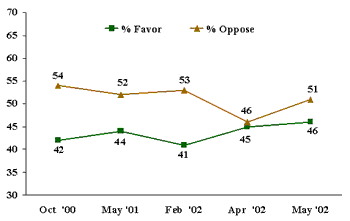
The new policy, as The Times acknowledged, hits squarely in the middle of one of the more controversial areas of American public opinion. There is no overwhelming consensus on either side of the issue among the American public. In the latest Gallup poll on this subject, conducted in May, 46% of those interviewed favored the idea of allowing homosexual couples to form civil unions with some of the legal rights enjoyed by married couples, while 51% opposed the idea. The gap had been as wide as 12 percentage points in October 2000.
Americans are more clearly opposed to the concept of full-fledged marriage, with all of the associated rights, for homosexual couples. Gallup's last reading on this, from January 2000, found only 34% of Americans in favor of this, while 62% were opposed.
There are predictable differences in opinion on the issue of same-sex unions by political party and ideology. The strongest demographic difference occurs by age, with younger Americans much more in favor than older Americans.
Details
- Since Gallup first asked the public a question about homosexual "civil unions, giving them some of the legal rights of married couples" in October 2000, Americans have been somewhat more likely to be opposed than in favor. The October 2000 poll found 54% of respondents opposed to homosexual civil unions, while 42% supported them. Gallup found similar results in May 2001 and February 2002. An April 2002 poll showed an increase in support, but in the most recent May 2002 Gallup poll, opposition has gone up again by a slight margin, to the point at which 51% are in favor, with 46% opposed.
| Would you favor or oppose a law that would allow homosexual couples to legally form civil unions, giving them some of the legal rights of married couples? |
 |
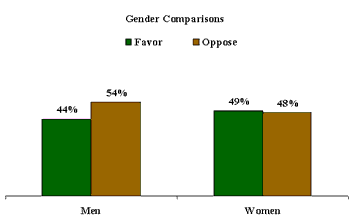
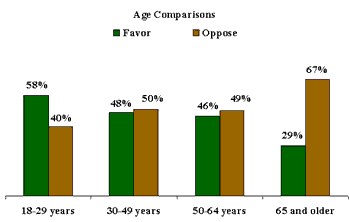
- Men are slightly more likely than women to oppose homosexual civil unions, by a margin of 54% to 48%. But a bigger distinction is seen in terms of age. Older Americans are much less likely to support same-sex unions than are younger generations. Two-thirds of adults aged 65 and older oppose homosexual civil unions, compared to roughly half of all adults in the 30 to 49 and 50 to 64 age categories, and only four in 10 adults aged 18 to 29.
| Would you favor or oppose a law that would allow homosexual couples to legally form civil unions, giving them some of the legal rights of married couples? |
 |
| May 6-9, 2002 |
| Would you favor or oppose a law that would allow homosexual couples to legally form civil unions, giving them some of the legal rights of married couples? |
 |
| May 6-9, 2002 |
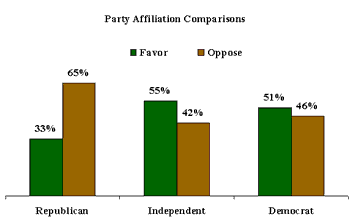
- Nearly two-thirds of Republicans oppose same-sex civil unions, compared to fewer than half of Democrats. There are similar distinctions in the views of conservatives and liberals.
| Would you favor or oppose a law that would allow homosexual couples to legally form civil unions, giving them some of the legal rights of married couples? |
 |
| May 6-9, 2002 |
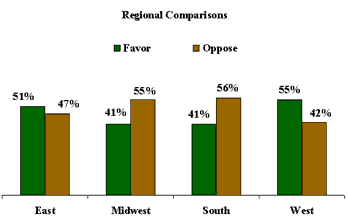
- Adults living in the eastern and western regions of the United States are more likely to support homosexual civil unions than are people living in the middle of the country. Over half of those living in the East (51%) and the West (55%) favor same-sex unions, while only about four in 10 people living in the Midwest and South favor them.
| Would you favor or oppose a law that would allow homosexual couples to legally form civil unions, giving them some of the legal rights of married couples? |
 |
| May 6-9, 2002 |
- There is a strong relationship between religiosity and support for homosexual civil unions. Seven in 10 of those who attend church weekly are opposed to civil unions between same-sex couples. Only one-third of adults who go to church infrequently oppose them.
|
Demographics for Support/Opposition to Homosexual Civil Unions |
|||
|
2002 May 6-9 |
Favor |
Oppose |
No opinion |
|
% |
% |
% |
|
|
Gender |
|||
|
Men |
44 |
54 |
2 |
|
Women |
49 |
48 |
3 |
|
Age |
|||
|
18- to 29-year-olds |
58 |
40 |
2 |
|
30- to 49-year-olds |
48 |
50 |
2 |
|
50- to 64-year-olds |
46 |
49 |
5 |
|
65 years and older |
29 |
67 |
4 |
|
Gender/Age |
|||
|
Men, 18-49 |
48 |
51 |
1 |
|
Men, 50+ |
36 |
60 |
4 |
|
Women, 18-49 |
55 |
43 |
2 |
|
Women, 50+ |
39 |
56 |
5 |
|
Region |
|||
|
East |
51 |
47 |
2 |
|
Midwest |
41 |
55 |
4 |
|
South |
41 |
56 |
3 |
|
West |
55 |
42 |
3 |
|
Party Affiliation |
|||
|
Republican |
33 |
65 |
2 |
|
Independent |
55 |
42 |
3 |
|
Democrat |
51 |
46 |
3 |
|
Ideology |
|||
|
Conservatives |
29 |
69 |
2 |
|
Moderates |
56 |
41 |
3 |
|
Liberals |
67 |
30 |
3 |
|
Church Attendance |
|||
|
Weekly |
26 |
70 |
4 |
|
Nearly weekly |
41 |
57 |
2 |
|
Less often |
64 |
34 |
2 |
|
Education |
|||
|
Post-graduate |
55 |
43 |
2 |
|
College graduate only |
53 |
46 |
1 |
|
Some college |
45 |
52 |
3 |
|
High school or less |
43 |
54 |
3 |
- Gallup first asked Americans in 1996 if "marriages between homosexuals should or should not be recognized by the law as valid, with the same rights as traditional marriages." About one-quarter of respondents said yes to the "marriage" question. Gallup re-asked this question in 1999 and 2000 and found only a slight increase in the percentage of Americans who favored the concept of an officially sanctioned same-sex marriage.
Implications
No more than half of Americans accept the concept of legalized homosexual unions. Although the exact percentages have varied over the last two years, the concept is generally opposed by slightly more Americans than favored.
Our analysis shows, however, that there are very significant variations in support for the concept within demographic, political and regional groups. These differences are relevant to the New York Times situation, given that the paper's readership can generally be considered to be skewed toward the East Coast and toward those with higher educational levels, both characteristics associated with more acceptance of gay and lesbian unions. The conventional wisdom, additionally, assumes that the readers of The Times may be more Democratic and liberal than the average American. If that is indeed the case, then it is clear from the analysis presented here that the paper's readers will be generally more supportive of the new policy than others across the country.
One of the interesting findings in these data is the sharp variation in acceptance of legalized civil unions by age. Clearly the oldest groups of Americans -- those ages 65 and older -- are strongly against the concept. But almost six out of 10 of those who are aged 18 to 29 are in favor. It is difficult to know whether these types of age variations result from specific cohort effects that will not necessarily affect groups of younger Americans who come of age in the decades ahead, or if they represent a cultural shift that will be reflected more and more strongly as the years move on.
Survey Methods
The results below are based on telephone interviews with a randomly selected national sample of 1,012 adults, aged 18 and older, conducted May 6-9, 2002. For results based on this sample, one can say with 95% confidence that the maximum error attributable to sampling and other random effects is ±3 percentage points. In addition to sampling error, question wording and practical difficulties in conducting surveys can introduce error or bias into the findings of public opinion polls.
Would you favor or oppose a law that would allow homosexual couples to legally form civil unions, giving them some of the legal rights of married couples?
|
Favor |
Oppose |
No opinion |
||
|
% |
% |
% |
||
|
2002 May 6-9 |
46 |
51 |
3 |
|
|
2002 Apr 8-11 |
45 |
46 |
9 |
|
|
2002 Feb 8-10 |
41 |
53 |
6 |
|
|
2001 May 10-14 |
44 |
52 |
4 |
|
|
2000 Oct 25-28 ^ |
42 |
54 |
4 |
|
|
^ |
WORDING: Suppose that on election day this year you could vote on key issues as well as candidates. Please tell me whether you would vote for or against each one of the following propositions. Would you vote -- [RANDOM ORDER]? (For or against a law that would allow homosexual couples to legally form civil unions, giving them some of the legal rights of married couples) |
|||
Do you think marriages between homosexuals should or should not be recognized by the law as valid, with the same rights as traditional marriages?
[BASED ON --514-- NATIONAL ADULTS IN FORM A]
|
Should |
Should not be recognized |
No |
|
|
2000 Jan 13-16 |
34% |
62 |
4 |
|
1999 Feb 8-9 |
35% |
62 |
3 |
|
1996 Mar 15-17 |
27% |
68 |
5 |
Do you think gay partners who make a legal commitment to each other should or should not be entitled to the same rights and benefits as couples in traditional marriages?
[BASED ON --513-- NATIONAL ADULTS IN FORM B]
|
Should |
Should not |
|
|
|
2000 Jan 13-16 |
40% |
53 |
7 |
