This is 12th in a series exploring the 12 items that best measure congregational engagement.
People expect to learn and grow when they join congregations. And for the most part, congregations seem to be doing a good job at offering growth opportunities: in a 2001 Gallup survey*, six out of 10 (61%) members of U.S. congregations strongly agreed with that statement, "In my congregation, I have opportunities to learn and grow."
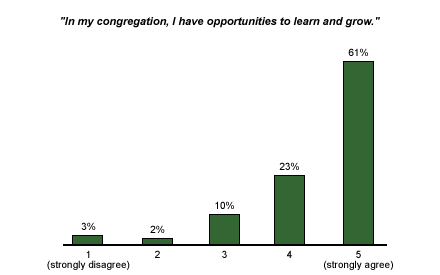
There is an apparent relationship between the opportunity to learn and grow and the likelihood that congregation members will be inclined to reach out and serve their communities. According to Gallup's research, 66% of those who donate two or more hours per week to their communities also strongly agree that they have opportunities to learn and grow in their congregations. Leaders who want to encourage community outreach among their members would do well to start by focusing on providing growth opportunities.
Key Points for Spiritual Leaders
- "Opportunities to learn and grow" means different things to different people. Each member of your congregation will define this phrase differently. Some want to learn from challenging and powerful sermons or homilies. Some want short-term classes on subjects that interest them. Others want to participate in small groups on a long-term basis for support and study. Others want in-depth Bible studies led by the pastor/priest/rabbi. Still others want opportunities to serve the poor in their communities. Whether you serve a congregation of several hundred or several thousand, a broad variety of opportunities should be presented to meet the needs and desires of your members.
- Whose responsibility is it to find and create opportunities for learning and growing? It is your members' responsibility -- and yours. As a spiritual leader, it is part of your job to create the kind of environment in which your members can learn and grow. It is also your responsibility to provide a wide range of learning options. It is your members' responsibility to select from those options, and to track their growth.
- The fact that opportunities are offered does not mean everyone is taking advantage of them. Accurate record keeping can help you see whether your members are taking advantage of the opportunities offered. It is also important to follow up with each of your members on his or her progress (see "In the Last Six Months, Someone in My Congregation Has Talked to Me About the Progress of My Spiritual Growth" in Related Items.) With systems and processes in place to check the progress of members' spiritual growth, you can see how well they are taking advantage of the learning opportunities offered. You will also begin to see, through follow-up and record-keeping, which opportunities seem to be attracting the most people and having the most impact. This will help you decide which types of learning and growth opportunities would be most effective within your congregation.
The SE25 are protected by copyright of The Gallup Organization, Princeton, NJ, 2001.
*Results are based on telephone interviews with 729 adult members of a church, synagogue, or other religious faith community, aged 18 and older, conducted October through November 2001. For results based on this sample, one can say with 95% confidence that the margin of sampling error is ±3.6%.
