The G-7 finance ministers met in Washington, D.C., last weekend to prepare for the International Monetary Fund (IMF) and World Bank meetings. Among their worries are: the world's plunging stock markets, the debt crisis in Latin America, the inability of the world's second-largest economy -- Japan -- to grow, the potential for renewed recession on a global scale and the probable war with Iraq. New investor sentiment data suggest that if they haven't already, the world's finance ministers should add plummeting investor confidence in Europe to their list of concerns.
EU5 Investors Turn Pessimistic
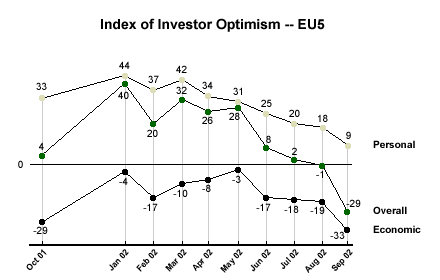
European investor sentiment turned decidedly pessimistic in September, according to the Index of Investor Optimism -- EU5, a joint effort of UBS and The Gallup Organization to measure investor sentiment in five key European nations*. The EU5 Index is now at -24 -- down 23 points from its essentially neutral stance in August (-1). The September reading is the EU5 Index's most negative measurement since its baseline was established at +4 in October 2001.
Overall, the EU5 Index turned substantially negative (net pessimistic), but although the Personal Dimension of the Index also decreased, it remained positive at +9. The Personal Dimension hit its 10-month high of +44 last January. By August, it had declined to +18 before falling another nine points in September. Not great news, but at least EU5 investor perceptions along the Personal Dimension remain in net optimistic territory.
The Economic Dimension of the EU5 Index is the reason EU5 investors are currently net pessimistic. The Economic Dimension plunged 14 points this month -- going from -19 in August to -33 in September. European investor sentiment toward the economy is now more negative than it was about a year ago, when investors rated this dimension a -29. EU5 investors have become very negative about the prospects for the European economy in the months ahead.
Older EU5 Investors Are More Pessimistic
European investors of both genders are about equally as pessimistic. The overall September EU5 Index figures were -22 for male investors and -25 for female investors.
On the other hand, younger European investors are much less pessimistic than their older counterparts. The September overall EU5 Index for investors 40 years and older was -34. In sharp contrast, the EU5 Index for investors under age 40 was +1, meaning that younger EU5 investors remain virtually neutral -- neither net optimistic nor net pessimistic.
Key Points
Investor confidence is in pretty bad shape around the world as we enter the fourth quarter of 2002. In the United States, investor optimism has stabilized at very low levels during the past couple of months, as many investors continue to worry about the validity of today's corporate accounting and reporting (see "Is the Fed Listening to Investors?" in Related Items). At the same time, European investor sentiment has become decidedly pessimistic. New data show that the potential for war with Iraq has added significantly to EU5 investors' concerns about the future of the European economy (see "Tensions With Iraq Alarm European Investors" in Related Items).
This is an extremely dangerous situation for the worldwide economy. Four out of 10 investors in Europe say that the stock market's weak performance over the past couple of years has permanently changed the amount of money they will invest in equities. And nearly nine out of 10 of these investors (86%) say this means they will reduce their stock market investments. With so many investors pulling their money out of the world's equity markets, it is hard to see how any country can build economic momentum. Corporate executives are not likely to make major new capital investments to grow their businesses. New entrepreneurs are not going to be able get venture capital funding, and the corporate credit crunch is likely to get worse.
The world's finance ministers are currently focusing on some important issues. Setting up a way for countries facing a debt crisis to enter a negotiated bankruptcy process is essential. Anticipating the potential worldwide economic impacts of a war with Iraq is another vital issue. Still, it would be a big mistake for the world's economic policy-makers to ignore the current crisis of confidence in the investor community. Unfortunately, at least for the immediate future, that appears to be their plan.
*Results for the Index of Investor Optimism -- EU5 are based on interviews with approximately 200 investors each in France, Germany, Great Britain, Italy, and Spain conducted Sept. 1-15, 2002. For results based on a total sample of approximately 1,000 investors, one can say with 95% confidence that the margin of sampling error is ±3%. In addition to sampling error, question wording and practical difficulties in conducting surveys can introduce error or bias into the findings of public opinion polls.