What role does religion play in the world today? Do people attend religious services on a regular basis? Gallup data collected in the United States, Canada and Great Britain suggest that at least in these countries, a majority do not. Most people affiliate themselves with a particular religious group, but attending religious services is often not a priority.
Church Attendance
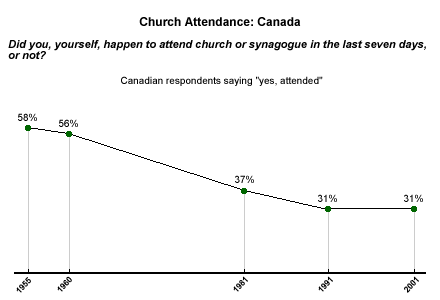
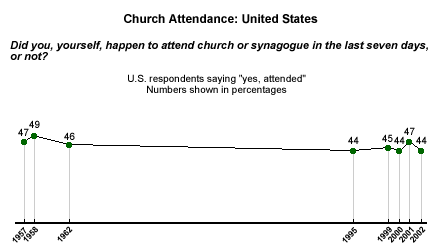
While a majority of Americans affiliate themselves with an organized religion, less than half (44%) said that they attended church or synagogue in the past week in a March 2002 survey*. In May 2001**, less than a third of Canadians (31%) said they attended a place of worship in the past seven days.
While the religious service attendance numbers have remained fairly consistent over the past several decades in the United States, the number of Canadians saying they attended services in the past seven days has dropped dramatically from 50 years ago; 58% of Canadians responded affirmatively to this question in 1955.
In the United States and Great Britain, respondents were also asked how often they attend church. In an Oct. 3-6 survey***, 31% of Americans said they attend church or synagogue at least once a week (12% say they attend almost every week), while in a 1999 survey****, 12% of British residents said they attend church more or less every Sunday. (The difference between the British and American responses could be partially explained by question wording: the British question only asked about church attendance, and did not mention other types of religious institutions.)
Slightly more than a quarter (28%) of Americans report that they "seldom" attend church or synagogue; while 16% say they "never" attend. In Britain, 25% of residents said they only attend church for christenings, funerals and weddings, while 17% said they very seldom or never attend.
Regional Differences
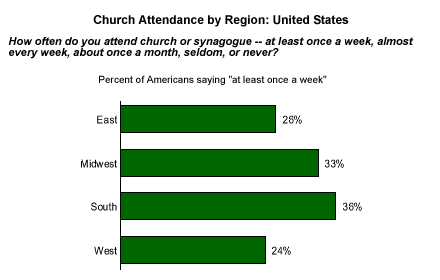
In the United States, residents of the traditional "Bible Belt" areas, the South (36%) and the Midwest (33%), are more likely than Easterners (26%) or Westerners (24%) to say they attend services once a week.
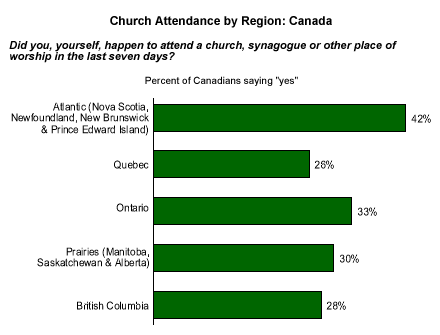
Regarding regional differences in church attendance in Canada, residents of the Atlantic provinces (42%) are the most likely to say that they have attended a place of worship in the last seven days, while residents of Quebec (26%) are the least likely.
Church Attendance Passé With Today's Youth?
In all three countries, older residents are much more likely to attend religious services than are their younger counterparts. Nearly twice as many Americans aged 65 and older attend church or synagogue at least once a week as those between the ages of 18 and 29 -- 46% to 24%, respectively.
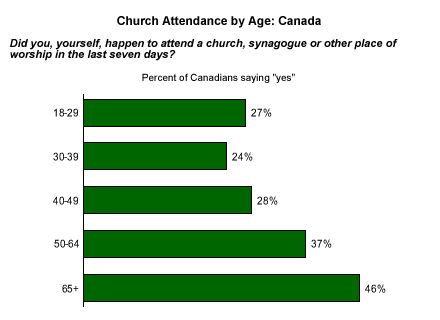
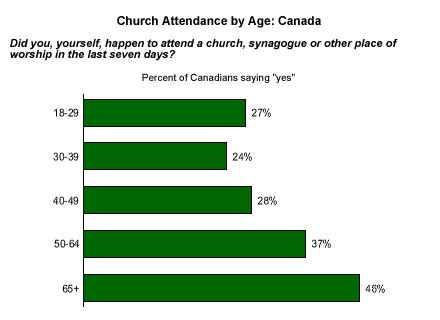
In Canada, 46% of senior citizens aged 65 and older have attended religious services in the past week, compared to 37% of those between 50 and 64, and about a quarter for each of the younger age categories.
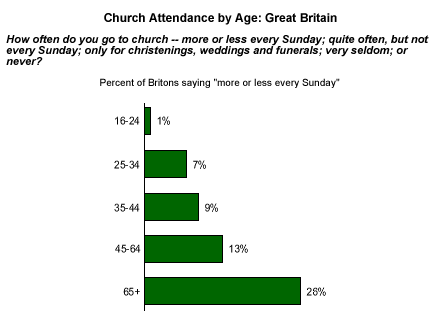
While a quarter of senior citizens in Great Britain said they attend church more or less every Sunday, only 1% of people aged 16 to 24 claimed the same.
Key Points
Attending religious services is not a consistent habit for the majority of citizens in three of the most developed countries in the world. Al Winseman, D.Min., Gallup's Global Practice Leader for Faith Communities, suggests this downward trend may be connected to a "failure of uniting movements." He observes, "The United Church of Canada has brought together most of the traditionally ‘mainline' denominations into one ‘super denomination' and attendance has declined in the past 50 years. And while attendance has remained fairly steady in the United States over that time, the denominations in the United States that have gone through mergers [the Methodist Church and the Evangelical United Brethren merged in 1968 to become the United Methodist Church] have declined -- it is the emergence of new independent congregations and new denominational movements that have gained. Diversity is a strength, not a weakness, of religious expression."
*Results are based on telephone interviews with 1,009 U.S. adults, aged 18 and older, conducted March 18-20, 2002. For results based on the total sample of national adults, one can say with 95% confidence that the maximum margin of sampling error is ±3%.
**Results are based on telephone interviews with 1,017 Canadian adults, aged 18 and older, conducted May 24-30, 2001. For results based on the total sample of national adults, one can say with 95% confidence that the maximum margin of sampling error is ±3%.
***Results are based on telephone interviews with 1,502 U.S. adults, aged 18 and older, conducted Oct. 3-6, 2002. For results based on the total sample of national adults, one can say with 95% confidence that the maximum margin of sampling error is ±3%.
****Results are based on telephone interviews with 1,013 British adults, conducted Nov. 11-18, 1999. For results based on the total sample of national adults, one can say with 95% confidence that the maximum margin of sampling error is ±4%.
