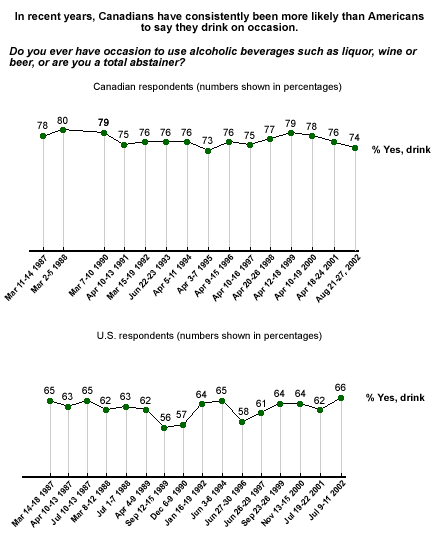
While residents on either side of the border enjoy tipping back a few drinks, Canadians are slightly more likely to say they do so than Americans. A majority in both countries says they indulge in alcohol consumption. A full two-thirds (66%) of Americans recently told Gallup* that they "have occasion to use alcoholic beverages such as liquor, wine or beer …." On the other hand, about a third (34%) of Americans insist that they are "total abstainers" when it comes to alcohol. Almost three-quarters (74%) of Canadians** drink alcohol, while the other quarter say they are total abstainers.
This trend has fluctuated over the years in the United States since Gallup first began asking the question more than 50 years ago. In Canada, however, the number of people who say they drink alcohol has steadily increased. In 1939, 58% of Americans admitted to drinking alcohol -- a figure almost identical to the percentage of Canadians who reported drinking alcohol in 1943 (59%). But over the last few decades, Canadians have consistently tippled more than Americans. Since the mid-1970s, at least three-quarters of Canadians have reported that they drink alcohol. Canadian drinking rates increased during the economic boom times of the 1980s, reaching 82% in 1985. In the United States, drinking did not increase at the same rate during this time period, and has actually dipped slightly since the 1970s, when the percentage of Americans who reported drinking peaked at 71%.
However, this is not to say that Canada currently counts a greater social cost from alcohol use than the United States. There are, in fact, indications to the contrary: while the number of alcohol-impaired driving fatalities in the United States remained fairly consistent through the late 1990s, the number of highway deaths in Canada involving a driver who had been drinking dropped 30% between 1995 and 1999***.
Young People Drinking More in Both Countries
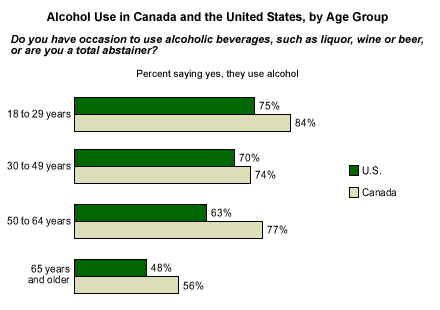
In the United States, one may begin to legally consume or buy alcohol at the age of 21. In Canada, the minimum age requirement is 18 or 19, depending on the province. In both countries, younger people are drinking more than their older counterparts. In the United States, 18- to 29-year-olds exhibit drinking patterns similar to those of the overall Canadian population, with 75% reporting that they drink alcohol. In the United States, the likelihood of respondents to say they drink declines with age -- 70% of 30- to 49-year-olds do so, compared to 63% of 50- to 64-year-olds, and less than half (48%) of those 65 and older.
In Canada, members of each generation are at least slightly more likely to say they drink than are their American peers of the same age. Drinking also declines with age in Canada, although rates remain fairly steady among those in their 30s, 40s and 50s. Eighty-four percent of Canadians between the ages of 18 and 29 say they drink alcohol. That figure declines to 74% among Canadians in their 30s and 40s, then rises slightly to 77% for the 50- to 64-year-old age bracket. Canadian seniors seem to be indulging more than their American senior counterparts, with 56% of them saying they drink alcoholic beverages.
Key Points
Drinking alcohol can be as much a part of socializing as eating food. Enjoying a glass of wine with dinner or a drink at the end of a long workday is fairly commonplace in North American society -- even more so in Canada than in the Unites States. Given the social nature of drinking, it makes sense that those who have more opportunity to socialize -- such as those in the younger age brackets -- are least likely to say they abstain from alcohol altogether.
*Results are based on telephone interviews with 1,004 U.S. adults, aged 18 and older, conducted July 9-11, 2002. For results based on the total sample of adults, one can say with 95% confidence that the maximum margin of sampling error is ±3%.
**Results are based on telephone interviews with 1,004 Canadian adults, aged 18 and older, conducted Aug. 21-27, 2002. For results based on the total sample of adults, one can say with 95% confidence that the maximum margin of sampling error is ±3%.
***According to statistics from the Traffic Injury Research Foundation