Canadians today have a more liberal point of view regarding marijuana use than they did in the midst of the swinging '70s. According to a 2002 Gallup Poll*, fewer than one in four Canadians think that the possession of small amounts of marijuana should constitute a criminal offense and the vast majority believes that the use of marijuana for medicinal purposes should be made legal.
Marijuana Possession
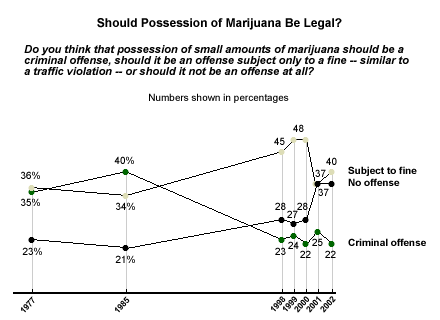
In 1977, Canadians were fairly evenly divided on the legality of possessing a small amount of marijuana. Thirty-five percent of Canadians believed that it should be a criminal offense, 36% believed it should be an offense subject only to a fine, and less than a quarter (23%) thought that possessing a small amount of marijuana should not be considered an offense at all.
Twenty-five years later, opinion has shifted in support of treating marijuana possession less harshly. In the 2002 poll, 40% of Canadians said that the possession of a small amount of marijuana should be subject to a fine, while a similar percentage (37%) said it should not be considered an offense at all -- only 22% said it should be a criminal offense. The percentage of Canadians believing that marijuana possession should be a criminal offense peaked in 1985 at 40%. Since that time, only about a quarter of Canadians have held this view.
Those in the age group that corresponds roughly with the baby boomer generation (aged 50 to 64) -- who were young adults in the 1970s -- are most likely to believe that the possession of a small amount of marijuana should not be considered an offense.
Marijuana Use for Medicinal Purposes
In more recent years, Canada has struggled with the implications of legalizing the use of marijuana as an aid to controlling pain associated with medical conditions. Since Gallup first began asking Canadians about this issue in 1998, a majority has favored such a move. In 2002, 81% of Canadians were in favor of legalizing marijuana strictly for medicinal purposes, while only 18% were opposed. Older Canadians (those aged 65 and older) were least likely to favor the legalization of marijuana for medicinal purposes, although two-thirds (67%) of even this group were in favor. Once again, Canadians between the ages of 50 and 64 were most likely to take a liberal stance, saying they favor legalizing marijuana for medicinal purposes.
Bottom Line
Despite the hedonistic image of the 1970s, Canadians are more accepting of marijuana use today than they were 25 years ago, particularly marijuana use for medicinal purposes.
Canadian law may soon coincide with the public's view on this subject. Recently, an Ontario Supreme Court judge ruled that the federal regulations governing the use of marijuana for medical purposes are unconstitutional because although patients can possess marijuana with written permission from their doctor, they currently have no access to a legal supply of the drug. As Justice Sidney Lederman stated, "Access is compromised because there is simply no legal way for individuals with production licenses to obtain the marijuana seeds required to grow marijuana. Consorting with criminal drug dealers strikes me as a relatively risky means of obtaining medicine."
*Results based on telephone interviews with 1,005 Canadian adults, aged 18 and older, conducted March 12-18, 2002. A sample of this size is accurate with a 3.1 percentage point margin of error, 19 in 20 times. A stratified random sample is used with age and gender weights.