As discussed in my 1989 book, The People's Religion (co-authored with James Castelli), the decline in the proportion of mainline Protestants that occurred between the late 1960s and the end of the 20th century resulted from losses among young adults. Feeling that the church was irrelevant and not life-changing, many young people moved into the ranks of other Protestant denominations or dropped out of church altogether. The percentage of U.S. adults who state their religious preference as Episcopal, Presbyterian, or Methodist, was one-third lower in 2002* than it was three and a half decades ago in 1967. Losses for Lutheran churches over this period of time are less pronounced, and the number of Baptists remains at about the same level as in the late 1960s.
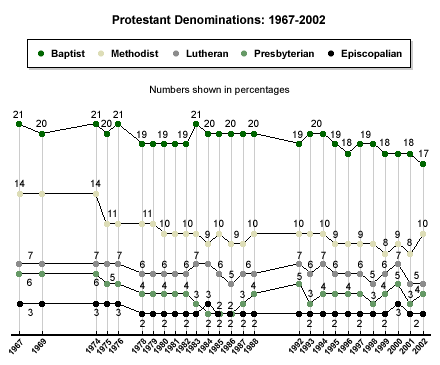
These results were compiled from respondents' answers to the following Gallup question: "What is your religious preference -- Protestant, Roman Catholic, Jewish, or an Orthodox religion such as the Greek or Russian Orthodox Church?" Those who respond "Protestant" are then asked, "What specific denomination is that?" It's important to note that respondents' answers do not necessarily denote formal membership in a particular faith community.
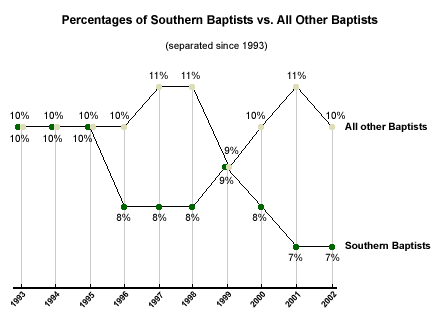
In 1993, Gallup began to break out those Americans who report "Southern Baptist" from the overall Baptist category. While those reporting "other Baptist" have remained stable in the past decade, those identifying themselves as Southern Baptists have declined from 10% in 1993 to 7% today.
Factors in the Decline
In Vanishing Boundaries: The Religion of Mainline Protestant Baby Boomers, a book by Dean R. Hoge, Benton Johnson, and Donald Luidens, the authors suggest that any local church body or denomination that places few demands on its congregants -- and does not pay attention to the ultimate questions of faith -- will find itself on the sidelines.
Another possible factor in the decline was the lack of emphasis on evangelism or invitation among mainline Protestant churches, in contrast to evangelical churches. In a survey undertaken for the above book**, emphasis on evangelism scored lowest among Episcopalians, followed by Presbyterians, Lutherans, and Methodists.
The level of "engagement" among congregations is also of key importance. As Al Winseman, Gallup's Global Practice Leader in Faith Communities, has stated, "Gallup research into the nature and role of engagement within congregations strongly suggests that it has very little to do with theology or doctrine, but has a great deal to do with the engagement level of congregation members." (See Related Items.)
Bottom Line
From the aforegoing it would appear that the following steps are important if a particular denomination seeks to experience growth in the depth and breadth of its followers in the years ahead:
- Focus on ultimate questions of faith
- Place certain demands on congregants and "engage" them
- Build youth programs
- Stress a program of evangelism and invitation
*Aggregated findings for 2002 were compiled from telephone surveys of national adults, aged 18 and older, conducted throughout the year.
**Findings are based on telephone interviews with 1,051 national adults, aged 18 and older, in December 1988.
