Last week's article examined how women differ from men in their views on several political and social issues in the United States. This article discusses how women differ from men on moral and gender-related questions, as well as whether there are any true "women's issues."
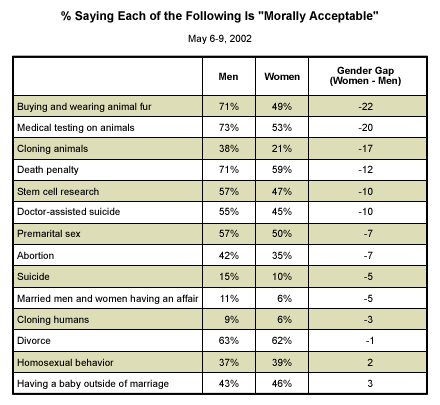
The results of Gallup's May 2002 Morals and Values survey* provide a fairly comprehensive inventory of American moral attitudes. According to the results, women are substantially less likely than men to support infringements on animal rights, such as wearing animal fur and medical testing on animals. Women are also less supportive of the death penalty. A slim majority of men are tolerant of doctor-assisted suicide, while women are closely divided on this issue. In general, however, no dramatic gaps are evident in the moral views of men and women; that is, there are no issues on which women clearly and consistently see differently from men.
Gender Equity
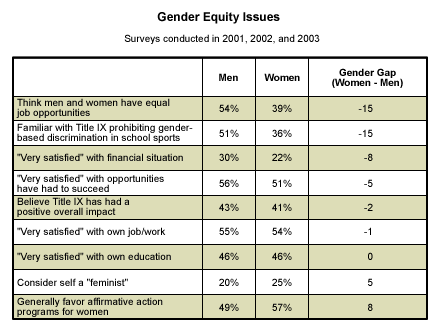
An examination of data from a variety of Gallup surveys conducted over the past three years offers some insight on how women and men feel about various gender issues in this country. Men and women do differ in their perceptions about equal job opportunities for women. Women are also moderately more supportive than men of affirmative action programs targeted to help women (57% of women vs. 49% of men). On the other hand, women are less attentive to the Title IX issue (and no more likely than men to think it has been a positive force). In terms of their own experiences, men and women report equal levels of personal satisfaction with their own jobs, their own education, and their own opportunities to succeed in life.
From the findings above, as well as the findings from last week's article, only a handful of issues emerge as potential women's issues:
- On gun control, a majority of women (61%) want to see the laws made more strict, while a majority of men (60%) disagree.
- On job equity, a majority of women (60%) are skeptical that men and women have equal job opportunities, while a majority of men (54%) feel confident about this.
- Although women are about evenly divided on questions about animal rights, large majorities of men consider medical testing on animals and the use of animal fur in clothing to be acceptable practices -- creating a large gender gap on these issues.
On a number of other issues, moderately sized attitudinal gaps exist, but they do not put men and women into separate camps.
- Women are more likely than men to be concerned about the moral and ethical climate of the country.
- Women are more accepting of expanding homosexual rights.
- Women are less supportive of the death penalty, stem cell research, and doctor-assisted suicide.
- While not presented here, other data show women to be more likely than men to believe that racial minorities face discrimination and need the help of affirmative action.
The Bottom Line
The gender gap in voting is not all that large, but it is real. It must stem from something. But as the data presented here suggest, it may be folly to try to explain it in terms of "women's issues" (or "men's issues," for that matter). Women are as demographically diverse as men, and more numerous. It is probably a mistake to assume that they represent a voting bloc, or that there are any specific issues or campaign themes that would have special appeal to them as a group.
The gender gap may simply come down to demographics. By virtue of being older, less financially secure, more religious, and less likely to be in the workforce, women may, on average, have slightly different worldviews than men, and the net effect may be more favorable for the Democratic Party than the Republican. Appealing to these views may help Democratic candidates win additional support from women. But using this strategy to win the female vote may come down to playing percentages -- championing an issue that appeals to 30% of women, as opposed to 25% of men, and risks offending only 20% of women as opposed to 35% of men. Enter the realm of standard election politics. And at that point, "women's issues" are a far cry from the simple list ticked off by candidates and the media at election time.
*Results are based on telephone interviews with 1,012 national adults, aged 18 and older, conducted May 6-9, 2002. For results based on the total sample of national adults, one can say with 95% confidence that the maximum margin of sampling error is ±3%.
