President Bush's declaration Thursday that the major fighting in Iraq is over was met with cheers from the sailors aboard the USS Abraham Lincoln. But while the bulk of the fighting may be over, it may be years before the president can claim that the campaign's goals have been attained. Keeping the peace, establishing a new government, and rebuilding the country's infrastructure will require significant U.S. military resources. A poll conducted just after Bush's speech shows that 54% of those who watched Bush's speech believe the war is essentially over, while 44% believe it is not. In any case, as media focus shifted to the war's aftermath, a recent CNN/USA Today/Gallup poll* explored the effects Americans say the war personally had on them and on the country as a whole.
Personal Effects
When asked about the current war's effect on them personally, slightly more than a third (37%) of Americans say that it had a positive effect on them, while 16% say it had a negative effect. Close to half (45%) say it did not have much effect on them. Compared to the first war with Iraq in 1991, belief in the war's positive effects is less dramatic this time around. A Los Angeles Times poll conducted in March 1991, shortly after the conclusion of the war, found that 55% of Americans said the war had a positive effect on them, compared to 11% who said the war had a negative effect and less than a third (31%) who said it did not have much effect.
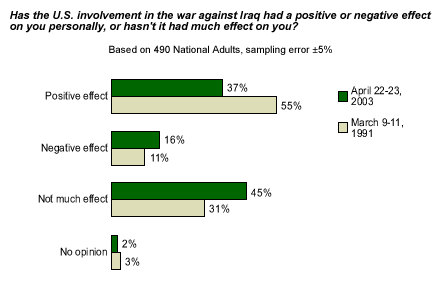
The recent survey data illustrate differences on the responses by political identification. Republicans are more than twice as likely as Democrats to say the war had a positive effect on them personally, 54% to 23%. A third of political independents (34%) say the war's effect on them was positive.
Effect on Life in the United States in General
A separate question asked Americans about the effect they thought the war had on life in the United States generally. In this case, Americans are somewhat more likely to describe the effect as positive -- just over half (52%) do so, compared to 18% who say it was negative, and a third who (32%) say it did not have much effect. Again the effect appears muted when compared with March 1991 results; the Los Angeles Times poll from that time shows that a majority -- 78% -- said they thought the war with Iraq generally had a positive effect on life in the United States. Just 7% described the effect as negative, while 10% said it did not have much effect.
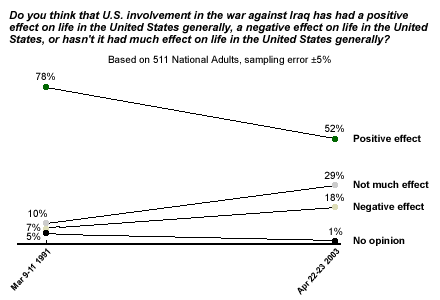
Again, the numbers from the recent survey show variance by party. Specifically, 67% of Republicans describe the war's effect on general life in the United States as positive, compared to 44% of independents and 45% of Democrats who say it was positive.
*Results are based on telephone interviews with 1,001 national adults, aged 18 and older, conducted April 22-23, 2003. For results based on the 490 national adults in the Form A half-sample and 511 national adults in the Form B half-sample, the maximum margins of sampling error are ±5%.
