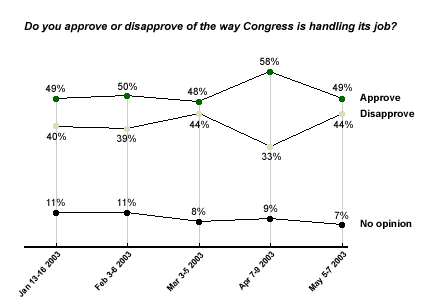
Times of war are often accompanied by surges in public support -- which are called "rally effects" -- and the recent war with Iraq was no different. Many Gallup measures experienced an increase in positive opinion in the weeks leading up to the U.S. victory, including public approval of the way Congress is handling its job. A new Gallup Poll* demonstrates that as military activity in Iraq has waned, so too has the short-lived rally in opinion of the way Congress is handling its job.
A Brief Rally
An April 7-9 Gallup Poll showed a 10-percentage-point rise in public approval of Congress compared with March data, from 48% to 58%. The latter number was the highest rating Congress had received in 12 months, and certainly the highest since the Republicans gained control of Congress in late 2002. This rally did not last long, however, as a poll conducted last week shows a return to the levels typical of earlier this year, with 49% approving of the way Congress is handling its job and 44% disapproving.
The Usual Suspects
Opinion of the Republican-controlled Congress is undoubtedly linked to respondents' political affiliations. Six in 10 Republicans (61%) say they approve of the way Congress is handling its job, compared with 47% of independents and just 38% of Democrats.
Opinion of the economy is another relevant factor. Among those who say that economic conditions are excellent or good, 58% approve of the way Congress is doing its job. Among those who rate the economy fair or poor, the percentage approving of Congress dips to 46%. Although it should be pointed out that economic ratings are influenced by one's partisan affiliation.
Generation Gap?
Consistent with what Gallup has observed for some time, younger Americans are much more likely to approve of Congress than older Americans are. A majority (62%) of the youngest adults -- 18- to 29-year-olds -- say they approve of the way Congress is handling its job. The percentage approving decreases steadily with age. Among those in the oldest group, aged 65 and older, less than a third (31%) say they approve of Congress. The reasons for that trend are unclear, whether it is due to greater optimism among younger generations, or part of a generational change with younger generations not adopting as negative a disposition toward Congress as older generations tended to.
Bottom Line
The short-lived rise in American approval of Congress is typical, as this politically divided body often cannot sustain a rally to the degree that a president can. Economic conditions and political opinions definitely play a role in the return to more typical ratings of Congress, but a significant age gap exists as well. All of this sets the stage for what is sure to be heated congressional debate over President Bush's proposed tax-cut package.
*Results are based on telephone interviews with 1,005 national adults, aged 18 and older, conducted May 5-7, 2003. For results based on the total sample of national adults, one can say with 95% confidence that the margin of sampling error is ±3%.
