Despite being roughly half the size of what the president initially requested, the $350 billion tax cut signed into law last week is being claimed as a major political victory by the White House. A prominent factor in the Bush administration's satisfaction with the final version of the law is the inclusion of an amendment to reduce the dividend tax on investors, one of the most contentious aspects of the bill. But even the inclusion of that amendment is not an unmitigated win for Bush. The president settled for lowering the dividend rate cap to 15% -- and even that change, according to the bill's current sunset provision, would disappear at the end of 2008.
The dividend tax issue throws the philosophical differences between the two parties into sharp relief. The Bush camp sees the dividend tax as an unfair double-taxation on investors (because corporations already pay income taxes on their profits), while critics say cutting the levy is unfair because it shifts more of the tax burden from the wealthy to middle-class and lower-income Americans. The debate is unlikely to be resolved, but it helps to have an idea of how many Americans will be affected by the cut, and how strongly they feel about it.
The highly partisan nature of the tax-cut issue is reflected among the public as well as its representatives. The Senate voted on the amendment largely along party lines. As Gallup reported last week, a May poll* found public support for the tax cut as a whole largely corresponds to party affiliation -- 74% of Republicans think the tax cuts are a good idea, compared with 30% of Democrats who share that sentiment.
A January 2003 poll** found support for doing away with the dividend tax specifically to be only slightly less polarized: 63% of Republicans said they favored eliminating the tax, as did 31% of Democrats. Independents fell somewhat closer to the Republicans: 51% favored eliminating the dividend tax, while 43% opposed it. Overall, by a slim 49% to 44% margin, Americans said they were in favor of eliminating taxes on dividends.
Who Are Dividend Tax Payers?
How many people actually pay dividend taxes? America is a nation of investors -- about two-thirds of adults currently say they are stockowners -- but only 22% of Americans overall, and 36% of American investors, report paying dividend taxes on stocks.
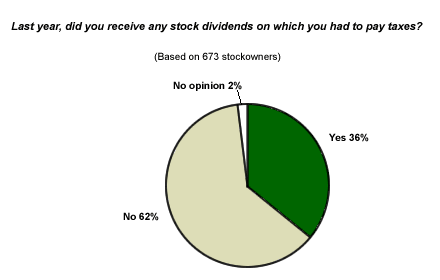
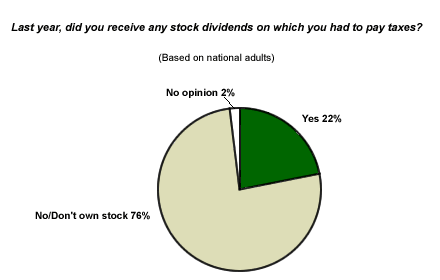
The president has said that, in addition to small-business owners, older Americans are particularly likely to benefit from the dividend tax cut. Indeed, older Americans are more likely to say they pay dividend taxes (30% of those aged 50 and older, compared to 18% of those under 50).
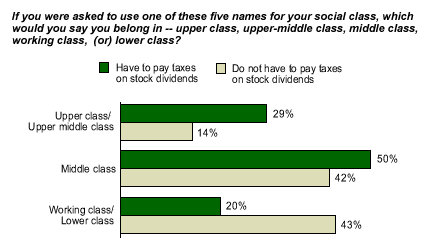
But opponents of the cut can point to the fact that Americans who pay dividend taxes are more likely than those who don't pay dividend taxes to claim annual incomes of $75,000 or higher (46%, compared to 14% of those making less than $75,000), and to describe themselves as "upper" or "upper-middle" class.
The fact that 30% of Republicans versus just 17% of Democrats have to pay dividend taxes helps explain the greater likelihood of dividend tax payers to favor Bush's economic policies. But the attitudinal gap between dividend tax payers and non-dividend tax payers on this issue does not appear to be extremely wide. While 63% of Americans who have to pay dividend taxes said in January that they favored Bush's economic plan, non-dividend tax payers were evenly divided in their views, with 45% in favor and 46% opposed.
Bottom Line
The ultimate economic impact of the dividend tax reduction will determine whether it is considered a good idea in the long run. But as is the case with the larger tax cut, immediate personal economic gains resulting from the new law will be limited given the fact that only about one in five Americans pay dividend taxes.
*Results are based on telephone interviews with 1,014 national adults, aged 18 and older, conducted May 19-21, 2003. For results based on the total sample of national adults, one can say with 95% confidence that the margin of sampling error is ±3%.
**Results are based on telephone interviews with 1,002 national adults, aged 18 and older, conducted Jan. 10-12, 2003. For results based on the total sample of national adults, one can say with 95% confidence that the maximum margin of sampling error is ±3%.
