While there is no clear consensus, the results of a Gallup Youth Survey conducted in early 2003* suggest that teens are not completely satisfied with the quality of the extracurricular programs their schools offer.
This finding is important to note for two main reasons. Primarily, teens derive substantial developmental benefits -- social, physiological, or academic -- from extracurriculars. But they are also of increasing concern to many teens and parents in recent years for the role they play in college admissions.
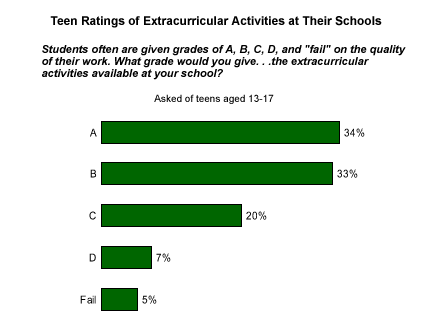
About two-thirds of teens (ages 13 to 17) grade the extracurricular activities at their schools with an A or B (34% and 33%, respectively). Twenty percent think their school deserves a C. The remainder would give a D or a failing grade. Based on a grade-point scale, with 4 points for an A, 3 points for a B, 2 points for a C, and so on, schools would earn a GPA of 2.82 -- a C+ -- for their extracurricular offerings.
Participation in Sports/Exercise Means Higher Ratings
Teens' levels of participation in extracurricular activities their schools offer may explain differences in the grades some teens' gave their schools' extracurricular programs. While extracurricular activities are not limited to sports (they typically also include theater and academic clubs such as debate or science), respondents who indicated that they regularly participate in sports or exercise were more likely to grade extracurricular activities with an A (37%) than teens who do not participate in sports or exercise (25%).
Higher Class Ranking Links to Higher Ratings
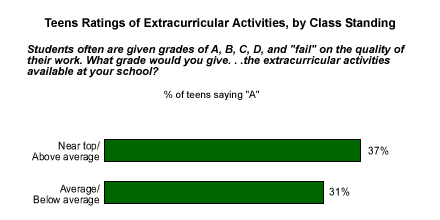
Teens' perceptions of the extracurricular activities available at their schools are also more likely to be positive if their class standing is high. That is, teens who consider themselves above average or near the top of their class were more likely to give their schools As than teens who consider themselves average or below average.
Risk Behaviors
Smoking and alcohol use are often considered to be indicators of anti-social teenage behavior. Students who engage in these activities are often less apt to participate in community and/or school-related extracurricular activities. According to the Gallup survey, teenagers who smoke have lower opinions of the extracurricular activities available at their schools than those who do not smoke, with only 49% of smokers giving an A or B grade compared to 69% of non-smokers who gave As and Bs.
Bottom Line
The benefits of participation in extracurricular activities can be enormous for teenagers, socially and otherwise. Mediocre teen ratings of the extracurricular activities at their schools (a C+ overall) suggest there is ample room for schools to improve the extracurricular programs they offer. Although it should be noted that teens grade their schools higher for their extracurricular activities than they do for its technology and higher than their overall grade of their school.
Teens who are involved in sports and with higher class standing are generally more satisfied with the programs than other teens are, and they are likely to be the ones who more consistently engage in extracurricular activities. It's a bit of a chicken-and-egg question, but one approach for schools seeking to raise students' positivity toward extracurricular groups may simply be to focus on getting them in the door by increasing participation requirements.
*The Gallup Youth Survey is conducted via an Internet methodology provided by Knowledge Networks, using an online research panel that is designed to be representative of the entire U.S. population. The current questionnaire was completed by 1,200 respondents, aged 13 to 17, between Jan. 23-Feb. 10, 2003. For results based on the total sample, one can say with 95% confidence that the maximum margin of sampling error is ±3%. For a complete description of the sampling and weighting procedures used to conduct the survey, click here.