Last week's headlines were filled with encouraging economic news. Fed Chairman Alan Greenspan predicted that the U.S. economy will soon rebound, and the National Bureau of Economic Research announced that the economy has been in a recovery phase since the end of its recession in November 2001. It remains to be seen what effect, if any, these latest announcements will have on the American public. And there is a considerable amount of concern to overcome.
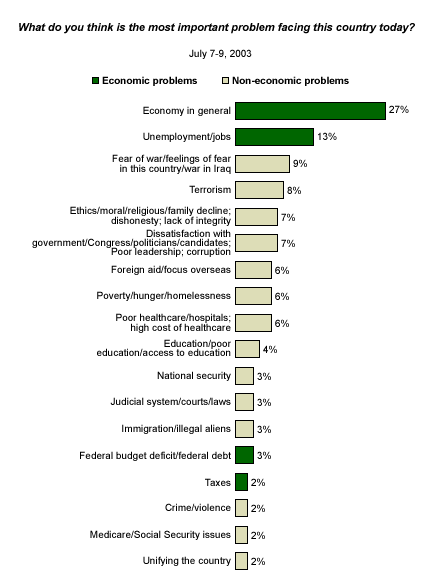
In a July 7-9 Gallup Poll*, which followed a mixed bag of economic news that included record unemployment numbers and another interest rate cut, nearly half of Americans mentioned some aspect of the economy as the nation's most important problem for the fourth month in a row. Twenty-seven percent of Americans spontaneously mentioned the economy in general as the top problem, and 13% mentioned unemployment or jobs. The federal budget deficit, taxes, lack of money, and the high cost of living or inflation were also mentioned.
Although it's a political hot button, concern about the economy crosses party lines. Republicans, independents, and Democrats all mention the economy as the nation's top problem. However, the percentage of Republicans mentioning the economy in general has declined since May, and is now significantly lower than the percentage of Democrats mentioning it.
It's Not Just the Economy
Though the economy and unemployment loom large, they aren't the only problems on Americans' minds. Included among the top non-economic concerns are fear of war and the situation in Iraq, terrorism, decline of morals and family, and the ethics of politicians. There has been little change in the percentage of Americans naming terrorism as the nation's top problem in recent months. However, the percentage of Republicans mentioning terrorism is down significantly, from 20% in June to 12% in July. The percentage mentioning Iraq dropped abruptly in early April as the major fighting wound down (from 29% in early March to 16% in early April), and declined further in May to roughly its current level.
Are You Satisfied?
The July poll finds Americans split in their satisfaction "with the way things are going in the United States at this time." Fifty percent of Americans said they are satisfied with the way things are currently going in the United States, and 48% are dissatisfied. In March, April, and May, satisfaction ranged between 54% and 60%.
Political partisanship is strongly related to the likelihood to claim satisfaction with the way things are going in the United States. Slightly fewer Republicans are satisfied in July (70%) than were satisfied in June (76%), but they still remain the most content. Democrats, at 34% satisfied, are the least content among those who identify with a particular political party, but they are more satisfied than they were in June (26%). Independents, 44% of whom are satisfied, are in between, but closer to Democrats' level of satisfaction.
July's data also reveal a gender gap in satisfaction. In July, 56% of men said they are satisfied with the way things are going, compared to 45% of women who said the same. This 11-point gap between men and women is the largest measured since the March poll conducted shortly after the war began. The gap was much narrower last month, when men and women were about equally likely to say they are satisfied -- 49% vs. 46%, respectively.
Bottom Line
If tax cuts, rising stock prices, and lower interest rates will spur U.S. economic growth, as Greenspan predicts, we may see more movement away from American concern about the economy, and more satisfaction with the way things are going. However, it will almost certainly take more than predictions of economic growth to ease Americans' economic worries -- they need to see such predictions come true.
*Results are based on telephone interviews with 1,006 national adults, aged 18 and older, conducted July 7-9, 2003. For results based on the total sample of national adults, one can say with 95% confidence that the margin of sampling error is ±3%.
