As America's employees return to work after Labor Day celebrations, Gallup's annual survey on the workplace finds that most of them are generally satisfied with their jobs and with most aspects of their jobs. The poll, conducted Aug. 4-6, finds employed adults most satisfied with the physical safety conditions at work, coworker relationships, and flexibility of hours, and least satisfied with work-related stress and their salaries or income. Gallup data compiled over the past three years also show interesting differences in satisfaction with certain job aspects among men and women in different age groups, among different classifications of workers, and among part-time and full-time employees.
The poll asked employed adults two questions about their level of satisfaction with their current jobs. The first question asked if the respondent was completely satisfied, somewhat satisfied, somewhat dissatisfied, or completely dissatisfied with "your job." The second question measured satisfaction with a variety of job characteristics, ranging from pay to promotion opportunities. Gallup's combined sample, drawn from Gallup's annual Work and Education polls from 2001 through 2003, includes more than 1,700 employed adults.
Overall Results
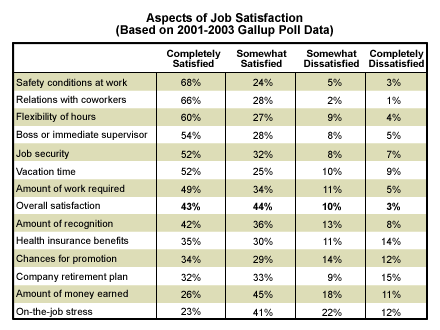
According to the aggregated data, 43% of employed adults throughout the country say they are completely satisfied with their jobs, and an additional 44% say they are somewhat satisfied. Only 13% of workers say they are somewhat or completely dissatisfied with their jobs.
A majority of employed adults say they are completely satisfied with the following aspects of their jobs: the physical safety conditions at work (68%); coworker relationships (66%); the flexibility of hours (60%); their bosses or supervisors (54%); job security (52%); and the amount of vacation time available (52%).
Workers are least completely satisfied with the amount of on-the-job stress (23%), their salaries or income levels (26%), company retirement plans (32%), the chances for promotion (34%), and their health insurance benefits (35%).
Workplace Ratings Among Men and Women, Young and Old
Men between the ages of 30 and 49 tend to be less satisfied on specific job characteristics than men in other age groups tend to be, particularly when it comes to stress, workload, and coworkers.
- Roughly one-third of both 18- to 29-year-old men and men aged 50 and older say they are completely satisfied with the amount of on-the-job stress, compared with only 19% of 30- to 49-year-old men who say so.
- A majority of 18- to 29-year-old men (58%) and a majority of men aged 50 and older (55%) are satisfied with the amount of work required, but only less than half (45%) of employed men in the 30- to 49-year-old age group are satisfied.
- Three-quarters of employed 18- to 29-year-old men are completely satisfied with their coworker relationships, 11 percentage points higher than men aged 30 to 49 and men aged 50 and older.
There are also differences among women in different age groups.
- More than 7 in 10 women aged 50 and older are satisfied with their coworker relationships, compared with 58% of women aged 18 to 29.
- However, younger women are much more satisfied with their chances for promotion than older women are: 45% of 18- to 29-year-old women, 29% of 30- to 49-year-old women, and only 22% of women aged 50 and older say they are satisfied. Men exhibit a similar pattern by age.
Generally speaking, men and women who are roughly the same age are similarly satisfied with aspects of their jobs. However, there are some interesting differences between employed men and women in the 18- to 29-year-old age category. Specifically, by a 75% to 58% margin, younger men are much more likely to express satisfaction in their relations with coworkers than younger women are. Younger men are also more likely than younger women to say they are satisfied with the amount of on-the-job stress they experience (34% to 20%, respectively), though neither is particularly satisfied with this aspect of their work. Interestingly, this is the only age group in which men and women express similar levels of satisfaction with their chances for promotion.
|
18- to 29- |
30- to 49- |
50 years and older |
||||
|
Men |
Women |
Men |
Women |
Men |
Women |
|
|
% |
% |
% |
% |
% |
% |
|
|
Overall satisfaction |
44 |
35 |
41 |
41 |
52 |
44 |
|
Job security |
59 |
55 |
52 |
48 |
53 |
50 |
|
Vacation time |
50 |
53 |
47 |
53 |
57 |
56 |
|
On-the-job stress |
34 |
20 |
19 |
20 |
33 |
20 |
|
Amount of work required |
58 |
49 |
45 |
47 |
55 |
48 |
|
Chances for promotion |
43 |
45 |
36 |
29 |
31 |
22 |
|
Flexibility of hours |
53 |
68 |
56 |
63 |
65 |
62 |
|
Health insurance benefits |
38 |
35 |
37 |
34 |
32 |
35 |
|
Company retirement plan |
34 |
32 |
31 |
33 |
31 |
28 |
|
Amount of recognition |
49 |
40 |
40 |
42 |
46 |
40 |
|
Amount of money earned |
23 |
22 |
27 |
25 |
33 |
26 |
|
Boss/immediate supervisor |
55 |
55 |
50 |
56 |
52 |
58 |
|
Safety conditions at work |
67 |
71 |
70 |
64 |
68 |
70 |
|
Relations with coworkers |
75 |
58 |
64 |
67 |
64 |
71 |
|
N= |
198 |
167 |
519 |
413 |
229 |
204 |
Professionals, White-Collar, and Blue-Collar Workers Rate the Workplace
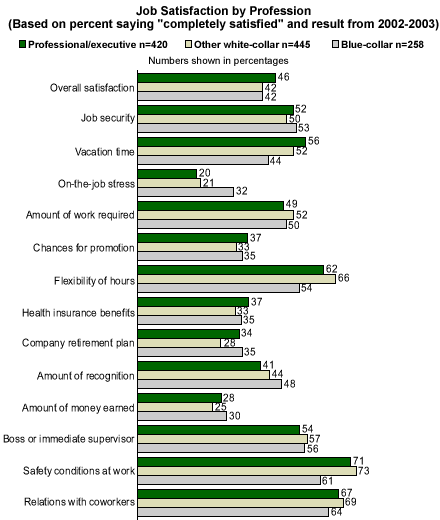
Workers in different professional job categories -- professional or executive, other white-collar, and blue-collar -- show few differences in their overall satisfaction with their jobs. There are some differences, however, among these groups on certain job characteristics.
Professionals, executives, and other white-collar workers have higher levels of job satisfaction than blue-collar workers do in three main areas.
- When asked about the amount of vacation time allotted, 56% of professionals or executives and 52% of other white-collar workers say they are completely satisfied, compared with 44% of blue-collar workers who offer this response.
- More than 6 in 10 professionals or executives and roughly two-thirds of other white-collar workers say they are completely satisfied with the flexibility of work hours, while only 54% of blue-collar employees feel this way.
- Executives, professionals, and other white-collar workers are most likely to say they are satisfied with the physical safety conditions at work, including 71% of executives and 73% of other white-collar workers. By comparison, 61% of blue-collar workers are satisfied with job safety conditions.
Blue-collar workers actually have higher levels of satisfaction when it comes to the amount of on-the-job stress, although this characteristic is rated low among all professional groups.
Differences in Job Satisfaction Levels Between Full-Time and Part-Time Workers
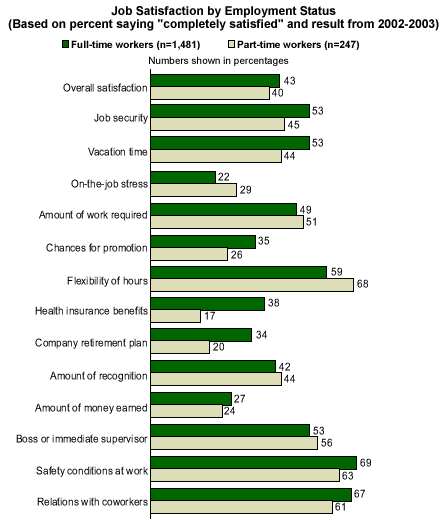
Perhaps not surprisingly, full-time workers are much more likely than part-time workers (38% vs. 17%) to say they are completely satisfied with the health insurance benefits their employers provide, as well as with their company retirement plans (34% vs. 20%). Full-time workers are also more satisfied with their chances for promotion, the amount of vacation time their employers provide, and their job security.
On the other side, part-time workers are somewhat more inclined to be satisfied with the flexibility of their work hours and the amount of work-related stress.
The results are based on telephone interviews with a randomly selected national sample of 3,023 adults, aged 18 and older, compiled from polls conducted Aug. 16-19, 2001, Aug. 5-8, 2002, and Aug. 4-6, 2003. For results based on this sample, one can say with 95% confidence that the maximum error attributable to sampling and other random effects is ±2 percentage points.
For results based on a randomly selected sample of 1,728 adults, aged 18 and older, who are employed full or part time, compiled from polls conducted Aug. 16-19, 2001, August 5-8, 2002 and Aug. 4-6, 2003, one can say with 95% confidence that the maximum error attributable to sampling and other random effects is ±3 percentage points.
For results based on a randomly selected sample of 1,122 adults, aged 18 and older, who are employed full- or part-time, compiled from polls conducted Aug. 5-8, 2002 and Aug. 4-6, 2003, one can say with 95% confidence that the maximum error attributable to sampling and other random effects is ±3 percentage points.
In addition to sampling error, question wording and practical difficulties in conducting surveys can introduce error or bias into the findings of public opinion polls.
