In recent months, some American teens have found out the hard way that it is illegal to share music on the Internet. The Recording Industry Association of America (RIAA) did not actually file the first 261 lawsuits against music "pirates" until Sept. 8, but it has been aggressively publicizing its plans to do so since early last summer.
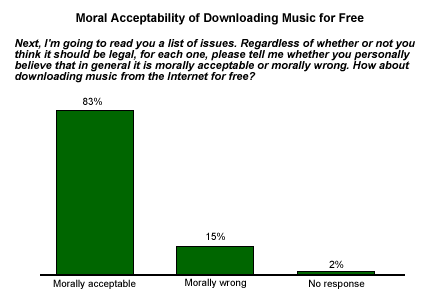
But the industry has a long way to go -- last February's Gallup Youth Survey found 47% of teens saying they use the Internet for downloading music. Legal issues aside, Gallup wanted to know where teens stand on the morality of downloading music from the Internet without paying for it. In an August 2003 Gallup Youth Survey*, 83% of teens (aged 13 to 17) said that it is morally acceptable to download "music from the Internet for free."
The Morality Spectrum
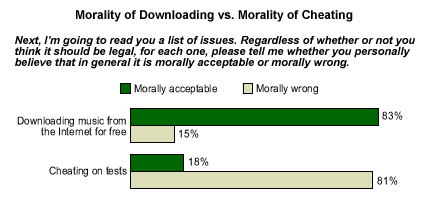
The August finding was part of a broader question asking teens about the moral acceptability of a number of items. Downloading free music was by far the item most likely to be deemed morally acceptable by teens, surpassing items such as divorce (which 67% of teens found morally acceptable), gambling (61% morally acceptable) and sex between an unmarried man and woman (57% morally acceptable). Gallup asked about cheating on tests, another topic with which teens are familiar. Interestingly, in the February poll, 48% of teens admitted to having cheated on a test or exam -- the same percentage that admitted to downloading music for free. Yet when teens were asked in the August poll whether cheating on tests is morally acceptable or morally wrong, only 18% said that it was morally acceptable.
Brad, a 15-year-old high school sophomore, is part of the minority of teens who thinks downloading is morally wrong. Yet his views reflect how teens are straddling the fence on this issue. "Downloading music is theft and theft is morally wrong," he says. "Just because you're not walking into a store and grabbing a CD from the shelf, it's still wrong. It's hurting the record industry and the artists who make the music. But will it stop me from downloading? No way."
Since the question did not explicitly mention copyrights or authorizations by the recording industry, some teens may have responded with the recognition that downloading free music per se is not a crime. On the other hand, it may simply be that teens do not feel an obligation to the music industry to pay for music. They are able to "consume" music for free over the radio, and the Internet is simply another place to find the same music at no charge.
"I suspect the largest moral issue is simply the old beach-combing, law-of-the-sea, finders-keepers mentality," says Rushworth Kidder, president of the Institute for Global Ethics in Camden, Maine. "[Teens think,] 'If something falls overboard into the great sea of the Internet and washes up on my computer -- hey, it's there, isn't it? If those guys REALLY wanted to restrict its usage, they should tie down their cargo more tightly. Not MY fault I stumbled onto it.'"
Elizabeth, a 17-year-old high school junior, sees it this way. "I think downloading music from the Internet is morally acceptable because it's the same thing as taping a song from the radio -- no one is getting hurt," she says. "But cheating on a test is getting help from an outside source without studying and learning the material. So you're not only harming yourself, but possibly your classmates, as well, by creating a false curve."
Bottom Line
Whatever the reason, the survey data suggest that teens may not be inclined to give music downloading voluntarily anytime soon, and any effort to curb downloads by teens will fall on parents, law enforcement, and the recording industry. But these groups will be getting some help from the movies shortly. The Motion Picture Association of America, in an effort to derail a downloading frenzy in their own industry, has partnered with Junior Achievement to bring school programs in "Digital Citizenship" to teens and preteens in grades 5 through 9.
*The Gallup Youth Survey is conducted via an Internet methodology provided by Knowledge Networks, using an online research panel that is designed to be representative of the entire U.S. population. The current questionnaire was completed by 517 respondents who had participated in the prior survey, aged 13 to 17, between Aug. 1-Aug. 29, 2003. The prior wave was completed by 1,200 respondents, aged 13 to 17, between Jan. 23-Feb. 10, 2003. For results based on the current sample, one can say with 95% confidence that the maximum margin of sampling error is ±8%. For results based on the prior sample, one can say with 95% confidence that the maximum margin of sampling error is ±4%.