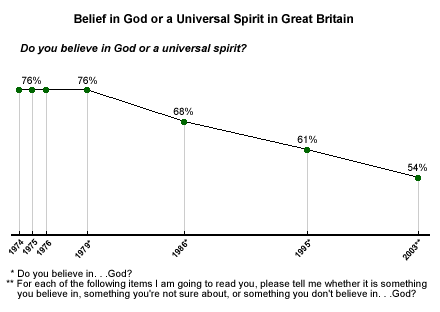
Among all of the tumultuous changes that have occurred in post-World War II Great Britain, one of the biggest stories in the religious community has been the diminishing of religious faith. According to a series of Gallup Polls conducted during the past six decades, the percentage of British adults saying they believe in God or a universal spirit has fallen steadily, from 76% in 1974-1976 to barely half (54%) today. Going farther back, a 1947 Gallup Poll in Britain found 84% believing in a "personal God" or "some sort of spirit or vital force that controls life."
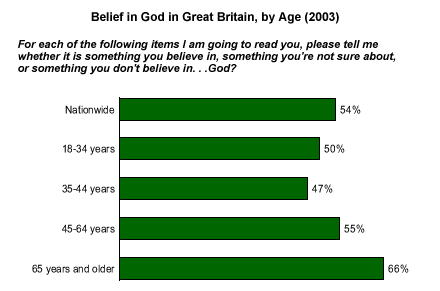
Rev. Canon Dr. Michael Green, advisor to the archbishops of Canterbury and York on evangelism, blames the downward trend in British religiosity on the younger half of the population, many of whom "have no links whatever with the church or Christianity of any kind." Canon Green sees multiple factors spurring this downward trend among younger adults in Britain: "a mixture of postmodernism, dismissing the concepts of both truth and objective morality; hedonism -- let's live it up; and materialism -- money and what money can buy is all that matters."
Data from Gallup's most recent survey in Great Britain confirm that the level of belief in God or a universal spirit is lower among younger adults.
The Rev. Chris Smith, curate of Holy Trinity Church in Cambridge, England, also believes that the national British church (the Church of England) is somewhat responsible for the trend. "Secular forces and an ineffective church have both played their part in the slippage of religious commitment in this country. British people still express faith today, but the object of their faith is often science, money, or pleasure instead of God."
Canon Green believes that the Church of England needs to become more appealing and visible to the British population. "The goal is to be a renewed church, indifferent to denomination and passionately concerned with Christian action … There have to be more Christians in politics and the media, especially the ‘soaps,' which determine attitudes among the general population."
Belief in God Much Higher in the United States
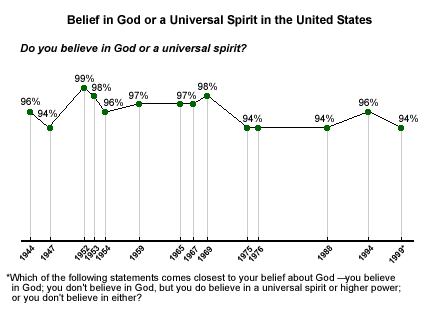
In sharp contrast to the trend in Great Britain is the trend in belief in God or a universal spirit in the United States, which has generally held steady over approximately the same period. Belief in God or a universal spirit currently stands near 90% in the United States, roughly 40 percentage points higher than the comparable number in Great Britain.
Bottom Line
D. Michael Lindsay, a graduate fellow at Princeton University who has conducted extensive comparative research on religion in the United States and Great Britain, provides some interesting insights on why Americans are so much more likely than Britons to profess a belief in God or a universal spirit.
"Two important aspects explain at least a portion of the gap [in religiosity between Americans and Britons]: demographics and church-state relations. First, the United States has two minority groups -- namely, African-Americans and Southerners -- who boost the overall levels of religious commitment in the U.S. … Second, the American church has been a source of encouragement and resistance for blacks and Southerners in their struggle against the establishment. The fact that England has an established church means that minority groups in Great Britain don't often rally around religion in the same way."
