The characterization that women tend to be conservative investors proved to be true -- and profitable -- for female investors during most of the 2001 recession and the bear market that followed. Results from the UBS/Gallup Index of Investor Optimism*, which asks investors to report the actual rate of return they've earned on their overall investment portfolios in the past year, indicate that on average, female investors outperformed their male counterparts.
Do Women Make Better Money Managers?
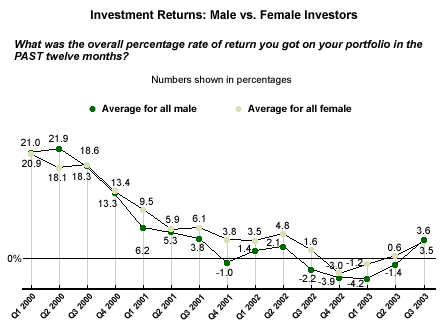
In response to the question, "What was the overall percentage rate of return you got on your portfolio in the past 12 months?", female investors reported higher average returns than male investors did in 12 out of the 15 quarters from January 2000 to the third quarter of 2003.
Interestingly, while both female investors' and male investors' reported returns nose-dived with the collapse of the Internet bubble, female investors weathered the slow economic conditions best. Conversely, male investors reported higher returns during the first and second quarters of 2000 -- a time when the economy was still riding the tide of its longest period of expansion.
The gap in investment performance between the two genders was largest during the fourth quarter of 2001 (during which the eight-month recession ended). In that period, female investors reported average overall portfolio returns of 3.8%, compared to -1% reported by male investors. So in the late stage of the 2001 recession, women outperformed men by 4.8 percentage points, on average. In fact, women have outperformed men in each quarter since the beginning of 2001, and the gap in investment performance has closed only in the most recent quarter of 2003, in which both genders reported similar average gains. Women outperformed men because they invested more conservatively, and were making small gains with their value funds while men were losing money on their growth funds.
What Women Want
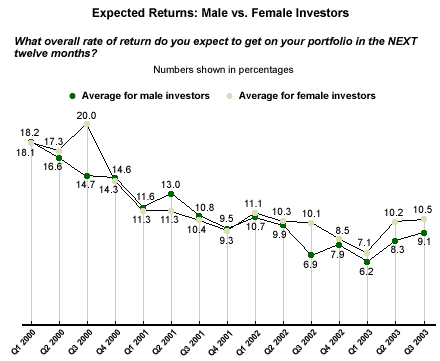
While research about gender differences in investment behavior suggests that women are more risk averse, quarterly data from the Index of Investor Optimism suggest that female investors are as aggressive as male investors, if not more so, in their projections for future overall investment returns. Such expectations can be taken as a measure of risk aversion in the sense that if those who demand higher investment returns must be willing to accept greater risk. In answer to the question, "What overall rate of return do you expect to get on your portfolio in the next twelve months?", female investors have reported higher expected returns than male investors have in every quarter since the beginning of 2002.
Bottom Line
Female investors may be stereotyped as more conservative than male investors, but Gallup's findings show that this did not stop them from targeting higher investment returns than male investors received between 2000 and 2003. At any rate, their investing style seems to have worked well in the recent bear market, with Gallup data suggesting that female investors earned higher investment returns when the going got tough. However, if the aggressive economic growth that the Federal Reserve is predicting translates into the next bull market, female investors' typically more conservative investment strategy might not position them well to earn higher returns in the coming months.
*Results are based on monthly telephone surveys, each with approximately 1,000 investors nationwide, aged 18 and older, from January 2000 to September 2003. Quarterly data consist of roughly 3,000 interviews per quarter. For results based on the quarterly sample, one can say with 95% confidence that the margin of sampling error is ±2 percentage points.
The minimum number of female investors interviewed in a quarter has been 1,018. The minimum number of male investors interviewed in a quarter has been 1,402. For results based on the quarterly sample, one can say with 95% confidence that the margin of sampling error for female investors and male investors is ±3 percentage points.