Smoking, being overweight, and excessive drinking have all, in one way or another, been associated with poor health. A recent Gallup survey asked Americans about all three of these habits and also measured respondents' self-reported physical and mental health. The results indicate that being overweight is significantly related to poor physical health, even more so than smoking. Drinking alcohol, on the other hand, is associated with good health. Overall, about 8 in 10 people said they engage in at least one of the three habits, and the more habits they have, the lower their rating of physical health.
Three Habits and Physical Health
Here are the basic relationships between each of the three habits being considered in this analysis and self-reported "excellent" health. The overweight measure being used here is based on an estimated Body Mass Index (BMI), calculated using the respondents' self-reported height and weight:
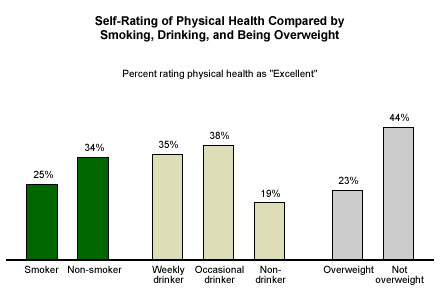
It's clear that Americans who are overweight are less likely to report excellent health (23%) than those who are not overweight (44%). This general relationship is not surprising; Americans have been warned repeatedly in recent years about the dangerous relationship between excessive weight and heart disease, diabetes, and other medical conditions. The interesting finding here is that overweight people obviously feel worse about their health than others do.
One of the more interesting findings from these data is that Americans who don't drink alcohol at all are substantially less likely to say they are in excellent health than those who drink occasionally and/or those who drink on a weekly or more frequent basis.
There has been widely reported medical evidence in recent years that shows moderate drinking is actually correlated with lower chances of getting heart disease. So the observed relationship we are finding here is not necessarily surprising.
Those Americans who are teetotalers are not necessarily much older than those who drink, indicating that their less-than-excellent health is not just a secondary effect of their age (older Americans are much less likely to report excellent health than younger Americans).
Three Habits and Mental Health
The chart below represents the relationship between these three habits and self-reported mental health:
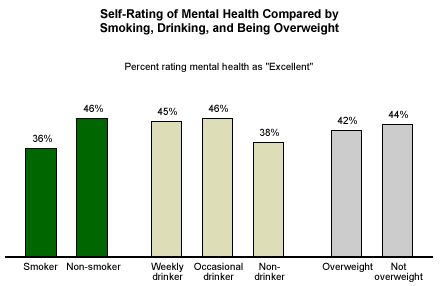
Among all people who are overweight, 42% rate their mental health as excellent, compared with 44% among the rest. But among people who are "obese" (not shown in the chart) -- with a Body Mass Index of 30 or more -- only 36% rate their mental health as excellent, compared with 46% among people who are overweight but not obese.
There is a 10-point difference in the percentage of smokers (36%) versus non-smokers (46%) who rate their mental health as excellent. It is perhaps reasonable to assume that people with poor mental health begin (or continue) to smoke as a way to help alleviate their mindset. Or, there may be something about viewing oneself as a smoker that leads to a more negative self-image.
As is the case for physical health, teetotalers are less likely to report excellent mental health than those who drink at least occasionally. Again, it is difficult to tease out causality here. It may be that drinking itself helps alleviate anxiety and worry (which alcohol may do in the short term) or that people without positive mental health are less likely to drink alcohol for other reasons.
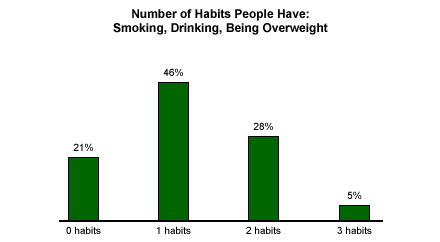
Number of People With All Three Habits
The number of Americans who qualify for all three habits -- they are overweight, they drink more than occasionally (at least weekly), and they smoke every week -- is just 5%. The number of Americans who engage in none of these behaviors is 21%.
There is a slightly negative relationship between weight on the one hand, and smoking and drinking on the other. Overweight people are somewhat less likely to smoke (24%) than Americans who are not overweight (30%), and they are less likely to drink on a weekly basis (33% vs. 42%, respectively).
However, there is a positive correlation between smoking and drinking: 35% of weekly drinkers smoke, compared with 23% of occasional drinkers and 18% of teetotalers.
Similarly, 49% of smokers also drink on a weekly basis, compared with 32% of non-smokers.
Three Habits and Health Ratings
The more habits people have among the three analyzed here, the smaller the number who rate their physical health as excellent. However, there is little correlation between mental health ratings and the number of habits.
|
Relationship Between Number of Habits and Health Ratings |
||
|
|
% Rating Physical Health |
% Rating Mental Health |
|
0 Habits |
42 |
47 |
|
1 Habit |
31 |
45 |
|
2 Habits |
27 |
40 |
|
3 Habits |
17 |
42 |
Among people who are not overweight and who do not drink or smoke regularly, 42% report excellent physical health and 47% report excellent mental health.
As the number of habits increases, the percentage rating physical health as excellent declines -- with 31% giving that rating among those with one habit, 27% among those with two habits, and just 17% among those with all three habits.
The decline in excellent mental health ratings, however, is modest, and within the sample's margin of error.
Results are based on telephone interviews with 1,007 national adults, aged 18 and older, conducted Nov. 3-5, 2003. For results based on the total sample of national adults, one can say with 95% confidence that the margin of sampling error is ±3 percentage points.
In addition to sampling error, question wording and practical difficulties in conducting surveys can introduce error or bias into the findings of public opinion polls.