The health risks associated with cigarette smoking are widely known, and efforts to reduce smoking, especially among the nation's youth, are vigorous and widespread. These efforts include the removal of ads targeting young people (such as "Joe Camel"), and TV and school campaigns emphasizing the dangers of tobacco use and urging young people not to take that first puff.
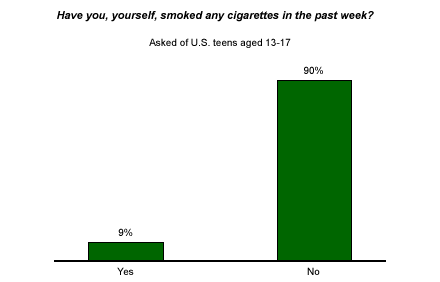
So how many kids continue to light up? In response to a recent Gallup Youth Survey of teens between the ages of 13 and 17*, slightly fewer than 1 in 10 U.S. teens (9%) said that they have smoked cigarettes in the last seven days. This percentage is about the same as it was one year ago, when 8% of teens reported smoking in the last week.
Childhood smoking, according to an American Lung Association (ALA) report, produces significant health problems in kids, such as persistent cough, respiratory problems, and decreased physical fitness levels. The ALA also reports that if current tobacco use patterns persist, an estimated 6.4 million children will die prematurely from a smoking-related disease.
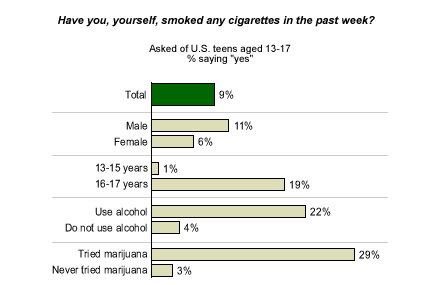
The Gallup survey shows that 19% of teens between the ages of 16 and 17 have smoked in the last seven days, consistent with ALA estimates showing that 20% of high school seniors are daily smokers. Gallup data also show that only 1% of younger teens -- those between the ages of 13 and 15 -- report smoking. This age gap underscores the reality that the middle teen years are a crucial point for making decisions about smoking and other risk behaviors.
Though men were once significantly more likely to be smokers than women, more recent data suggest that smoking rates have become more uniform between the sexes. In keeping with this trend, Gallup's teen data show no significant differences in the incidence of smoking between boys and girls.
This destructive habit is clearly related to other injurious health habits among young people. Teens who drink are more than five times more likely than those who do not drink to report smoking in the past week (22% vs. 4%), and teens who have tried marijuana are nearly 10 times more likely to report having smoked than are those who have not tried marijuana (29% vs. 3%).
Bottom Line
According to the 2003 Monitoring the Future study by the University of Michigan, teen smoking rates have declined significantly since 1997, but the problem is far from eradicated. Smoking still costs the United States over $150 billion each year in annual healthcare costs and lost revenue. In addition, research published by the ALA indicates that 90% of smokers start before the age of 21, and that young people have as difficult a time quitting as adults do.
The ALA recommends a variety of policies and practices to prevent young people from smoking, including school anti-smoking education, restrictions on advertisements, a ban on smoking on school grounds, enforcing bans on selling tobacco products to those under 18, and providing cessation programs at school, among other things. But perhaps the best way to prevent young people from lighting up is also the simplest -- setting a good example. Research shows that kids who live in households in which the adults do not smoke are among those least likely to ever take up the habit in the first place.
*The Gallup Youth survey is conducted via an Internet methodology provided by Knowledge Networks, using an online research panel that is designed to be representative of the entire U.S. population. The current questionnaire was completed by 785 respondents, aged 13 to 17, between Jan. 22 and March 9, 2004. For results based on the total sample, one can say with 95% confidence that the maximum margin of sampling error is ±4 percentage points.