Among the plethora of second-tier issues (behind terrorism and the economy) that may come into play in next year’s presidential election, the effect of gun control may be one of the hardest to predict. Gallup’s most recent annual survey on crime issues* found that a slight majority of Americans (55%) think the laws covering the sale of firearms should be made more strict (9% say they should be made less strict, and 36% say they should be kept as they are). The percentage favoring stricter laws has changed little in the past two years, but is significantly lower than it was in the 1990s.
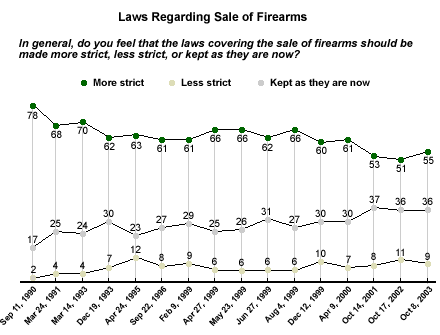
The issue has yet to register even as much as a blip in this year’s presidential election campaigns. Democrats may be hesitant to bring it up, recognizing that it doesn't always play well for them -- even after the 2002 sniper shootings in the Washington, D.C., area, Democratic candidates in midterm elections tended to avoid pushing for tougher gun laws. But that could change once the Democratic presidential nominee is known and the general election campaign begins.
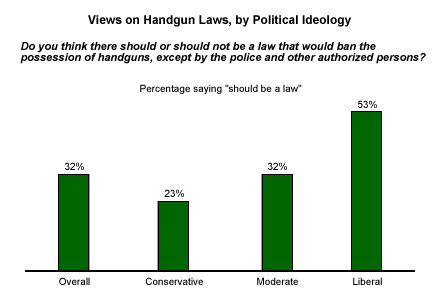
Results for other gun-related questions from the recent crime poll are also relatively unchanged from last year: A majority of Americans (67%) do not favor a law banning possession of handguns from everyone except police and other authorized persons.
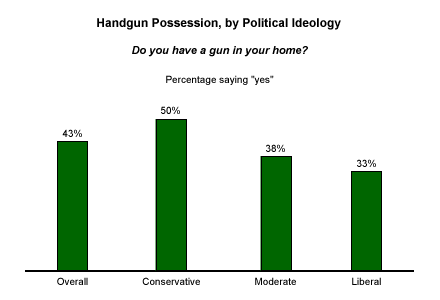
According to the crime poll, gun ownership among Americans remains in the 40% range, as 43% say they have a gun in their home and an additional 2% own a gun kept outside of their home. The number of Americans who say they have purchased a handgun as a means of protecting themselves from crime is 27%. Both percentages have shown slight increases when compared to 2000. However, earlier data on gun ownership showed a greater percentage of Americans owning guns than who report doing so now. Specifically, close to half of Americans said they owned a gun in the early 1990s.
Political Polarization
But is gun control likely to be a high-profile issue in the 2004 election? Probably not, but that doesn’t mean it won’t have implications. Certainly it is highly politicized: A majority of self-described liberals (53%) favor banning the possession of handguns, compared with 32% of moderates and 23% of conservatives. Also, half of conservatives (50%) say they own guns, compared to 38% of moderates and just 33% of liberals.
Already, Democratic front-runner Howard Dean has taken criticism from members of his own party for refusing to advocate stricter federal gun control laws. Dean’s stance may stem from his desire to maintain broad appeal among Democrats, an approach which led to his now-notorious comment about wanting to be "the candidate for guys with Confederate flags in their pickup trucks." Indeed, Southerners and those who live in rural areas are less likely than others to favor banning handguns.
Still, though advocating a total ban on handguns would alienate much of the voting public, supporting lesser restrictions could be a politically appealing strategy. Past surveys have shown that Americans are highly supportive of measures such as handgun registration and background checks.
A poll taken during the last presidential election, in May 2000, found that about two-thirds (65%) of Americans would be more likely to vote for a candidate who favors stricter registration of all handguns. Seventeen percent said this stance would make them less likely to vote for a candidate and 15% said it wouldn’t make much difference. About the same number (66%) said they would be more likely to vote for a candidate who favors requiring gun manufacturers to install built-in trigger locks on all handguns.
Bottom Line
At a time when the American political arena is arguably more divisive than it’s been in decades, it has become increasingly difficult for presidential candidates to find and stake out middle-ground territory. But gun control may present presidential hopefuls from both major parties with an opportunity to take a centrist position. Though Americans are wary of extreme positions that may raise concern about restricting civil liberties, past polls have demonstrated that a variety of more modest gun control proposals have strong support -- and a majority of Americans still feel laws regarding gun sales should be made stricter.
*Results are based on telephone interviews with 1,017 national adults, aged 18 and older, conducted Oct. 6-8, 2003. For results based on the total sample of national adults, one can say with 95% confidence that the margin of sampling error is ±3 percentage points.
