Many nonsectarian and religiously affiliated hospitals alike have chaplaincy or pastoral care programs in place. As healthcare organizations prepare to go through another set of belt-tightening budget cycles in response to shrinking reimbursement, they may ask themselves whether these programs are worth the expense. It seems obvious that chaplaincy and pastoral care programs benefit patients and their families, but do these benefits outweigh the costs? In other words, does attention to the spiritual needs of patients and their family members have a measurable impact on patient satisfaction and loyalty?
Gallup's 2002 healthcare database contains two optional questions (that is, questions not included in the core items appearing in every patient survey) about spirituality, each of which Gallup asked of thousands of patients in 2002:
- How satisfied were you with how well the staff was able to meet your spiritual needs?
- How satisfied were you with how well the staff was able to meet your spiritual and emotional needs?
These questions were asked predominantly by religiously affiliated hospitals, but this limitation does not prevent analysis of the relationship between the responses and patients' overall satisfaction and loyalty to the facility.
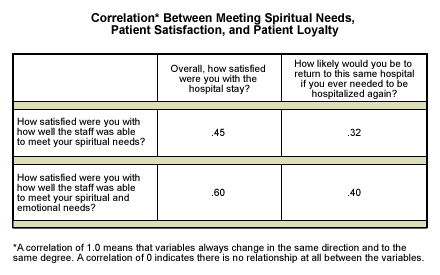
Gallup researchers assessed the relationship between the two spiritual items, overall patient satisfaction (measured by the question: "Overall, how satisfied were you with the hospital stay?"), and patient loyalty (measured by the question: "How likely would you be to return to this same hospital if you ever needed to be hospitalized again?"). Correlation scores tell us about the strength of the relationship between the two measures, but do not imply causality.
The analysis shows that patient satisfaction and patient loyalty are both highly correlated with "meeting spiritual needs" and "meeting spiritual and emotional needs," but that the relationship is strongest between the two spiritual needs items and patient satisfaction.
Patient Satisfaction and Meeting Spiritual Needs
The fact that the patient satisfaction question correlates more highly with meeting spiritual needs than the loyalty question does is not surprising. Patient satisfaction measures the overall service experience, and attention to spiritual needs directly affects this experience. Loyalty, on the other hand, tends to incorporate considerations of both satisfaction with the service experience and perceptions of the hospital's expertise (see "Bad Press May Hurt Patient Loyalty" in Related Items). The impact of spirituality is therefore diluted by the hospital's reputation for clinical quality.
There is a stronger relationship between patient satisfaction and the broader question -- "meeting spiritual and emotional needs" -- than between patient satisfaction and "meeting spiritual needs." This finding implies that patients and families don't only need to have their spiritual needs met in a religious sense, but need to have them met also in a broader, emotional sense. Meeting spiritual needs is a component in the creation of a caring and compassionate environment.
Employees who are sensitive to the spiritual needs of patients and families are also more likely to exhibit generalized caring behaviors, such as showing concern and helping to calm fears. Staff members need not be religious, just sensitive to the spiritual needs of their patients and families.
Bottom Line
So do religiously affiliated hospitals have an inherent advantage in achieving high patient satisfaction because of their naturally stronger focus on the spiritual aspects of care? The answer is no. Religious designation or affiliation does not directly affect scores. Success in meeting the spiritual and emotional needs of patients and families starts with selecting caring and compassionate staff members with the talent to put these values into practice. Whether religiously affiliated or nonsectarian, any hospital has an equal opportunity for success in this area.
What is the proper role for pastoral care and chaplaincy programs? Religious professionals should provide leadership, expertise, and focus in helping other employees to meet the spiritual and emotional needs of their patients. They can serve as trainers, coaches, and internal consultants in areas in which greater levels of support are required, such as the ICU or in an oncology unit. But if healthcare employees view meeting spiritual and emotional needs as solely the domain of the pastoral care or chaplaincy program, the hospital will fail in this regard. Every employee must take responsibility for meeting all the needs of patients and their families.