The likelihood of patients to return to the same hospital is a key indicator of a hospital's future financial performance. Gallup has conducted extensive research on how to measure and improve patient loyalty. But how might the public's perceptions of the healthcare industry overall affect patients' likelihood to be loyal to a specific hospital? Can those more general attitudes tell us anything about the future of patient loyalty in America?
Determinants of Patient Loyalty
A recent Gallup study of more than 2,800 recently treated patients from 52 facilities in 12 metropolitan areas indicates that the following three factors are key determinants in the likelihood of a patient to return to a healthcare facility:
- The patient's overall satisfaction with the services provided
- The patient's perception regarding whether or not the hospital is one of the best at treating the medical condition for which he or she was hospitalized
- The patient's trust of the hospital to always provide high-quality care
If patients report satisfaction with the care they received at a particular hospital, but feel that another hospital may be better able to treat their specific medical condition, or if they do not trust the facility for some reason, then they are significantly less likely to return than a patient who gives high scores on all three of these criteria.
Patient Trust
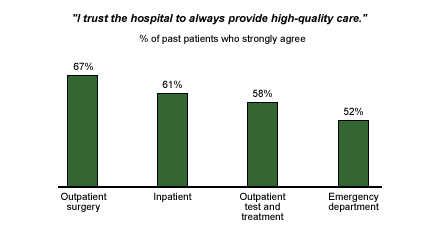
Patients obviously can't be loyal to a hospital they don't trust. According to the 2001 Gallup Patient Loyalty Database, a majority of patients trust the hospitals at which they received care. More than half of past patients in each service area measured (discharged six to eight weeks prior to the interview) strongly agree (giving a score of "5" on a scale of 1 to 5) that they trust the hospital they used to always provide quality care.
Trust of Healthcare Professionals
In a November 2001 Gallup Poll* on the honesty and ethics of 23 professions, healthcare professionals were well represented. Nurses ranked No. 2 on the list behind firefighters, with 84% of respondents rating their honesty and ethical standards as "high" or "very high." Doctors, pharmacists and dentists also all scored in the top 10, as they almost always do when Gallup conducts this poll each year. These results indicate that the high esteem that patients have for healthcare personnel could be successfully leveraged to increase patient loyalty.
Image of the Healthcare Industry
On the other hand, an August 2002 Gallup Poll** sought public opinion on the images of 24 major business and industry sectors. The healthcare industry was rated negatively by about half (49%) of all respondents. Thirty percent gave a thumbs-up, giving the healthcare industry a net negative rating of -19%, (19% more respondents rated the industry negatively than rated it positively). This is the lowest net negative rating of any of the 24 industries measured, and it has declined five points since 2001. Positive ratings of healthcare decreased from 37% in 2001 to 30% in 2002. This poor overall rating of the industry, at the same time that health professionals are rated positively, may result from the fact that managers of HMOs typically rank near the bottom of Gallup's annual audit of honesty and ethics in professions.
Key Points
Decades of Gallup polling have shown that it is not uncommon for people to rate specific people or organizations with which they have had contact more highly than they rate an industry as a whole. However, the differences are particularly acute in the healthcare area. Frequent news coverage about patient safety issues, rising healthcare costs and decreasing accessibility to basic services seem to have taken their toll on Americans' perceptions of the healthcare industry.
An August 2002 Gallup Poll story (see "Health Care, Lawyers, Energy and Accounting Suffer in Public's Eye" in Related Items) noted that the low ratings of the healthcare industry "suggest a significantly pent-up anger on the part of the population toward their health care and drug system that could have significant political effects in the months and years to come." Despite relatively high levels of patient trust in the hospitals they have used, and the fact that the public holds healthcare professionals in high esteem, the negative image of the healthcare industry suggests that there could be tough times ahead for hospitals seeking to build patient and community loyalty.
*Results are based on telephone interviews with 1,025 national adults, aged 18 and older, conducted Nov. 26-27, 2001. For results based on the total sample of national adults, one can say with 95% confidence that the margin of sampling error is ±3%.
**The results reported here are based on telephone interviews with a randomly selected national sample of 518 adults, aged 18 and older, conducted Aug. 5-8, 2002. For results based on the total sample of national adults, one can say with 95% confidence that the margin of sampling error is ±5%.