The Perfect Score, a film released in January, tells the story of a group of high school students in Princeton, N.J., who conspire to break into the Educational Testing Service headquarters and steal the answers to the SAT. The scenario may seem far-fetched, but the Gallup Youth Survey suggests that the general theme of the movie -- teens and cheating -- is all too real among American teenagers.
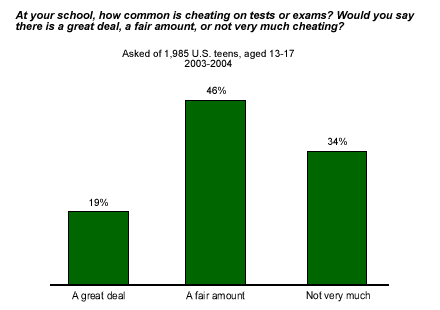
Aggregated data from the Gallup Youth Survey*, collected between January 2003 and March 2004, suggest that cheating on school tests or exams is a widespread phenomenon in the nation's schools. Nearly two-thirds (65%) of the nation's 13- to 17-year-olds say that there is either "a great deal" (19%) or "a fair amount" (46%) of cheating going on at their schools. About a third (34%) of teens say there is "not very much" cheating at school.
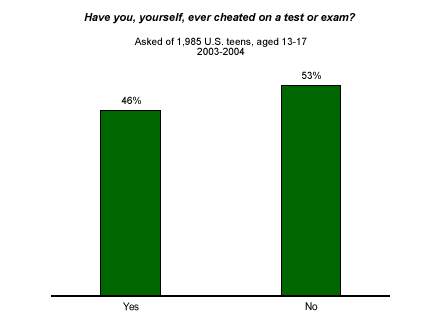
Almost half of all teens -- 46% -- say they have actually cheated on a test or exam themselves at some point. Fifty-three percent say they have not cheated.
Teens who say they have cheated on tests or exams themselves are more likely than teens who say they haven't cheated to perceive cheating as commonplace in their schools. Eighty-two percent of teens who have cheated say that there is either a great deal (31%) or fair amount (51%) of cheating at their schools, compared with just 51% (9% great deal, 42% fair amount) of teens who haven't cheated.
Obviously, teens who cheat are probably more tuned in to the acuteness of the cheating problem (because they're doing it themselves) and may assume everyone else cheats just because they do, while many teens who don't cheat remain blissfully unaware of what their peers are doing.
Who's Most Likely to Cheat?
Do Gallup data reinforce the adage that "cheaters never prosper"? The data show that teens who define their class standing as "below average" are more likely to admit they've cheated than teens who define their standing as "near the top" (44% compared with 32%). But surprisingly, the teens in the middle of the pack are the most likely to say they have cheated. Fifty-three percent of those who define their class standing as "average," and 51% who say it is "above average," admit to cheating on a test or exam at some point.
As shown in previous Gallup analyses (see "Are Teens Cheating Their Way to Higher GPAs?" in Related Items), substance use also relates strongly to teens' likelihood to cheat. Teens who say they have consumed alcohol, smoked marijuana, and smoked cigarettes are far more likely than other teens to admit that they have cheated in school.
Interestingly, girls and boys are about equally likely to confess to cheating (47% of girls, 46% of boys), but girls are somewhat more likely than boys to believe that there is a great deal of cheating at their schools. Twenty-four percent of girls say so, as do 15% of boys.
Bottom Line
Competition and pressure to get into college is fierce for today's teens, and so, therefore, is pressure to get good grades. This may possibly explain why middle-achieving teens -- those who are definitely college-bound but may be "on the bubble" when it comes to getting into the nation's leading colleges and universities -- are more likely than other teens to resort to cheating.
*The Gallup Youth survey is conducted via an Internet methodology provided by Knowledge Networks, using an online research panel that is designed to be representative of the entire U.S. population. Results based on questionnaires completed by 1,985 respondents, aged 13 to 17, in January 2003 to March 2003 and the same period in 2004. For results based on the total sample, one can say with 95% confidence that the maximum margin of sampling error is ±2 percentage points.