How many teens cheat on tests? It's a high-stakes question, given the intense pressure on today's teens to earn high GPAs in order to get into college. It's also a difficult question to answer, given that the only cheaters we usually know about are the ones who get caught. The 2003 Gallup Youth Survey* asked America's teens how common they think cheating is at their schools and whether they themselves have ever cheated.
How Many Students Cheat?
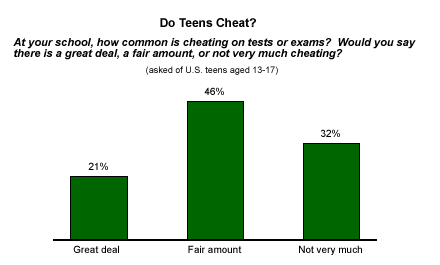
The Gallup survey asked U.S. teens (aged 13 to 17) how much cheating on tests goes on at their schools -- "a great deal, a fair amount, or not very much." Roughly one in five (21%) say there is a great deal of cheating, 46% say there is a fair amount, and just under a third (32%) say there is not very much cheating.
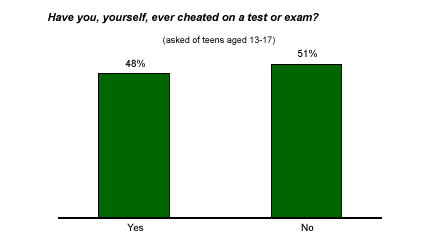
Gallup then asked teens more directly: "Have you, yourself, ever cheated on a test or exam?" Nearly half -- 48% -- say they have.
The poll shows girls are slightly more likely than boys to say they have cheated on a test or exam, 52% compared with 44%. Also, by a 53% to 44% margin, older teens -- those aged 16 to 17 -- are also somewhat more likely to say they have cheated than younger teens -- those aged 13 to 15. Fifty-four percent of teens living in the South say they have cheated, compared with 47% in the Midwest, 46% in the West, and just 38% who live in the Northeast.
Cheating and Health Habits
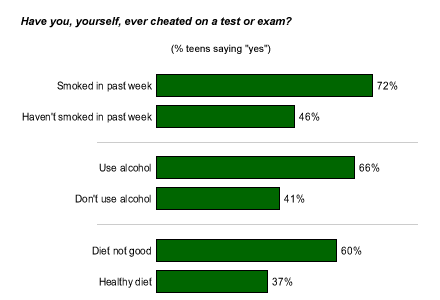
Teens who admit to engaging in certain unhealthy behaviors -- such as smoking, drinking alcohol, and eating an unhealthy diet -- are also more likely than other teens to say that they have cheated on tests. Nearly three-fourths (72%) of teens who say that they have smoked cigarettes in the past week say they have cheated, compared with less than half (46%) of teens who say they haven't smoked. Along similar lines, 66% of teens who consume alcohol admit to cheating, as do only 41% of teens who don't drink.
Teens who say that they have unhealthy eating habits are also more likely to say they have cheated than teens with healthy eating habits. Sixty percent of teens who say that their diet is "not good" report having cheated, but just 37% of teens who say they eat a "healthy" diet admit to cheating.
Bottom Line
There are many possible explanations for why teens who say they smoke, drink, and eat poor diets are more likely to admit to cheating in school. The connection may warrant further investigation into the effects of socioeconomic differences and other lifestyle factors. But it should also be kept in mind that teens who are more likely to admit to unhealthy habits are probably also more likely to admit to a negative behavior such as cheating. In any case, the idea that nearly half of American teens admit to cheating may give parents and teachers cause for concern.
*The Gallup Youth Survey is conducted via an Internet methodology provided by Knowledge Networks, using an online research panel that is designed to be representative of the entire U.S. population. The current questionnaire was completed by 1,200 respondents, aged 13 to 17, between Jan. 23-Feb. 10, 2003. For results based on the total sample, one can say with 95% confidence that the maximum margin of sampling error is ±3%. For a complete description of the sampling and weighting procedures used to conduct the survey, click here.